
What Is Order Consolidation and How Can It Reduce Fulfilment and Delivery Costs?
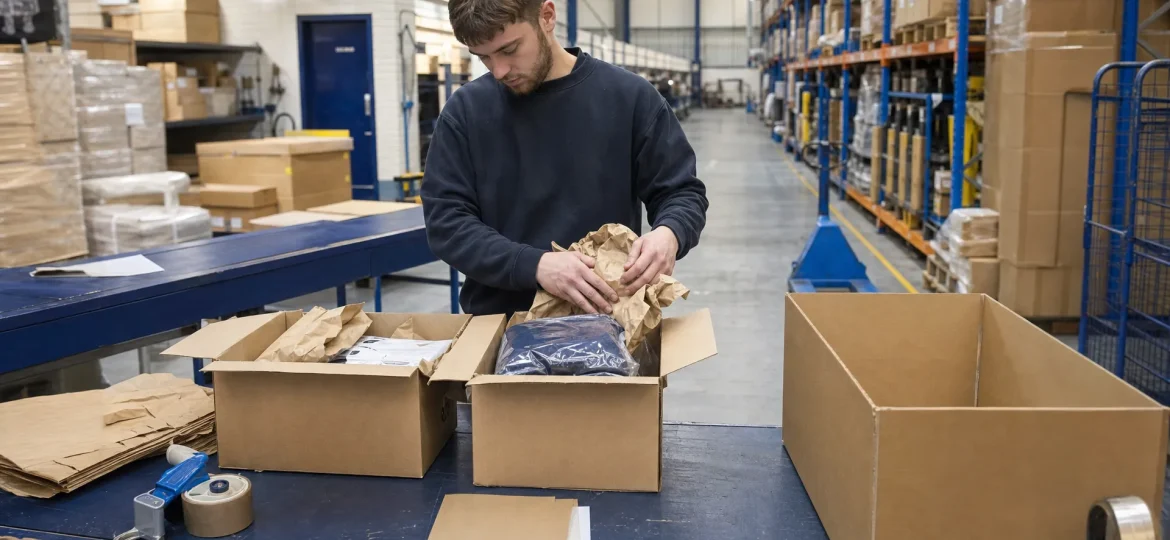
Sending two parcels to the same customer can mean paying twice for packaging, dispatch handling and delivery. Order consolidation brings compatible orders or items together before dispatch so they can travel as one shipment. For an eCommerce business, that can remove duplicated costs without changing what the customer receives. The saving is not automatic, though: a larger parcel, extra handling or a delayed dispatch can outweigh the benefit.
The practical question is which orders you can combine without compromising delivery promises, product protection or accurate records.
What gets combined, and what stays separate?
At fulfilment level, consolidation usually means combining items intended for the same recipient and delivery address. This might involve products from one order that would otherwise leave separately, or two orders placed by the same customer before either has been dispatched.
For example, a customer buys a product and then places another order for an accessory shortly afterwards. If both orders are available, compatible and due to use the same delivery service, they could potentially share one parcel. The original order references should remain traceable even if there is only one physical shipment.
There are two related processes worth distinguishing. Batch picking means collecting items for several orders during one warehouse picking run; those orders can still leave in separate parcels. Freight consolidation groups shipments for shared transport, potentially with different final destinations. Neither process automatically reduces the number of customer parcels.
For wholesale deliveries, several purchase orders for one retailer may travel together on a pallet, but their paperwork and receiving requirements still need to remain clear.
Where the cost savings come from
Order consolidation can reduce the repeated work and charges attached to separate dispatches. It does not remove the need to pick every item, check quantities or protect the products properly.
The most useful comparison is the complete cost of sending orders separately against the complete cost of combining them.
| Cost area | Separate dispatches | Combined dispatch |
|---|---|---|
| Delivery | Each parcel attracts its applicable charge | One shipment is charged according to its size, weight and service |
| Packaging | Each parcel needs suitable outer packaging | One outer package may be sufficient, with appropriate protection |
| Packing and dispatch | Separate packing, labels and dispatch checks | Some tasks may be shared, depending on the provider's process and pricing |
| Item picking | Every item still needs picking | Every item still needs picking |
| Additional handling | No consolidation step | Matching, holding or repacking may create an extra cost |
Net saving = total cost of separate dispatches – total cost of combined dispatch. Use the same cost categories and VAT basis on both sides.
Check the actual carrier tariff rather than assuming one parcel costs less than two. A combined carton may enter a higher weight band, incur a size-related surcharge or be priced using volumetric weight, which reflects the space it occupies.
Our guide to how fulfilment costs per order are calculated explains the wider charges to include. Order consolidation is worthwhile when the combined total is lower, not simply when the parcel count falls.
When keeping orders separate is the better choice
Combining orders should be a controlled option, not a rule applied to every matching address.
A shared address does not necessarily mean a shared customer. Offices, student accommodation and shared buildings can receive orders for several people. Even matching customer details are insufficient if the requested services or delivery dates differ.
Other reasons to keep shipments separate include:
- Different dispatch commitments: An express order should not wait for an order with a later dispatch date.
- Unavailable stock: Holding ready-to-send products for an uncertain replenishment date can create avoidable delays.
- Incompatible products: Fragile, heavy, liquid or temperature-sensitive items may need separate packaging or handling.
- Channel or retailer restrictions: Marketplace rules, purchase-order requirements or receiving instructions may prevent combining shipments.
- International requirements: Customs documentation, declared values and destination rules need checking before orders are merged.
The packing team also needs authority to reject a proposed combination when the contents cannot be protected adequately. Saving a carton is poor value if a heavy item damages a smaller product inside it.
Order consolidation should preserve the original customer promise; if it changes the agreed dispatch date or service, obtain approval or keep the orders separate.
How to build a workable process
The process needs rules that your warehouse team can follow consistently. A manual check may suit a small operation, while higher volumes may need system-supported matching. In either case, confirm what your software and fulfilment provider can actually support before relying on automation.
Set clear matching criteria
Start with orders for the same verified customer, recipient and full delivery address. Check that the delivery service, stock availability and dispatch deadline are compatible too.
Decide which orders are excluded. For example, a retailer may require separate purchase-order labels even when goods share a pallet. Gift orders may have different messages or presentation requirements despite going to the same address.
Do not alter the customer's original order records simply to simplify warehouse work. The combined shipment should connect back to every order it contains, with a clear record of the items and quantities allocated to each.
Define a short dispatch window
Decide how long an eligible order can remain available for matching before it moves into packing. Base that window on the delivery promise, carrier collection time and warehouse workload, rather than an arbitrary wait.
An order placed early in the day might be combined with another that arrives before packing begins. Once it is packed, labelled or handed to a carrier, reopening it may cost more than it saves.
Order consolidation works best when it fits into the existing dispatch timetable, rather than adding an open-ended holding period. Include a release rule so unmatched orders continue through fulfilment on time.
Preserve tracking and returns information
Where the sales channel supports it, attach the shared tracking reference to each original order. Check that dispatch confirmations accurately reflect what has shipped and do not leave one order looking unfulfilled.
Customer service staff should be able to identify everything in the parcel without asking the warehouse to reconstruct it. If a customer returns one item, the team still needs to connect that item to its original order and apply the correct refund process.
Agree how packing documents will work too. Combining parcels does not necessarily mean combining invoices or changing payment records. Keep the financial records intact and make the physical shipment easy to understand.
Test the savings before rolling it out
Order consolidation is easier to assess through a small, controlled trial than through a blanket policy. Start with a clearly defined group, such as same-customer orders that are fully in stock and use the same delivery service.
For each eligible combination, record the separate-dispatch cost and the actual combined cost. Include packaging, carrier charges and any additional handling. Record why proposed combinations were rejected, because that shows how much of your order volume is genuinely suitable.
Useful measures include:
- Net saving per combined shipment: The difference between the two complete cost calculations.
- Eligibility rate: The proportion of orders that meet your matching rules.
- On-time dispatch: Whether combined orders still meet their original commitments.
- Packing exceptions: Damage, repacking or additional handling linked to the combined shipment.
- Customer service impact: Queries about missing parcels, tracking or returns.
Judge the trial on net savings and service performance together. A lower delivery bill is not enough if packing labour rises or customers need more support.
Agree billing treatment with your provider before starting. If fees are charged per original order, combining two parcels may reduce carriage but leave order-processing fees unchanged. That can still be worthwhile, provided the calculation reflects what you will actually pay.
Frequently asked questions
Can two separate customer orders be sent in one parcel? Potentially, yes. Order consolidation can combine them when the customer, recipient, address, products and delivery requirements are compatible. Keep both order references traceable and check any sales-channel restrictions before dispatch.
Does combining orders always reduce delivery costs? No. The resulting package could move into a higher weight or size band, require more protective packaging or attract additional handling charges. Compare the actual combined cost with the cost of separate dispatches.
Will customers have to wait longer? They should not if the process operates within the original dispatch commitments. Set a matching deadline and release orders when it expires. Do not hold a ready order indefinitely while waiting for another purchase or unavailable stock.
Can orders from different sales channels be combined? That depends on the channels' requirements and the capabilities of your order-management and warehouse systems. Confirm how order status, tracking and shipment records will update on each channel. Integration alone does not prove that cross-channel combining is supported.
Is this useful for wholesale orders as well as eCommerce? Yes, compatible orders for one delivery location may share cartons, a pallet or a transport movement. Retailer booking rules, purchase-order references and receiving instructions still determine how the goods must be presented.
Discuss order consolidation with your fulfilment provider
Before introducing a new rule, give your provider a sample of recent orders, parcel dimensions, delivery charges and dispatch commitments. That provides a practical basis for identifying combinations that could save money and those that should remain separate.
Gus Logistics is a family-run provider based in Nantwich, Cheshire, supporting product businesses across the UK. Its order fulfilment and pick and pack services include integrations with more than 60 platforms. Its warehousing and storage services provide real-time WMS tracking through a client portal, helping businesses maintain visibility of available stock.
Ask the team whether your proposed matching rules can be supported for your products and sales channels, and how handling, tracking and billing would work. Gus Logistics has no minimum volume requirements, so smaller businesses can discuss their needs too.
Call Gus Logistics on 01270 335014 to discuss your fulfilment process and whether combining suitable orders could reduce your dispatch costs.
Looking for a Logistics Partner You Can Trust?
From warehousing and order fulfilment to transport and FSDU design - Gus Logistics handles it all from our base in Nantwich, Cheshire. Over 10 years experience, no minimum volumes, no long contracts.
