
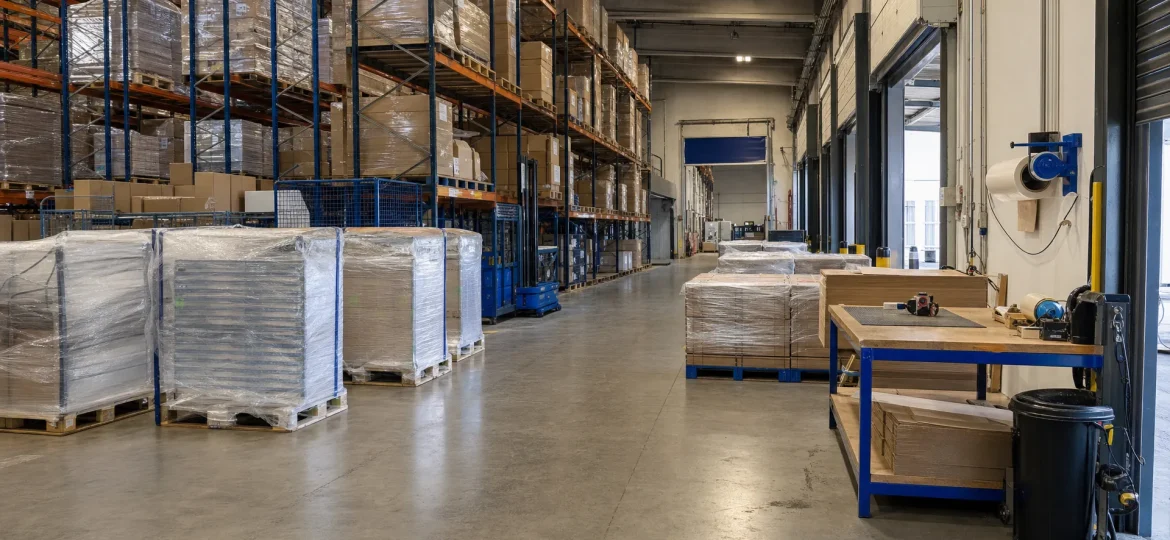
How Can I Get Products Packed and Labelled Without Hiring Extra Staff?
A large delivery has arrived, a retailer wants different labels or a promotion needs hundreds of gift sets assembled. Your existing team is already busy, but recruiting someone for a short-term packing job does not make sense. Outsourced packing and labelling lets you send that defined job to a specialist provider without adding people to your payroll.
You can outsource a single batch, arrange ongoing support or keep routine work in-house and send out the overflow. The practical task is to define exactly what needs doing, agree how quality will be checked and make sure the finished goods can reach their next destination on time.
Start with the job that is causing the bottleneck
You do not necessarily need to outsource your entire warehouse operation. Start by separating the packing problem from the rest of your business.
| Your immediate problem | Scope to request |
|---|---|
| Products need new retail labels | Label application to an approved specification |
| Several items must become one saleable bundle | Kitting, assembly and outer packaging |
| Existing packaging is damaged or unsuitable | Inspection and re-packing |
| Customer orders need packing every day | Ongoing pick and pack fulfilment |
The distinction matters because preparing a batch of retail-ready products is different from receiving individual customer orders and dispatching them daily.
If your regular team can manage normal demand, outsourcing only the promotional or labour-intensive work may be enough. You retain the operation that works and remove the task creating the backlog.
What to include in an outsourced packing and labelling brief
A provider needs more than a unit count and a deadline. Give them enough information to understand the work at a packing bench, including exceptions that could slow it down.
Your brief should cover:
- Products and quantities: Include product codes, variants, dimensions and the number of finished packs required.
- Contents of each pack: State exactly which items belong together and whether substitutions are prohibited.
- Packaging and labels: Identify who supplies cartons, inserts, protective materials and approved label artwork.
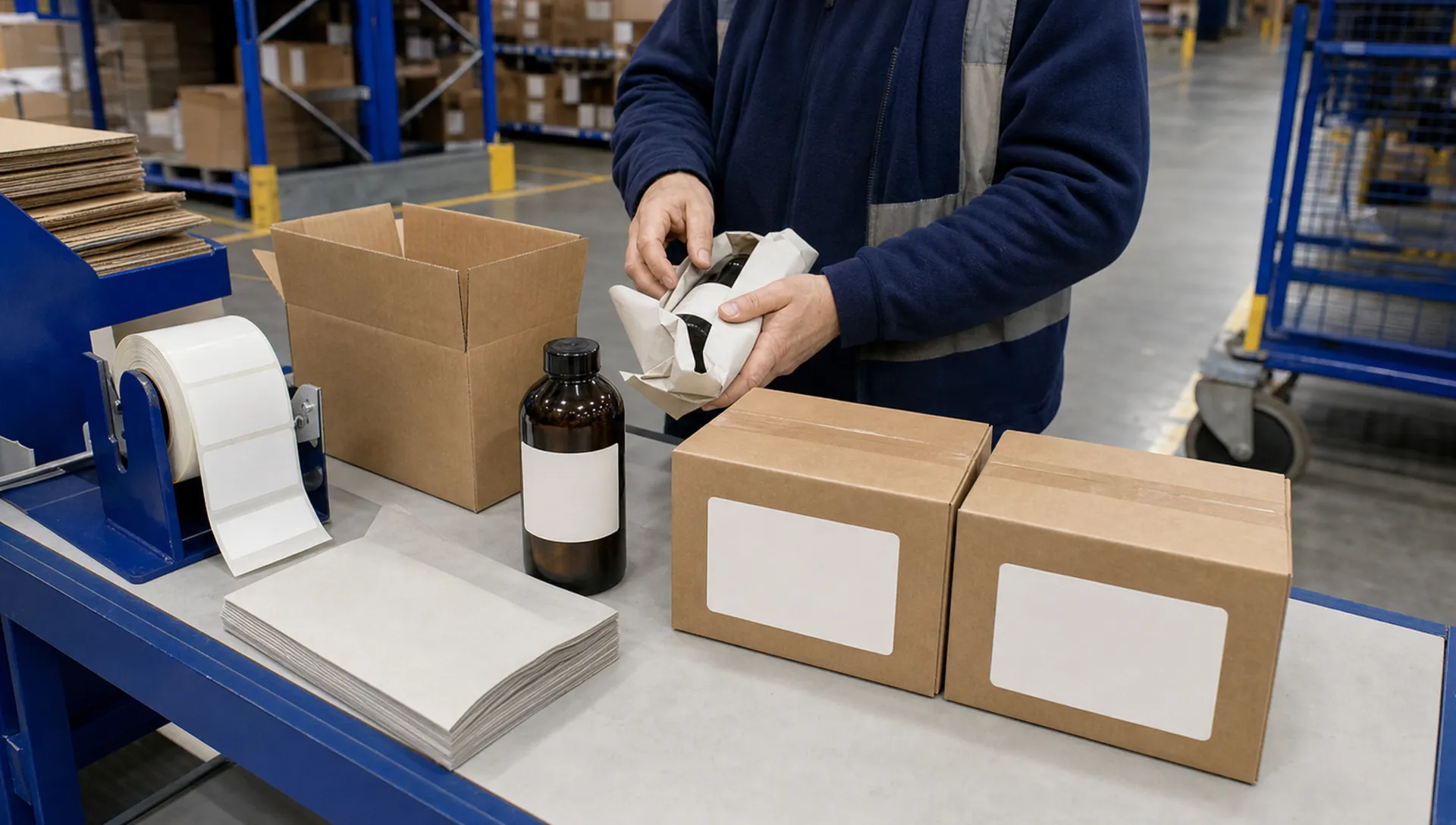
- Assembly instructions: Explain the sequence, orientation, label position and required finish, supported by photographs where useful.
- Dates and destination: Confirm stock arrival, completion deadlines and where the finished goods must go.
A physical sample is particularly useful when appearance matters. Mark it as the approved reference and record which version of the instructions it matches. Photographs alone may not show whether a label bridges an opening or whether an insert sits above or below the product.
For example, consider a hypothetical welcome kit for a business offering personal training and nutrition coaching. A bottle, printed guide and welcome card make a clear packing specification. “Prepare customer welcome packs” does not tell the packing team which guide version to use or whether the card belongs inside the bottle carton.
The same principle applies to retail bundles: describe the physical result, not just the purpose of the campaign.
Agree label approvals and quality checks before stock moves
With outsourced packing and labelling, the provider needs an approved instruction set, not responsibility for deciding what your product should say.
Separate product labels from delivery labels. Product labels may carry ingredients, warnings, identification or other required information. Delivery labels route a parcel or pallet to its destination. Approval of one does not approve the other.
Check the UK government’s product labelling guidance and any rules specific to your product and destination market. Do not assume that employing a packing contractor transfers your legal responsibilities or that every provider can handle regulated goods.
Agree who approves artwork, checks the first finished units and authorises production. Set out what happens if labels are unreadable, packaging arrives damaged or quantities do not match the delivery paperwork.
Your quality specification should distinguish a genuine defect from a cosmetic preference. “Apply straight” is open to interpretation; an approved sample with a defined position is easier to check consistently. Where barcode scanning matters, include a scan check in the agreed process.
If batches, serial numbers or best-before dates must remain traceable, establish how those details will be recorded and linked to the finished packs. Also specify what should happen to obsolete labels and unused printed materials so they cannot accidentally return to production.
Use a pilot batch to avoid moving the problem elsewhere
A small trial makes outsourced packing and labelling easier to control before you commit the full quantity. Choose enough units to include the main variations, rather than testing only the simplest product.
Start with a stock count at receipt. The provider should know what was expected, what actually arrived and which goods need to be held aside. Record shortages and damage before packing starts so they are not confused with losses during assembly.
Then approve the first completed packs against your reference sample. Check contents, presentation, label position and packaging strength. If a retail customer has supplied its own specification, use that as part of the approval rather than relying on a general visual check.
A pilot also tests whether the work is straightforward enough to price and schedule as expected. Awkward packaging, difficult-to-remove old labels or inconsistent incoming stock can change the labour required.
Keep one named contact on each side and a clear rule for stopping work. If a component is missing or the wrong label version arrives, the team should know whether to pause, quarantine affected stock or request written approval for a change.
Once the sample is accepted, release the remaining batch against the same documented instructions. Any later change should have a new version and an agreed effect on cost and completion dates.
Compare the complete job cost, not just the packing rate
A low price per unit is not the same as a low total cost. Ask each provider to quote against the same brief and make exclusions visible.
| Cost element | What to clarify |
|---|---|
| Set-up | Instruction preparation, sample approval and any equipment changes |
| Packing labour | What the quoted unit or hourly rate includes |
| Materials | Who buys them, delivery charges and treatment of surplus stock |
| Goods handling | Receipt, counting and movement of stock |
| Storage | Charges before, during and after the packing job |
| Exceptions | Rework, damaged goods and changes to the approved specification |
| Dispatch | Pallet preparation, collection or onward transport |
Compare this with the actual internal workload. As a simple illustration, 2,400 units taking 45 seconds each require 30 hours of hands-on work. That excludes preparation, stock movement, checks and clearing the workspace. It is an estimate to test, not an industry productivity benchmark.
For outsourced packing and labelling, the useful comparison is the complete cost of delivering an acceptable finished batch by the deadline. Your internal option should include supervision and the work your existing staff would otherwise complete, not just their hourly pay.
If you need more detail on the pricing components, this guide to contract packing costs in the UK provides a starting point. Request a job-specific quote rather than treating any general price as a promise.
Keep the handover simple and retain control
You can delegate the physical work without handing over every decision. Keep ownership of product specifications, approved artwork and changes to the brief within your business.
Use a shared job reference across the purchase order, incoming stock paperwork and packing instructions. Before dispatching stock to the contractor, confirm the delivery booking, quantities and packaging materials they expect to receive. Sending products before the labels or cartons are available can create storage time rather than progress.
At completion, ask for a reconciliation showing finished units, remaining components, rejected stock and any agreed wastage. Confirm how each balance will be returned, stored or disposed of.
The handover is complete only when the packed goods are ready for their next step. Agree whether they will return to your premises, remain in storage or move directly to a retailer or customer. This prevents a finished batch from missing its deadline while transport arrangements are still being discussed.
Frequently asked questions
Can I outsource a one-off packing job rather than commit to a long contract? Yes, outsourced packing and labelling can be arranged for a defined project, subject to the provider’s terms and availability. Confirm any minimum charges, set-up costs and storage arrangements. Gus Logistics has no minimum volume requirements, although each job still needs a suitable scope and quote.
Do I have to move all my stock to the packing provider? No. You can send the stock and components needed for a particular job while keeping the rest of your operation in-house. Check whether splitting stock creates extra transport, counting or replenishment work before deciding on that approach.
Can a provider apply labels I supply? Ask them to confirm suitability before sending the full quantity. Label size, adhesive, application surface and print quality can affect the result. Supply approved artwork or finished labels as agreed and identify the current version clearly.
How much notice should I give? Lead time depends on capacity, job complexity and when all stock and materials will be available. Give the provider your required delivery date as well as your preferred packing date, so inspection and transport are included in the plan.
Arrange practical packing support with Gus Logistics
If outsourced packing and labelling would free your team from a backlog or short-term project, Gus Logistics can discuss the work as a defined packing requirement rather than a staffing commitment.
A family-run provider based in Nantwich, Cheshire, Gus Logistics offers contract packing and co-packing services, including re-packing and POS assembly. Where the job also needs stock held before or after packing, its pallet and bulk storage services can form part of the discussion, alongside onward transport.
Send the product details, quantities, photographs or a sample, packaging requirements and required completion date. Gus Logistics has no minimum volume requirements and quotes are usually turned around the same working day. A quote is separate from a confirmed production slot, so agree the schedule before making customer commitments.
Call Gus Logistics on 01270 335014 to discuss your packing and labelling job and request a quote.
Looking for a Logistics Partner You Can Trust?
From warehousing and order fulfilment to transport and FSDU design - Gus Logistics handles it all from our base in Nantwich, Cheshire. Over 10 years experience, no minimum volumes, no long contracts.
