
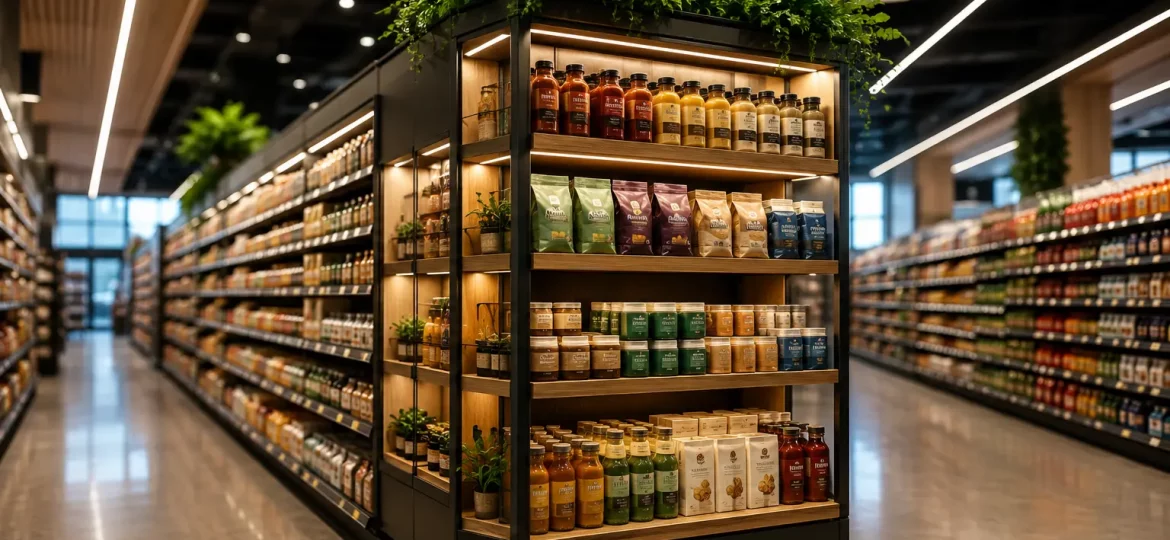
How Supermarkets Use End-of-Aisle Displays to Drive Sales
End-of-aisle displays are some of the most commercially valuable space in any supermarket. For brands that understand how they work – and how to use them properly – they represent a genuine opportunity to drive volume that standard shelf positioning simply cannot match.
This post covers why end-of-aisle locations perform so consistently well, how supermarkets decide what goes in them, and what brands need to know if they want to compete for that space.
If you’re planning a retail display programme and want to understand the logistics side – from design through to store delivery – our FSDU service page covers the full end-to-end process.
Why End-of-Aisle Space Performs So Well
The end of an aisle – known in retail as a gondola end or end cap – sits at a natural traffic intersection. Shoppers walking down an aisle have to pass it. Shoppers moving along the main walkway between aisles see it face-on. That combination of foot traffic from two directions is why gondola ends consistently outperform mid-aisle shelf positions on volume.
The uplift isn’t marginal. Research published by the Journal of Marketing Research found that end-of-aisle placement can generate sales uplifts of several hundred percent compared to the same product on standard shelving – particularly when combined with a price promotion or feature display. Even without a price cut, end-cap placement alone drives meaningful incremental volume simply through increased visibility and accessibility.
Part of the reason is dwell time. Shoppers slow down at the ends of aisles more than they do mid-aisle, particularly when navigating between sections. That extra second or two of attention is often enough to convert a passive glance into a purchase decision – especially for products with strong packaging or a clear price message.
How Supermarkets Decide What Goes in End-of-Aisle Positions
Gondola ends are not allocated randomly. The major multiples treat this space as a commercial asset and typically charge for it – either directly through listing fees and promotional space agreements, or indirectly by requiring brands to fund price promotions in exchange for the placement.
Category managers at supermarkets use a combination of sales data, promotional calendars, and supplier investment to decide what occupies end-cap positions. Products that are being supported with above-the-line advertising, new launches backed by marketing spend, or seasonal lines with a clear purchase occasion tend to get priority – because the retailer’s interest is in maximising the return from that high-traffic space, not just filling it.
For smaller brands or those without the budget to fund large promotional slots, independent retailers, convenience chains, and regional grocery groups often offer more accessible routes to end-of-aisle placement. The commercial terms are typically more flexible, and the relationship with the buyer is easier to navigate.
Understanding what IGD research consistently shows – that promotional space investment generates a measurable return on sales uplift – is useful context when building the business case internally for an end-of-aisle programme.
The Role of the Display Unit Itself
A gondola end can be used with standard supermarket shelving, or it can be occupied by a branded Free Standing Display Unit (FSDU) supplied by the brand. The latter is almost always more effective from a brand visibility standpoint – and increasingly expected by retailers for premium, new, or seasonal products.
A branded FSDU in an end-of-aisle position gives you complete control over the visual environment around your product. You’re not competing with adjacent shelf strips, neighbouring brands, or inconsistent retail signage. The display is yours – your colours, your messaging, your hierarchy of information – and it signals to the shopper that this product is worth stopping for.
The practical requirements for a retail-approved FSDU are more demanding than many brands expect. Major supermarkets have strict structural, dimensional, and material specifications, and any unit that doesn’t meet them will be refused at goods-in or removed from the floor. Getting the compliance brief from the retailer before you design the unit – not after – is essential. Our guide to what a FSDU is and how it works covers the key compliance considerations in plain English.
Seasonal and Promotional Timing
End-of-aisle positions are most intensely competed for during peak seasonal periods – Christmas, Easter, summer, and back-to-school. Retailers plan their promotional calendar months in advance, which means brands that want end-cap space during a seasonal window typically need to be in conversation with their buyer six to twelve weeks before the display needs to be in store.
The seasonal angle also shapes the display design. A Christmas end-of-aisle display that carries strong seasonal visual cues – not just a sticker on a standard unit – performs significantly better than a generic display in festive packaging. Shoppers in a seasonal purchase mindset respond to visual cues that confirm they’re in the right place. The theming needs to be immediately legible from across the aisle, which means bold graphics and a clear seasonal headline on the header card.
For limited edition or seasonal lines, the FSDU itself communicates scarcity and occasion in a way that standard shelving can’t. A product positioned on a purpose-built display signals that it’s here for a limited time – which is a genuine sales driver for categories like confectionery, gifting, and premium food and drink.
Impulse Categories and End-of-Aisle Logic
Not every product category benefits equally from end-of-aisle placement. The format works hardest for impulse categories – products with a low price point, immediate use case, and no need for extended consideration before purchase.
Confectionery, soft drinks, snacking, personal care, batteries, and seasonal gifting all consistently outperform in end-of-aisle positions. What they share is a purchase dynamic where visibility alone is often sufficient to convert – the shopper doesn’t need to research the product or compare alternatives. They see it, they want it, they put it in the basket.
For higher-consideration categories – appliances, supplements, technical products – end-of-aisle displays need to do more work. The display needs to resolve the purchase decision rather than just creating visibility. That means a clear “why buy this” message, a comparison or claim that removes uncertainty, and ideally a price point or offer that adds urgency. Our post on creative ways to use FSDUs covers educational and comparison display formats in more detail.
What Retailers Expect from Brands Using Their End-of-Aisle Space
Supermarkets are allocating a disproportionately valuable asset when they give a brand end-of-aisle space. In exchange, they expect a few things.
First, the display needs to be retail-ready. A unit that arrives at the distribution centre flat-packed, without clear assembly instructions, and requiring store staff to pick and fill it from bulk stock is a significant burden on a team that has limited time. A pre-filled, pre-assembled unit that a member of staff can position in under two minutes is dramatically more likely to end up on the floor in the right condition and in the right place.
Second, the display needs to be structurally sound. A unit that tips, collapses under product weight, or sheds its header card within a week reflects badly on the brand and creates a health and safety issue for the retailer. Material and structural specifications exist for a reason.
Third, the replenishment process needs to be planned. An end-of-aisle display that sells well and runs empty within a week – with no agreed replenishment route – creates a worse impression than no display at all. Build the replenishment plan into the programme before the display goes live.
Our order fulfilment team handles pre-fill, retail-ready packing, and store-level despatch as standard – units leave our Nantwich facility fully loaded, tracked to individual store locations, and ready to go straight to the floor.
Data, Analytics, and Measuring Performance
One of the advantages the major multiples have over independent retailers is the depth of data available to inform promotional decisions. Loyalty card data, EPOS sales tracking, and basket analysis all feed into category management decisions about which products occupy which positions.
For brands, this data is a double-edged sword. On one hand, it provides clear evidence of what end-of-aisle placement is worth in sales terms – which makes the investment easier to justify. On the other hand, retailers use the same data to hold brands accountable for the performance of their promotional space. An end-cap that underperforms against the category benchmark is unlikely to be renewed.
Going into an end-of-aisle programme with a clear measurement framework – baseline sales rate, expected uplift, total promotional period volume – puts you in a much stronger position in post-promotion reviews with the buyer. POPAI UK , the industry body for retail marketing, publishes useful benchmarks on in-store display performance by category that are worth reviewing when building your programme forecast.
Talk to Us About Your Retail Display Programme
Gus Logistics is a family-run 3PL based in Nantwich, Cheshire. We design, manufacture, pre-fill, and despatch point of sale displays and FSDUs direct to store locations across the UK – fully tracked, retail-ready, with no minimum volumes and same-day quotes as standard.
Whether you’re planning your first end-of-aisle display or looking to improve the logistics behind an existing programme, get in touch here or call us on 01270 335014 . We’ll get back to you the same working day.
Ready to Find the End-of-Aisle Solution?
Get in touch today for a tailored FSDU and End-of-Aisle quote - we'll usually get back to you the same working day.
