
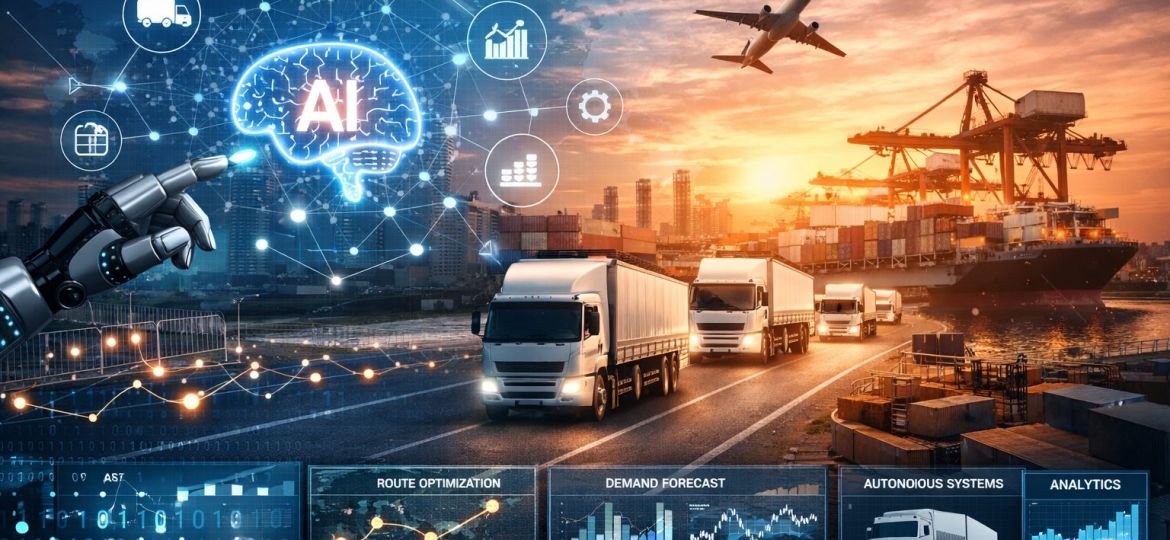
AI in Logistics: Why 2026 Marks a Turning Point for the Industry
Artificial intelligence has been part of logistics discussions for several years, often framed as a future innovation rather than an operational reality. By 2026, that distinction disappears. AI is moving beyond pilots and isolated use cases and becoming a core component of transport planning, execution, and supply chain management.
For logistics professionals, this shift is practical rather than theoretical. It affects how networks are planned, how disruptions are managed, and how decisions are made across day-to-day operations.
From Decision Support to Autonomous Action
Traditionally, AI in logistics has focused on decision support – generating forecasts, alerts, or optimisation recommendations that required human confirmation. By 2026, AI systems increasingly move toward autonomous action.
Modern platforms are now capable of:
Monitoring live operational data across transport and warehousing
Identifying risks such as delays, congestion, or capacity shortfalls
Initiating corrective actions, including rerouting, rescheduling, or reprioritisation
This evolution significantly reduces response times and allows operations teams to focus on exceptions that genuinely require experience and judgement.
Industry research has highlighted this transition from “assistive” to “decision-making” AI as a key step in improving supply chain resilience (see McKinsey’s analysis on AI-driven supply chains:
https://www.mckinsey.com/capabilities/operations/our-insights/ai-driven-supply-chains).
The Rise of AI-Native Logistics Systems
Another defining change is the move from legacy systems with AI layered on top to AI-native logistics platforms. These systems are designed from the ground up to learn from data continuously and adapt to changing conditions.
For logistics professionals, this results in:
More accurate and dynamic demand forecasts
Continuous route and capacity optimisation
Faster scenario modelling for planning and contingency management
Planning becomes less static and more responsive, enabling organisations to operate more effectively in volatile environments.
Specialised AI for Specific Logistics Functions
Rather than relying on a single general-purpose AI model, the industry is increasingly adopting specialised AI tools, each focused on a defined logistics function.
Common applications include:
Demand and volume forecasting
Transport network optimisation
Warehouse labour and resource planning
Disruption and risk management
These specialised systems work together within integrated ecosystems, sharing data and coordinating actions across the supply chain. This modular approach delivers higher accuracy and reliability than broad, one-size-fits-all solutions.
Governance, Transparency and Regulation
As AI systems take on more responsibility, governance and transparency become critical. Regulatory frameworks, particularly in Europe, require organisations to understand, monitor, and document how AI-driven decisions are made.
A notable example is the EU’s AI Act, which sets out requirements for transparency, risk management, and accountability in AI systems:
https://artificialintelligenceact.eu/
For logistics providers, this means:
Implementing monitoring and audit mechanisms for AI decisions
Ensuring systems are explainable and traceable
Maintaining strong cybersecurity and data governance practices
AI adoption is therefore not just a technical challenge, but an organisational one.
How AI Is Reshaping Logistics Roles
AI does not remove the need for logistics professionals – it reshapes their responsibilities. Routine planning and optimisation tasks increasingly shift to automated systems, while human expertise is redirected toward oversight, strategic decision-making, and exception handling.
New hybrid roles are emerging that combine:
Operational logistics knowledge
Data interpretation skills
An understanding of AI system behaviour and limitations
Organisations that invest in training and role evolution alongside technology will be best positioned to benefit.
Why 2026 Matters
By 2026, AI will no longer be a differentiator reserved for early adopters. It will be a baseline capability for efficient, resilient logistics operations. Companies that delay adoption risk falling behind in responsiveness, cost control, and service reliability.
For logistics professionals, the key question is not whether AI will shape the industry, but how effectively it is integrated into everyday operations, governance structures, and workforce development.
The coming years will define how logistics balances automation with expertise, and technology with trust.
Looking for a Logistics Partner You Can Trust?
From warehousing and order fulfilment to transport and FSDU design - Gus Logistics handles it all from our base in Nantwich, Cheshire. Over 10 years experience, no minimum volumes, no long contracts.
