
How to Choose the Right FSDU for Your Product – A Complete Buyer’s Guide
So you’ve decided an FSDU is the right move for your retail campaign. Good decision. But now comes the part that trips up a lot of brands – actually choosing the right one.
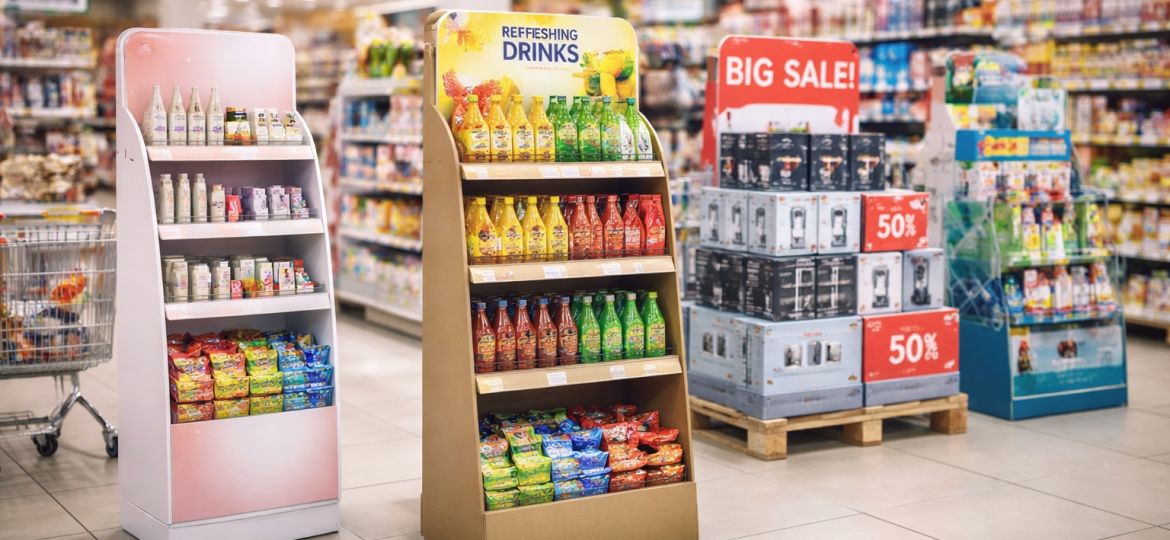
Walk into any busy supermarket and you’ll see dozens of Free Standing Display Units, all doing slightly different jobs. Some are holding cans of energy drink near the checkout. Others are displaying seasonal gifting at the store entrance. Some are hooked units carrying accessories at eye level, others are large shelved units anchoring a promotional island in the middle of the main aisle. They look similar from a distance, but each one has been specified for a particular product, a particular location, and a particular campaign objective.
Get the specification right and your FSDU will perform well, stay standing, and get restocked by store staff throughout its campaign life. Get it wrong and you’ll end up with a unit that collapses under product weight, fails retailer compliance checks, or simply doesn’t get built properly on the shop floor.
This guide walks you through every decision you need to make – from FSDU type and material to sizing, retailer compliance and supplier selection – so you can brief your FSDU partner with confidence and get a display that actually delivers.
If you’re still at the stage of understanding the basics, our what is a FSDU guide covers everything you need to know before reading on.
Step 1 – Choose the Right FSDU Type for Your Product
The first decision is format. There are several distinct FSDU types, and the right one depends on your product’s physical characteristics, your retail environment, and how you want customers to interact with the display.
Dump Bins
Best for: fast-moving, loose, impulse-buy products – confectionery, snacks, small accessories, promotional lines.
Dump bins are high-capacity open-top units where products are loosely stacked. Customers reach in and grab – which is exactly the point. They work because they create a sense of abundance and informality that suits impulse categories well. They’re also one of the cheapest FSDU formats to produce, which makes them ideal for high-volume, low-margin lines.
Avoid dump bins for: fragile products, anything requiring careful handling, premium items where the “pile it high” aesthetic conflicts with brand positioning.
Hooked Units
Best for: hanging SKUs – accessories, stationery, health and beauty, small hardware, personal care.
Hooked FSDUs use eurohooks or similar fittings to display products that hang in their own packaging. They maximise vertical space and make it easy for customers to browse multiple price points or variants. Particularly effective for categories where customers want to see the product clearly through the packaging before buying.
Avoid hooked units for: heavy products (weight distribution can cause stability issues), bulky items that don’t hang neatly, or anything that needs to be opened or handled before purchase.
Shelved Units
Best for: almost everything – the most versatile format across food, drink, health, beauty, homeware, electronics and more.
Shelved FSDUs present products on tiered horizontal shelves, typically with a branded header card above and sometimes side panels. They work across virtually every product category and retail environment, and they’re what most people picture when they think of a standard FSDU.
The key variables are shelf depth, shelf height, number of shelves, and load-bearing capacity – all of which need to be specified correctly for your product dimensions and weight.
Showstopper Displays
Best for: hero product launches, premium lines, brand activation moments.
Showstoppers are purpose-built to command attention. They typically combine bold structural design with high-impact graphics and are positioned in prime locations – store entrances, promotional islands, or feature areas. They cost more to produce than standard formats but deliver proportionally higher visual impact.
Best used when: you have a product or campaign that genuinely warrants the investment – a major new launch, a premium line, a brand anniversary or a high-profile seasonal moment.
Counter Top Units (CTUs)
Best for: smaller products at checkout, pharmacy counters, service desks.
Technically a separate format – a CTU sits on a surface rather than the floor – but specified and produced in much the same way as a floor-standing FSDU. Ideal where floor space is limited or where the product benefits from placement directly at the point of payment.
Pallet Wrap Displays
Best for: bulky or heavy products, large volume retail deployments, mobile in-store promotions.
A pallet wrap display is an FSDU designed to sit on a standard pallet – typically 1200mm x 1000mm. It’s particularly useful for heavy products that can’t be safely held by a standard cardboard structure, and for situations where the display needs to be delivered to store pre-stocked and simply positioned on the shop floor without assembly.
Step 2 – Choose the Right Material
Most FSDUs are made from corrugated cardboard – and for the vast majority of UK retail campaigns, this is the right choice. But not all corrugated cardboard is the same, and for some applications other materials are worth considering.
Corrugated Cardboard
The dominant material for UK retail FSDUs. Lightweight, cost-effective, recyclable, and easy to print on with high-quality graphics. Available in single-wall, double-wall and triple-wall constructions – the right choice depends on product weight and how long the display needs to stay in service.
Single-wall corrugated is suitable for lighter products and shorter campaigns. Double-wall offers significantly greater load-bearing capacity and is the standard specification for most retail FSDUs. Triple-wall is used for heavy products or displays that need to remain in service for extended periods.
At Gus Logistics, all our FSDU displays use 100% recyclable corrugated cardboard as standard – meeting retailer sustainability requirements without compromising on structural performance.
Plastic
Durable and water-resistant – better suited to outdoor, forecourt or wet environments where cardboard would deteriorate. Higher cost and less sustainable than cardboard. Typically used for semi-permanent or permanent displays rather than campaign-length promotions.
Metal
The strongest option – used for heavy products, high-traffic environments, or displays intended to remain in service for months or years. Significantly more expensive to produce and not recyclable in the same way as cardboard. Rarely used for standard retail promotional campaigns.
Wood
Adds a premium aesthetic – used for upscale brands in premium retail environments where the display itself is part of the brand story. High cost, heavy, and not suited to flat-pack delivery or rapid in-store assembly.
The bottom line: for the vast majority of UK retail FSDU campaigns, double-wall corrugated cardboard is the right specification. It balances cost, performance, sustainability and printability better than any alternative.
Step 3 – Get the Sizing Right
Sizing is where a lot of brands make avoidable mistakes. An FSDU that’s too tall gets repositioned or removed by store staff. One that’s too wide blocks sightlines and creates compliance issues. One with shelves that are too deep wastes space and makes products hard to reach.
Standard height guidelines
Most retail FSDUs fall between 1200mm and 1800mm in total height. The sweet spot for product display is typically between eye level (around 1400-1600mm) and waist level (around 900-1100mm) – this is where customer engagement is highest.
Header cards typically sit above 1600mm and are used for branding and messaging rather than product display.
Footprint
Retailers have strict rules about the floor space an FSDU can occupy, and these vary by retailer and by store format. As a general guide, most standard retail FSDUs have a footprint of between 400mm x 400mm and 600mm x 600mm. Anything larger typically requires specific retailer approval and may attract a premium placement fee.
Shelf depth and spacing
Shelf depth should be matched to your product dimensions – typically 10-20% deeper than your product’s footprint to allow easy restocking without products falling forward. Shelf spacing (the vertical gap between shelves) should be at least 20-30mm taller than your product height to allow easy placement and removal.
Weight capacity
This is critical and frequently underspecified. You need to know the total weight your FSDU will hold when fully loaded — not just the weight of a single unit of product. A shelved FSDU holding four shelves of bottled product can easily exceed 20-30kg when fully stocked, and the structure needs to be engineered accordingly.
 Step 4 – Understand Retailer Compliance Requirements
This is the step that catches out the most brands – particularly those new to retail distribution. Every major UK retailer has its own set of compliance requirements for FSDUs, and if your display doesn’t meet them it won’t make it onto the shop floor.
What retailers typically specify
- Maximum dimensions – height, width and footprint limits vary by retailer and sometimes by store format
- Minimum load-bearing capacity – the display must be able to hold its full product load safely
- Assembly requirements – most retailers require tool-free assembly in under a specified time
- Materials – many major retailers now require 100% recyclable materials
- Graphics and branding – retailer logos or branding restrictions on third-party displays
- Stability testing – some retailers require proof that the unit meets specified stability standards
Major retailer requirements to be aware of
Requirements change regularly and vary by category and store format, so always verify with your buyer or category manager before finalising your design. As a general guide:
Tesco, Sainsbury’s, Asda and Morrisons all have detailed FSDU compliance guides available through their supplier portals. Boots has specific requirements around display height and footprint in pharmacy and healthcare aisles. Specialist retailers like WHSmith, Waterstones and Sports Direct each have their own requirements that differ significantly from the major grocery multiples.
Working with an experienced FSDU partner who understands these requirements is one of the most effective ways to avoid costly redesigns and delays. At Gus Logistics, we work through retailer compliance requirements at the design stage so every unit is approved before manufacture begins.
Step 5 – Plan Your Graphics and Branding
The structure of your FSDU gets it onto the shop floor. The graphics are what make it work once it’s there.
Key design principles
Clarity at distance – your primary message needs to be readable from at least 3-4 metres away. Shoppers moving through a busy store have a fraction of a second to register your display. If the key message – product name, price point, promotional headline – isn’t immediately legible at distance, you’ve lost them.
Brand consistency – every element of your FSDU should align with your brand guidelines. Colour, typography, imagery and tone should be consistent with your packaging, your website and your wider marketing. Inconsistency creates confusion and undermines the trust you’ve worked to build.
Product as hero – the display is a frame for your product, not a canvas for creative expression. The product should be the most prominent visual element, with graphics supporting rather than competing.
Header card – the header card above the product display area is your primary branding and messaging space. Keep it simple, bold and on-brand. This is what shoppers see first as they approach the display.
Side panels – often underused. Side panels are visible from the aisle and represent a significant additional branding opportunity – particularly in end-of-aisle placements where the side of the display is the first thing shoppers see.
Step 6 – Decide Whether You Need Pre-Fill and Direct-to-Store Delivery
This is a decision that significantly affects both the specification of your FSDU and your choice of supplier – and it’s one that many brands don’t think through early enough.
Flat-pack delivery to a central location
The traditional approach – FSDUs are delivered flat-packed to a warehouse or distribution centre, then assembled and filled with product before being sent to stores. This gives you more control over the fill process but adds a logistics step and increases the risk of assembly errors at store level.
Pre-fill and direct-to-store delivery
The more efficient approach – your FSDU partner pre-fills each unit with your products before dispatch and delivers completed, retail-ready displays directly to individual store locations. This removes the central assembly step, reduces handling, and ensures every display arrives at store exactly as specified.
At Gus Logistics, pre-fill and direct-to-store delivery is a core part of our FSDU service. We hold your stock in our Nantwich warehouse, fill each unit to your exact planogram, and dispatch directly to individual store locations across the UK – fully tracked and retail-ready on arrival.
For brands distributing to multiple locations simultaneously, this end-to-end approach removes a significant layer of operational complexity and reduces the margin for error at store level.
Step 7 – Choose the Right FSDU Supplier
Once you’ve worked through the above decisions, you’re in a strong position to brief a supplier. Here’s what to look for – and what to watch out for.
What a good FSDU supplier looks like
✓ Design and structural engineering capability – they should be able to take a brief and develop a structural design that works for your product and your retailer, not just adapt a standard template
✓ Retailer compliance knowledge – they should know the requirements of the retailers you’re distributing through and build to those specs without you having to manage it
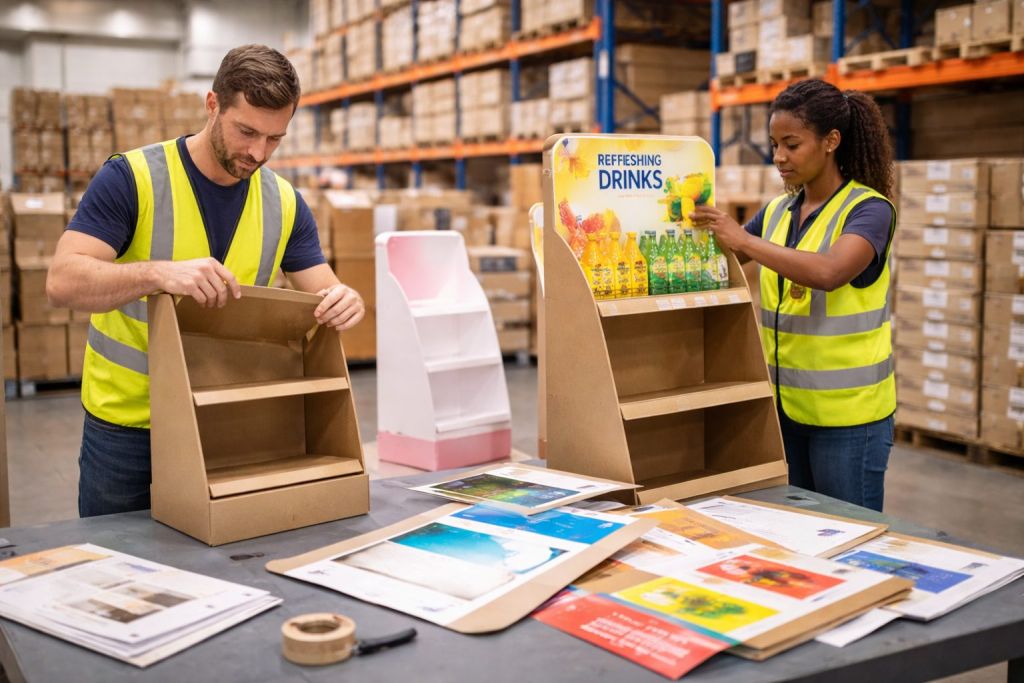
✓ Prototyping – a reputable supplier will produce a physical prototype before committing to full production, so you can check structural integrity, product fit and assembly before signing off
✓ Print quality – ask to see samples of their print work. High-quality graphics are non-negotiable for a display that needs to compete visually on the shop floor
✓ Lead times – understand the timeline from approved design to delivery, and make sure it fits your campaign window
✓ Pre-fill and logistics – if you need pre-fill and direct-to-store delivery, confirm the supplier can manage that end of the process or has a logistics partner who can
What to watch out for
✗ Suppliers who won’t provide a prototype before full production
✗ Overseas manufacturers with long lead times and limited ability to respond quickly to design changes
✗ Suppliers with no experience of your specific retailers’ compliance requirements
✗ Anyone who can’t give you a clear timeline and a fixed quote upfront
FSDU Buyer’s Guide – Quick Reference Checklist
Before briefing your FSDU supplier, make sure you can answer all of these:
✓ What type of FSDU do I need – dump bin, hooked, shelved, showstopper, CTU or pallet wrap?
✓ What material specification is right – single, double or triple-wall corrugated?
✓ What are my product dimensions and weights – fully loaded, per shelf, total?
✓ What retailer compliance requirements apply to my distribution outlets?
✓ What are the maximum dimensions – height, width, footprint – for each retailer?
✓ What graphics and branding assets do I have available?
✓ Do I need flat-pack delivery, pre-fill, or direct-to-store dispatch?
✓ What is my campaign timeline – when does the display need to be in store?
✓ What quantity do I need across how many store locations?
How Gus Logistics Can Help
At Gus Logistics, we provide a complete end-to-end FSDU service from our base in Nantwich, Cheshire – covering design, structural engineering, manufacture, print, pre-fill and direct-to-store delivery across the UK.
We work through retailer compliance requirements at the design stage, produce prototypes before committing to full production, and manage the full logistics process so your displays arrive at every store location retail-ready. Every unit uses 100% recyclable corrugated cardboard as standard.
If you’re still at the research stage, our what is a FSDU guide covers the fundamentals before you start specifying.
According to POPAI UK & Ireland, point of sale displays consistently deliver measurable uplift in sales when correctly specified and positioned – and the specification decisions covered in this guide are precisely what separates the displays that perform from those that don’t.
Call 01270 335014 or email hello@guslogistics.co.uk – we’re happy to talk through your FSDU requirements and turn a quote around the same working day.
