

How to CHoose Logistics Services for a Growing UK Business
Growth is a good problem to have, until logistics starts to slow everything down. Orders take longer to ship, stock becomes harder to find, customer messages increase, and your team spends more time firefighting than selling.
That is usually the point where a growing business starts comparing logistics services. The challenge is knowing what you actually need, what you can safely outsource, and which provider will still be a good fit when volumes rise again.
Choosing the right logistics partner is not just about finding warehouse space or cheaper delivery rates. It is about protecting customer experience, keeping stock under control, and building an operation that can scale without adding unnecessary complexity.
Start with the pressure points in your current operation
Before speaking to providers, look honestly at where your current setup is under strain. A business shipping 20 orders a week from a back room has different needs from a brand sending pallets into retailers, managing Amazon orders, or dispatching mixed product lines with batch control.
Common signs that your logistics setup needs to change include:
- Orders regularly missing dispatch cut-offs
- Staff being pulled away from sales, customer service, or production to pack orders
- Stock being stored in multiple places with no clear live view
- Delivery issues taking too long to resolve
- Seasonal peaks causing avoidable delays
- Retail or wholesale customers asking for requirements you cannot easily meet
These issues are not just operational annoyances. They affect revenue, reviews, cash flow, and your ability to take on larger opportunities. A good logistics provider should help you remove friction, not simply take boxes off your hands.
Know which logistics services you actually need
The term logistics services can cover a wide range of work. Some businesses need a full third-party logistics provider, often called a 3PL. Others only need overflow storage, same-day transport, or help building retail display units.
The first step is to match the service to the business problem. This avoids overbuying, underbuying, or choosing a provider that is strong in one area but weak in the area that matters most to you.
| Business need | Logistics service to consider | What to check before choosing |
|---|---|---|
| Online orders are taking too much internal time | Order fulfilment and pick and pack | Platform integrations, dispatch cut-offs, packing standards, returns handling |
| Stock is outgrowing your premises | Warehousing and pallet storage | Racked storage, floor storage, stock visibility, batch or best-before tracking |
| Deliveries need to move quickly or at short notice | Same-day or next-day transport | Fleet availability, vehicle types, proof of delivery, UK coverage |
| Products need to go into retailers | FSDU and retail display support | Design, manufacture, pre-fill, dispatch, retailer delivery experience |
| Products need repacking or assembly | Co-packing and contract packing | Accuracy, quality checks, packaging supply, labour flexibility |
A growing eCommerce business may start with fulfilment and storage. A manufacturer might need pallet warehousing and transport. A retail brand may need co-packing, FSDU assembly, and distribution into stores. The right choice depends on your sales channels, stock profile, and delivery promises.
Decide what should stay in-house and what should be outsourced
Outsourcing logistics does not mean losing control. In many cases, it gives you more control because processes become clearer, stock records improve, and dispatch performance becomes easier to monitor.
However, not every task should be outsourced immediately. If your brand relies on highly customised packaging, handwritten notes, or complex product configuration, you need to be sure the provider can handle that detail. If you mainly ship standard products and your internal team is spending hours picking and packing, fulfilment is often a clear candidate for outsourcing.
A practical way to decide is to separate tasks into three groups. First, tasks that create customer value and should be protected. Second, tasks that are necessary but repetitive. Third, tasks that need specialist equipment, vehicles, labour, or warehouse systems. The second and third groups are often where a logistics partner can add the most value.
If your main challenge is online order processing, it is worth understanding the benefits of using a fulfilment centre before you commit to expanding your own space or hiring more warehouse staff.
Check fulfilment capability carefully
For eCommerce brands, fulfilment is usually the most visible part of logistics. Customers may never see your warehouse, but they will notice late dispatches, poor packaging, missing items, and slow returns.
When comparing fulfilment providers, ask how orders flow from your sales channels into their warehouse system. Manual uploads might work for low volumes, but they become a risk as order numbers rise. If you sell through Shopify, Amazon, eBay, WooCommerce, Magento, or multiple channels at once, integrations matter because they reduce admin and help prevent errors.
Cut-off times are also important. A provider with later dispatch cut-offs can help you capture more same-day orders and meet next-day expectations. But cut-offs should be realistic, clearly agreed, and supported by the warehouse and carrier operation.
You should also ask how the provider handles:
- Product barcodes and SKU accuracy
- Branded or plain packaging
- Multi-item orders
- Returns and exchanges
- Stock adjustments and damaged goods
- Customer service queries linked to dispatch or delivery
The best fulfilment service is not always the one with the lowest pick fee. It is the one that can consistently send the right order, in the right packaging, on the right service, while keeping you informed.
Look for proper stock visibility in warehousing
As a business grows, stock control can become one of the biggest sources of hidden cost. If stock is hard to locate, incorrectly counted, or spread across unsuitable storage areas, you risk overselling, delaying orders, or tying up cash in inventory you do not need.
A warehousing provider should be able to explain how stock is received, checked, stored, picked, counted, and reported. For some businesses, simple pallet storage is enough. For others, you may need batch tracking, serial number control, best-before date management, or clear separation between product ranges.
Ask whether you will have access to real-time stock information and whether the warehouse management system gives you the level of detail you need. A client portal can be especially useful if your team needs to check availability, monitor movements, or answer customer questions without waiting for email updates.
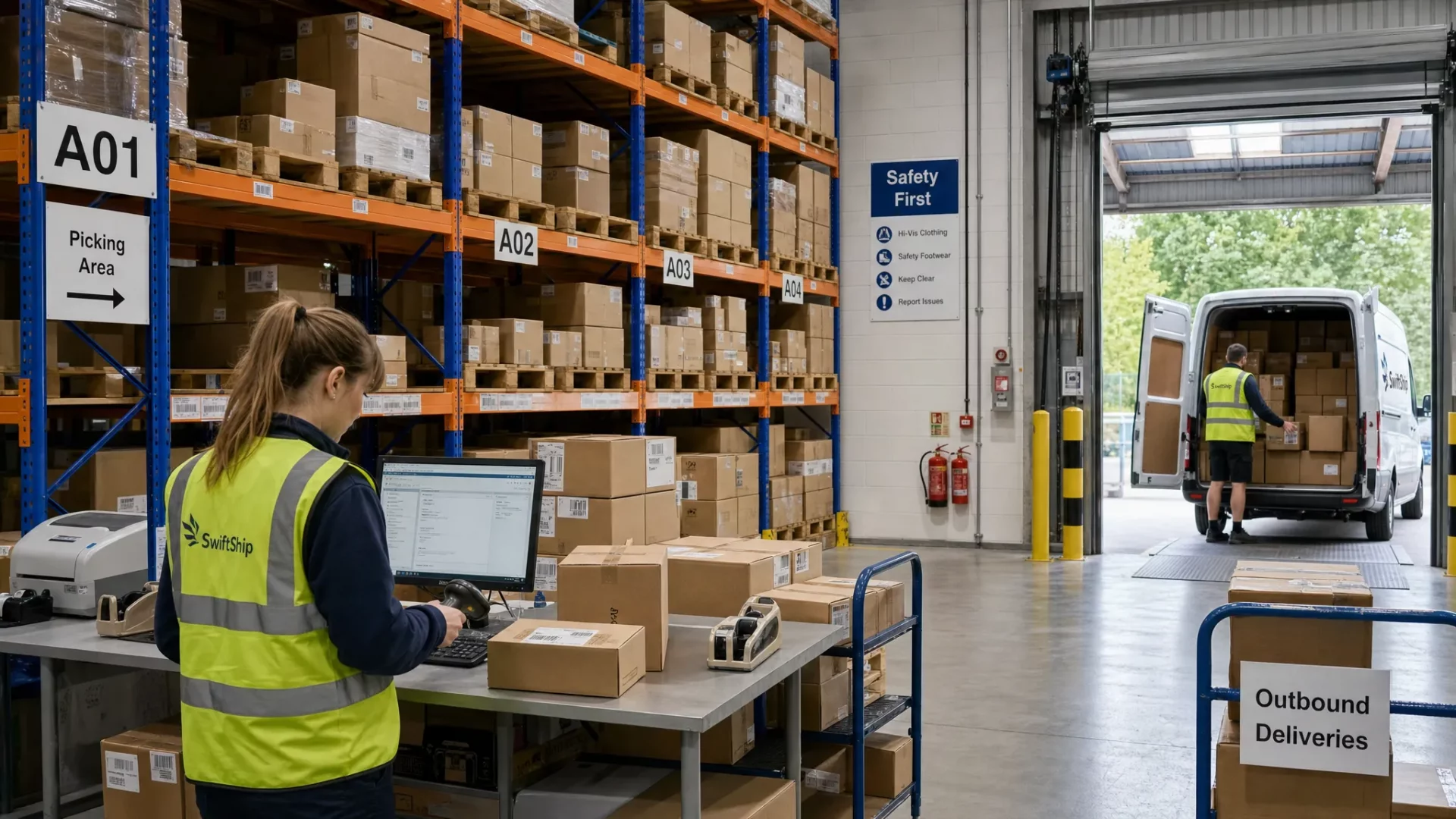
Good warehousing is not just storage. It is the foundation for accurate fulfilment, reliable wholesale dispatch, and confident purchasing decisions.
Make transport part of the decision, not an afterthought
Many businesses separate warehousing from transport when they compare providers. That can work, but it often creates gaps. If your warehouse team and transport provider do not communicate well, urgent orders, pallet movements, and retailer deliveries can become harder than they need to be.
For a growing UK business, transport requirements can change quickly. One week you may need a few cartons sent by parcel carrier. The next week you may need pallets moved to a retailer, stock collected from a manufacturer, or a same-day delivery to protect an important customer relationship.
When evaluating transport capability, look beyond headline coverage. Ask what vehicles are available, how urgent jobs are handled, whether digital proof of delivery is provided, and who you speak to when there is a problem. Direct communication matters, especially when timing is critical.
Location can also make a difference. A provider based near major routes can often support faster and more flexible distribution across the UK. If you are specifically comparing logistics companies in Cheshire, consider how access to the M6, M56, and M62 supports your delivery network.
Understand the full cost, not just the headline rate
Logistics pricing can be difficult to compare because providers may structure costs differently. A low storage rate might be offset by higher handling charges. A cheap pick fee may not include packaging, returns, stock counts, or account support.
Instead of asking only for the cheapest rate, ask for a clear breakdown that reflects your actual operation. This should include onboarding, goods in, storage, picking, packing, packaging materials, shipping, returns, and any specialist work such as relabelling, repacking, or display assembly.
The right provider should be willing to explain how pricing changes as your volume grows. That does not mean every cost will fall automatically, but you should understand the cost drivers and how to improve efficiency over time.
For a plain English overview of common charges, this guide to 3PL costs in the UK is a useful next step when building your comparison.
Ask the right questions before you commit
A professional logistics provider should welcome detailed questions. If answers are vague at the sales stage, they are unlikely to become clearer once your stock is already in the warehouse.
| Question to ask | Why it matters |
|---|---|
| What sales platforms can you integrate with? | Reduces manual work and order errors |
| What are your dispatch cut-offs? | Helps you set realistic customer delivery promises |
| How will I see stock levels and order status? | Gives your team visibility without constant chasing |
| Do you support batch, serial, or best-before tracking? | Important for food, cosmetics, electronics, and regulated product types |
| What happens during peak periods? | Shows whether the provider can scale with demand |
| Who do I speak to when something goes wrong? | Tests whether support is direct and practical |
| Can you handle transport as well as warehousing? | Reduces gaps between storage, dispatch, and delivery |
| Are there minimum volumes? | Important for growing SMEs with changing demand |
Pay close attention to how a provider answers. Clear, specific answers are a good sign. Overly generic promises should prompt follow-up questions.
Watch for red flags
Most logistics problems are easier to avoid than fix. Once your stock is moved into a warehouse and your order flow depends on a provider, changing partner can be disruptive. It is worth taking time to spot problems early.
Red flags include:
- No clear explanation of how stock is tracked
- Limited visibility of orders or inventory
- Unclear pricing or too many undefined extras
- Slow responses during the quotation stage
- No practical plan for peak periods
- Reluctance to discuss errors, returns, or exception handling
- A poor fit between your product type and their warehouse setup
A provider does not need to be the biggest in the market to be the right fit. In fact, many SMEs benefit from a partner that offers direct communication and flexible support. What matters is whether the provider can handle your current operation properly and support the next stage of growth.
Plan the transition properly
Moving logistics to a new provider should be treated as a project, not a quick handover. Even a straightforward fulfilment setup needs accurate product data, clean stock counts, agreed packaging rules, and tested order integrations.
A good transition plan usually covers product information, inbound stock booking, systems integration, test orders, reporting, returns handling, and go-live timing. If you are moving from an in-house setup, your team may also need to adjust how they manage customer service and purchasing once stock is held off-site.
Avoid switching at the busiest point of the year if you can. If that is not possible, build in extra time for testing and agree how urgent issues will be handled during the first few weeks.
Where Gus Logistics fits for growing UK businesses
Gus Logistics is a family-run 3PL logistics provider based in Nantwich, Cheshire, supporting eCommerce brands, manufacturers, retail brands, and product businesses across the UK.
For order fulfilment, Gus Logistics provides pick and pack services with integrations across 60+ platforms including Shopify, Amazon, eBay, WooCommerce, and Magento. Late cut-offs up to 10pm and next-day dispatch are available, helping growing brands keep pace with customer expectations.
For warehousing and storage, Gus Logistics offers racked and floor storage with real-time WMS tracking through a client portal. Batch, serial number, and best-before date tracking are also available where required.
For transport, Gus Logistics operates its own fleet including vans, 7.5t, 18t and 26t rigids, artics, and Moffetts, with access to 5,000+ vehicles across the UK and Europe. Same-day and next-day transport can support urgent deliveries, planned distribution, and wider supply chain needs.
For retail brands, Gus Logistics also supports FSDU design, manufacture, pre-fill, and dispatch, along with co-packing, contract packing, POS assembly, repacking, and container de-stuffing.
The key difference for many businesses is communication. Gus Logistics is family-run, with no call centres, so customers speak directly to the people handling their freight. There are no minimum volume requirements, same-day quotes are standard, and the Nantwich location gives strong access to the M6, M56, and M62 for UK-wide distribution.
Frequently Asked Questions
What logistics services does a growing business usually need first? Most growing product businesses start with warehousing, order fulfilment, or transport support. The right starting point depends on whether your main problem is lack of space, slow dispatch, poor stock visibility, or delivery pressure.
When should I outsource fulfilment? It is usually time to consider outsourcing when packing orders is taking staff away from higher-value work, dispatch deadlines are being missed, or order volumes are becoming difficult to manage accurately in-house.
Is a local logistics provider better than a national provider? Not always, but location can be important. A provider near major motorway links can offer practical advantages for collections, urgent deliveries, and UK-wide distribution. Local support can also make communication easier.
How do I compare logistics quotes fairly? Ask each provider to quote against the same order volumes, storage needs, product types, packaging requirements, and delivery services. Compare the full cost, not just storage rates or pick fees.
Can I outsource logistics without committing to high order volumes? Some providers require minimum volumes, while others are more flexible. If your business is growing but demand varies, ask about minimums, seasonal changes, and how pricing works at different volumes.
Ready to choose logistics services with confidence?
If your business is growing and logistics is starting to hold you back, Gus Logistics can help you assess the right mix of fulfilment, warehousing, transport, FSDU, and co-packing support.
Call 01270 335014 to speak directly with the team, or get in touch via the contact page to discuss your current operation and request a same-day quote.
Looking for a Logistics Partner You Can Trust?
From warehousing and order fulfilment to transport and FSDU design - Gus Logistics handles it all from our base in Nantwich, Cheshire. Over 10 years experience, no minimum volumes, no long contracts.
