
How Much Warehouse Space Does Your Business Actually Need?
Warehouse space is one of those costs that can quietly pull a growing business in two directions. Too little space causes blocked aisles, slow picking, damaged stock and missed dispatch targets. Too much space means you are paying for empty air, unused floor area and overheads that do not move the business forward.
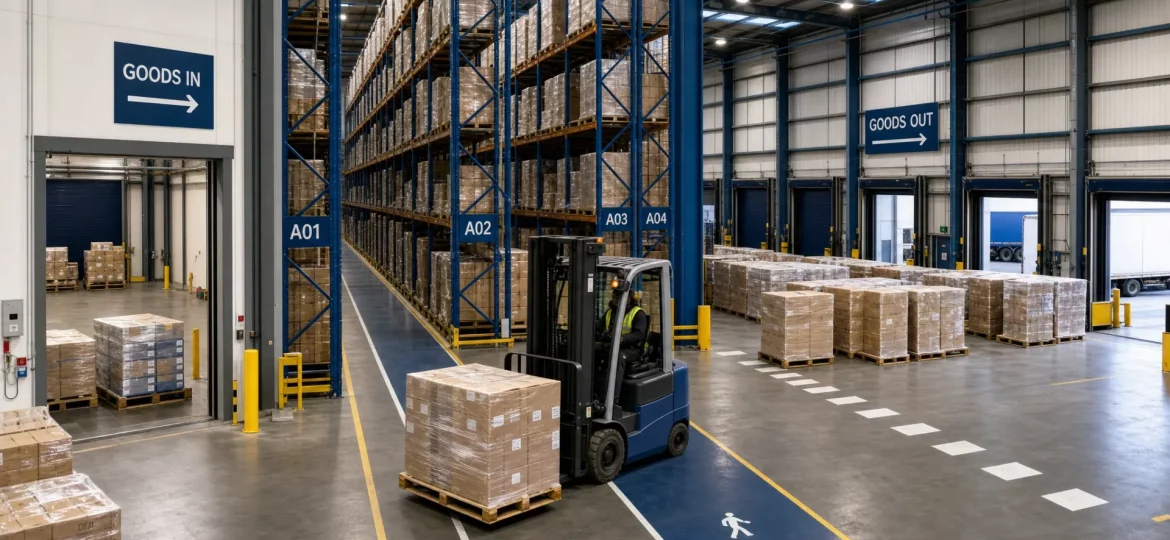
The difficult part is that warehouse space is not simply the size of the building. A 500 square metre unit does not give you 500 square metres of usable storage. You need room for access, handling equipment, goods in, packing, outbound orders, returns, packaging materials and safe movement around the site.
So, how much warehouse space does your business actually need? The practical answer is: enough to store your current stock safely, process orders efficiently and absorb realistic growth or seasonal peaks without turning the warehouse into a bottleneck.
Why warehouse space is easy to misjudge
Many businesses estimate warehouse space by looking at stock volume alone. They count pallets, cartons or product lines, then try to match that to a unit size. That is a useful starting point, but it misses how a warehouse really works day to day.
In warehousing and logistics, the same product can require very different space depending on how it is received, stored, picked and dispatched. A pallet of slow-moving stock kept in racking has different space requirements from fast-moving cartons that need to sit near a packing bench. Retail display units, bulky products and mixed-SKU orders all create extra handling needs.
Space problems often appear when a business grows beyond its original layout. What worked for 20 orders a day may not work for 200. Stock starts to sit in walkways. Goods in areas become temporary storage. Packing benches get surrounded by part-picked orders. At that point, the issue is not only space, it is flow.
Good space planning starts by asking what needs to happen inside the warehouse, not just what needs to fit inside it.
Start with the stock, not the building
Before looking at square metres, build a clear picture of your stock profile. This is the information a 3PL provider, warehouse manager or commercial property agent will need to make a sensible recommendation.
You should know:
- How many SKUs you hold and how many are active each month.
- Average stock on hand, measured in pallets, cartons, units or bins.
- Peak stock on hand during busy trading periods.
- Product dimensions, weight and whether items are stackable.
- How stock arrives, such as pallets, containers, cartons or mixed deliveries.
- How stock leaves, such as full pallets, cases, individual units or retail-ready displays.
- Whether you need batch, serial number or best-before date tracking.
This matters because two businesses with the same sales volume can need very different warehouse space. A brand selling small cosmetics may need many pick locations but relatively little pallet storage. A manufacturer holding bulky components may need fewer SKUs but far more floor space. A retail brand preparing FSDUs, or free-standing display units, may need assembly and staging space before dispatch.
The practical warehouse space formula
A simple way to think about warehouse space is:
Required warehouse space = product storage + access and handling + operational areas + growth allowance
The product footprint is only one part of the calculation. The areas around the stock are what make the warehouse usable.
| Space component | What it includes | Why it matters |
|---|---|---|
| Product storage | Pallet positions, shelving, floor locations, bins and bulk storage | Holds sellable stock safely and in a way that can be found quickly |
| Access and handling | Aisles, forklift routes, pedestrian routes and turning space | Allows people and equipment to move without constant disruption |
| Operational areas | Goods in, quality checks, packing benches, returns, outbound staging and packaging storage | Supports the work that happens before and after storage |
| Growth allowance | Space for seasonal peaks, new product lines, delayed inbound stock or retail campaigns | Reduces the risk of outgrowing the layout immediately |
Safe warehouse design also needs clear separation where appropriate between people, vehicles and stock movements. The Health and Safety Executive guidance on workplace transport is a useful reference if you operate your own site and need to assess routes, visibility and loading areas.
Calculate space by storage type
The most useful measure depends on what you store. Square metres are helpful for property comparisons, but operational planning often needs more specific measures.
| Stock type | Better measure to use | What to consider |
|---|---|---|
| Palletised goods | Pallet positions | Pallet type, height, weight, stackability and racking suitability |
| Carton pick stock | Shelving bays, bins or pick locations | SKU count, picking frequency and replenishment needs |
| Mixed B2B and direct-to-consumer stock | Pallet positions plus pick faces | Bulk reserve stock may sit separately from fast-moving pick stock |
| Bulky or awkward items | Floor locations and access routes | Long, fragile or heavy products can reduce usable density |
| FSDUs and POS displays | Assembly, pre-fill and staging space | Display units often need clean working areas before transport |
For palletised stock, start with the pallet footprint. A standard UK pallet is typically 1.2 metres by 1.0 metre, giving a footprint of 1.2 square metres. A Euro pallet is typically 1.2 metres by 0.8 metres, giving a footprint of 0.96 square metres. This does not mean 100 UK pallets only need 120 square metres of warehouse space, because you still need aisles, access, staging and operational areas.
If stock can be safely stored in racking, the building height and racking layout become as important as floor area. If stock must stay on the floor, or cannot be stacked, you will need more floor space for the same number of pallets. For a deeper local overview, Gus Logistics has a guide to pallet storage in Cheshire that explains what to look for in a flexible warehousing provider.
Worked example: why footprint alone is not enough
Imagine your business holds 80 standard UK pallets at a time. The pure pallet footprint is 80 x 1.2 square metres, which equals 96 square metres. On paper, that might make a 100 square metre unit look close to enough.
In practice, it is not enough for a working warehouse. You still need space to unload incoming stock, inspect goods, move pallets safely, access locations, pick orders, prepare outbound consignments and deal with returns. If the stock is fast-moving, you may also need pick faces close to packing areas. If the stock is slow-moving, you may be able to store it more densely, depending on racking and handling equipment.
If the same 80 pallets are safely stackable two high, you might reduce the number of floor locations needed. If they are fragile, uneven, heavy or restricted by best-before rotation, stacking may not be suitable. This is why a proper space estimate should look at product characteristics and handling methods, not just pallet count.
Space many businesses forget to include
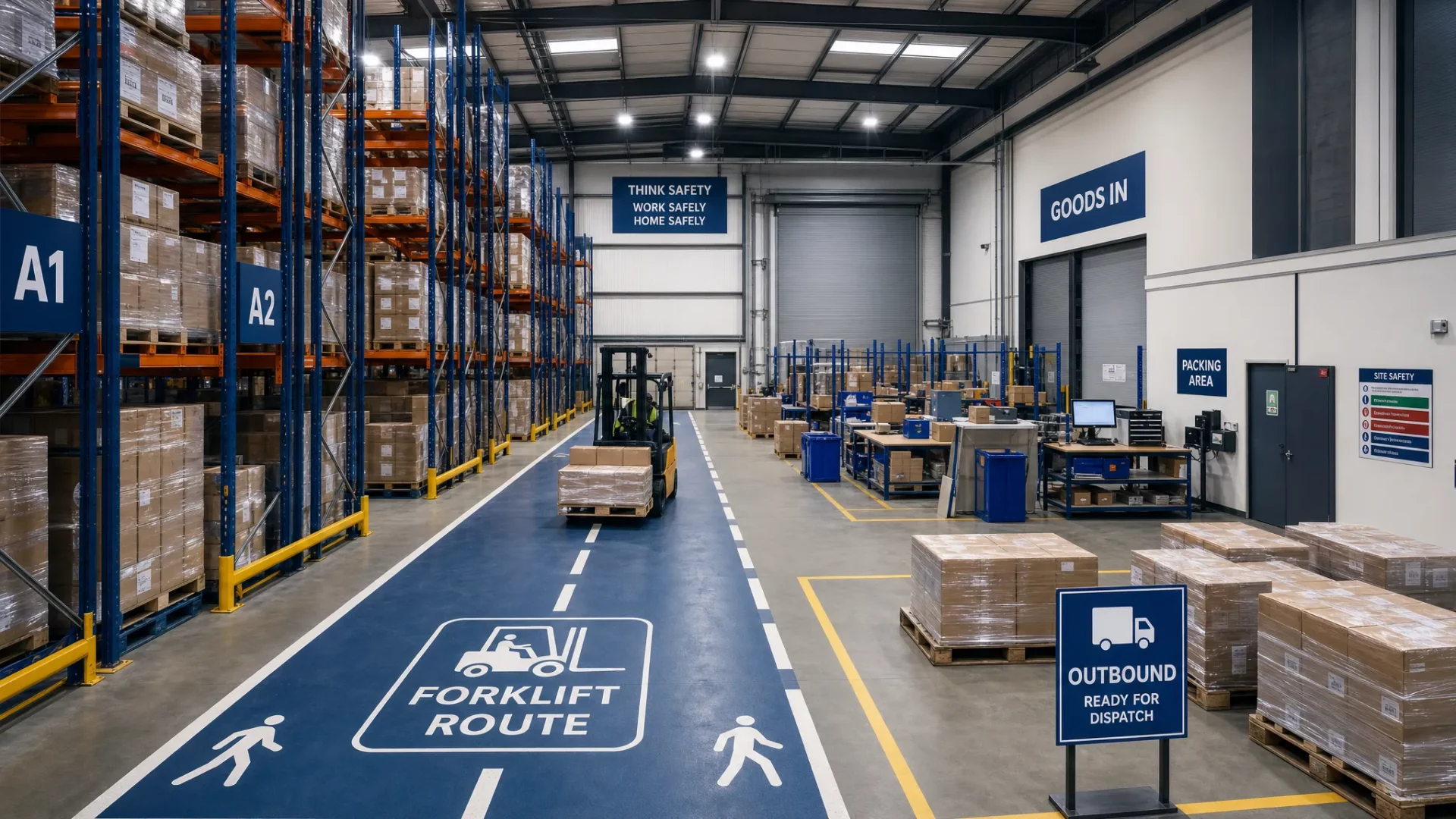
When warehouse space becomes tight, it is often the hidden areas that cause the biggest operational problems. These areas may not directly hold stock, but they are essential for keeping orders moving.
| Area often overlooked | Common mistake | What to allow for |
|---|---|---|
| Goods in | Using the nearest empty aisle as a receiving area | Space to unload, check, label and put stock away without blocking operations |
| Outbound staging | Packing orders with nowhere to hold them before collection | Space to group orders by carrier, route, customer or dispatch date |
| Returns | Treating returns as an afterthought | A clear area to inspect, rework, restock or isolate returned goods |
| Packaging materials | Storing boxes and void fill wherever they fit | Dedicated space near packing benches to avoid wasted movement |
| Slow-moving stock | Letting old stock occupy prime pick space | Separate locations for reserve, clearance or long-tail inventory |
| Seasonal stock | Planning around average stock only | Temporary capacity for campaigns, peak trading and delayed inbound shipments |
A warehouse can be full while still having empty locations if the layout is wrong. For example, fast-moving SKUs may be too far from packing, large cartons may not fit standard shelving, or mixed pallets may require extra sorting before they can be used. If you are reviewing your current setup, our article on why good warehouse storage solutions matter covers how storage quality affects productivity, safety and inventory control.
When you need more space, and when you need a better layout
Not every warehouse problem is solved by taking on a bigger unit. Sometimes you need more space. Sometimes you need better stock control, clearer processes or a layout that matches order flow.
Signs you may genuinely need more warehouse space include:
- Stock is regularly stored in aisles, loading areas or packing zones.
- Incoming deliveries cannot be processed before the next delivery arrives.
- Peak periods require temporary off-site storage or last-minute reorganisation.
- Orders are delayed because staff cannot access stock efficiently.
- Returns, packaging or outbound orders are competing with sellable stock for space.
- You are rejecting new sales channels or product lines because storage is already stretched.
Signs that layout or process may be the bigger issue include frequent stock discrepancies, pickers walking unnecessary distances, poor labelling, unclear put-away rules or slow replenishment from reserve stock to pick locations. In these cases, re-slotting stock, improving inventory visibility or introducing a warehouse management system may release capacity without increasing the building size.
A good test is to ask whether the space problem happens every day or only at specific pressure points. Daily congestion suggests capacity or layout issues. Short-term congestion around deliveries, retail campaigns or peak season may be better handled with flexible overflow storage.
Should you lease, expand or outsource?
Once you know your space requirement, the next decision is how to secure it. For growing SMEs, this is often a bigger financial and operational decision than expected.
| Option | When it can work well | Main risk |
|---|---|---|
| Leasing your own warehouse | Demand is stable, the business needs full control and you can manage staffing, systems and equipment | Fixed costs continue even when stock levels fall |
| Expanding an existing site | Your current location works and you have room to grow safely | Expansion may not solve poor layout or process issues |
| Short-term overflow storage | You need extra capacity for seasonal peaks, campaigns or delayed inbound stock | Stock may be split across sites if not managed carefully |
| Outsourcing to a 3PL | You want flexible storage, fulfilment, transport or specialist handling without running the warehouse yourself | You need a provider that understands your products, order profile and service expectations |
Outsourcing can make particular sense when storage is only one part of the problem. If your team is also struggling with picking, packing, carrier collections, returns or transport, a 3PL arrangement may remove several bottlenecks at once. If cost is part of your decision, our plain English guide to how much 3PL costs in the UK explains the typical areas to consider, including storage, goods in, pick and pack and shipping.
What a warehouse provider will ask you
A reliable provider should not quote space based on guesswork. They will usually ask for enough detail to understand both your current operation and your likely growth.
Useful information to prepare before asking for a warehouse quote includes:
- Current and peak pallet count.
- Number of SKUs and typical units per SKU.
- Product dimensions, weights and storage restrictions.
- Monthly order volume and average order profile.
- Inbound delivery frequency and format.
- Any batch, serial number or best-before tracking requirements.
- Returns volume and how returned goods should be handled.
- Seasonal peaks, retail campaigns or planned product launches.
- Whether you need transport, co-packing, FSDU work or order fulfilment alongside storage.
The more accurate this information is, the more accurate the space plan will be. It also helps avoid paying for capacity you do not need or underestimating the working areas needed to run the operation properly.
How Gus Logistics helps businesses right-size warehouse space
Gus Logistics is a family-run 3PL provider based in Nantwich, Cheshire, supporting eCommerce brands, manufacturers and product businesses across the UK. For businesses trying to work out how much warehouse space they need, the benefit of working with a 3PL is flexibility. You do not have to build your operation around a fixed lease before you know how stock and order volumes will change.
Gus Logistics provides pallet and bulk warehousing with racked and floor storage, real-time warehouse management system tracking through a client portal, and batch, serial number and best-before date tracking where required. The team also supports order fulfilment and pick and pack, with integrations across 60+ platforms including Shopify, Amazon, eBay, WooCommerce and Magento.
For businesses that need more than storage, Gus Logistics can also help with same-day and next-day transport, co-packing, contract packing, container de-stuffing and FSDU design, manufacture, pre-fill and dispatch. The location near the M6, M56 and M62 makes Nantwich a practical base for UK-wide distribution, particularly for businesses in Cheshire, the North West and the wider UK.
Just as importantly, there are no minimum volume requirements. That can be useful if you are growing, launching a new product range, testing a new sales channel or looking for overflow warehouse space without committing to a larger premises too early.
Frequently Asked Questions
How do I calculate how much warehouse space I need? Start with your product footprint, usually in pallet positions, cartons or pick locations. Then add space for access routes, goods in, packing, outbound staging, returns and seasonal growth. The usable space you need is always more than the footprint of the stock itself.
What is a pallet position? A pallet position is a storage location designed to hold one pallet. It is often more useful than square metres because it reflects how stock is actually stored in racking or floor locations.
Should I rent extra warehouse space for peak season? Only if peaks are predictable, long enough to justify fixed costs, and you have the staff and systems to manage them. Many businesses use flexible 3PL warehousing or overflow storage instead, so they are not paying for unused space all year.
When should I outsource warehouse storage? Outsourcing can make sense when stock volume is variable, your team is spending too much time moving goods, accuracy is slipping, or you need fulfilment, storage and transport under one provider. It can also help if you do not want to commit to a larger lease.
Can Gus Logistics handle both storage and fulfilment? Yes. Gus Logistics provides pallet and bulk warehousing, order fulfilment and pick and pack, co-packing, FSDU support, and same-day or next-day transport services for businesses across the UK.
Need help working out your warehouse space?
If you are not sure whether you need more space, a better warehouse layout or a flexible 3PL solution, Gus Logistics can talk through your stock profile and recommend a practical next step.
Call 01270 335014 for a same-day quote, or get in touch via the contact page to discuss warehousing, fulfilment, transport, FSDUs or co-packing support for your business.
Looking for a Logistics Partner You Can Trust?
From warehousing and order fulfilment to transport and FSDU design - Gus Logistics handles it all from our base in Nantwich, Cheshire. Over 10 years experience, no minimum volumes, no long contracts.
