
FSDU Pre-Fill and Dispatch: How It Works and Why It Saves Brands Time
Getting an FSDU into store sounds simple until the launch date gets close. The display units need to be built, filled with the right stock, protected for transport, labelled correctly and delivered to the right stores at the right time. If any part slips, your sales team, warehouse team or retailer can end up dealing with avoidable pressure.
That is where FSDU pre-fill and dispatch comes in.
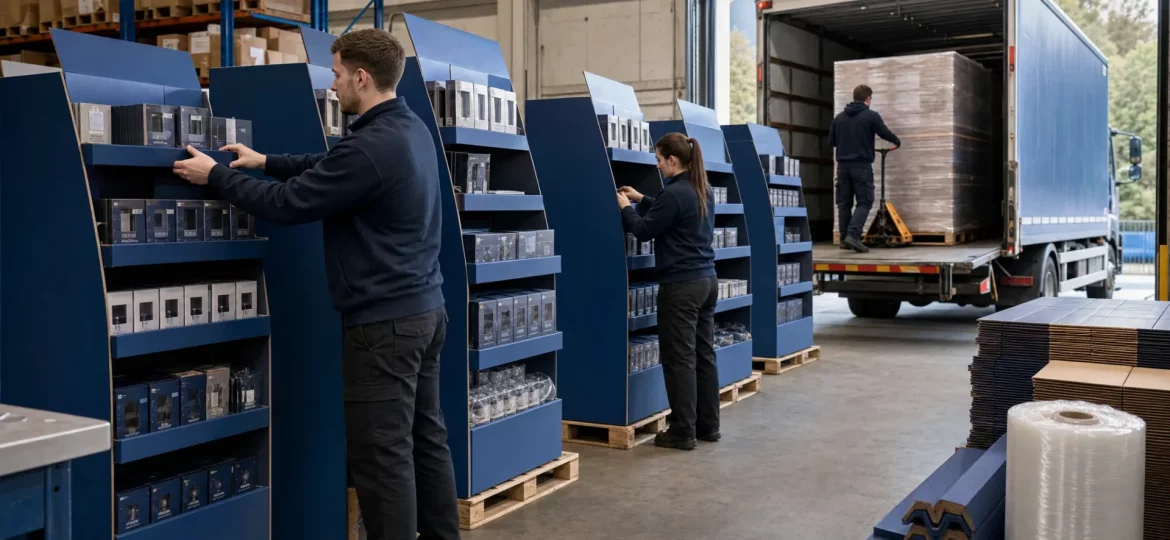
Instead of sending flat display units and loose stock separately, a logistics partner prepares each Free Standing Display Unit before it reaches store. The unit can arrive built, stocked, packed for safe movement and ready for retail teams to place on the shop floor. For busy brands, especially those managing seasonal launches, promotions or multiple retail locations, this can save a serious amount of time and admin.
Below, we explain how FSDU pre-fill and dispatch works, where it saves the most time, and what to check before choosing a partner.
What does FSDU pre-fill and dispatch mean?
FSDU pre-fill and dispatch is the process of assembling a retail display unit, loading it with product and sending it to stores, depots or distribution centres in a planned, trackable way.
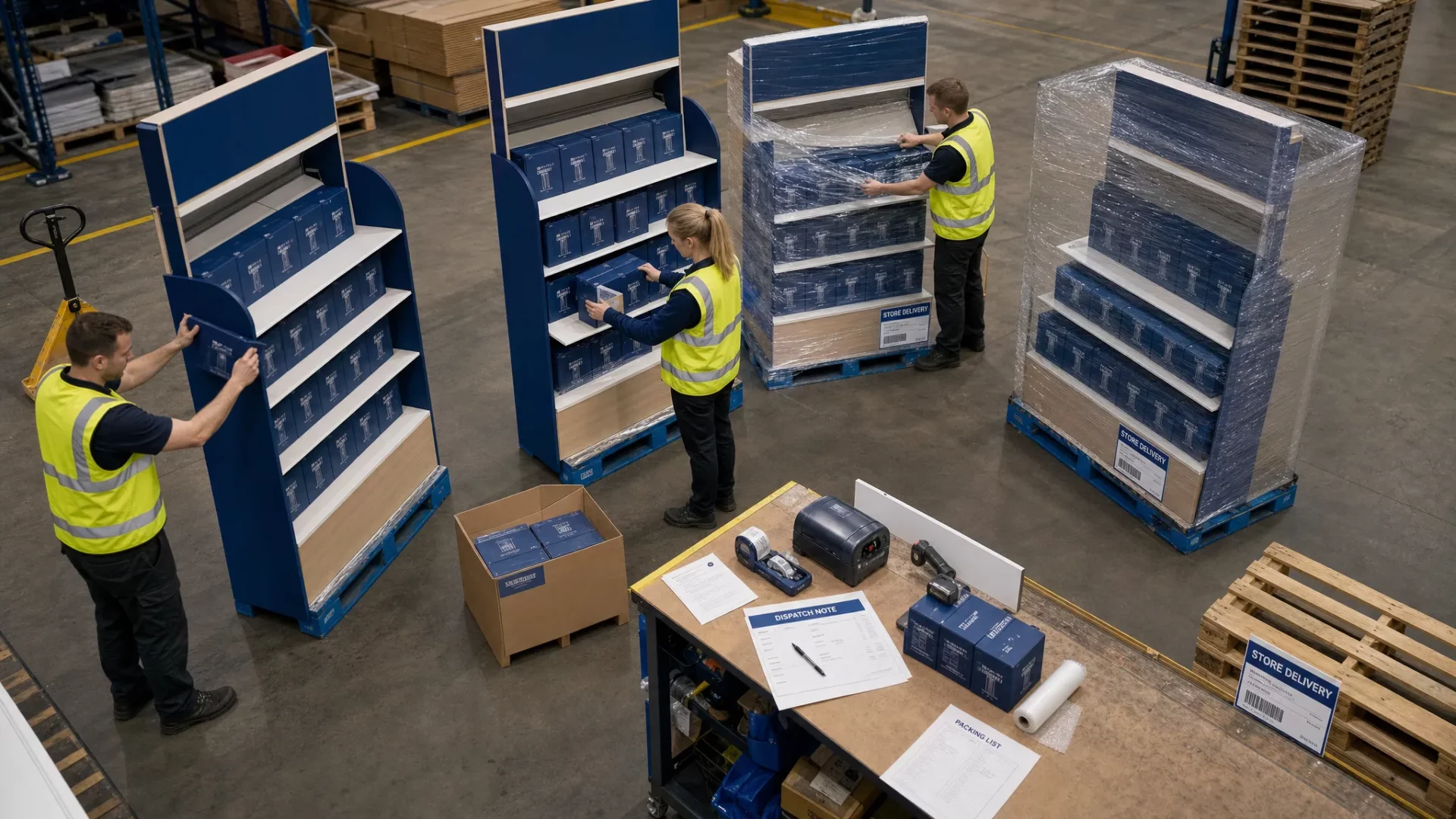
A typical pre-fill project may include receiving the printed display units, receiving the product stock, building the units, filling shelves or hooks, checking quantities, applying labels, protecting the unit for transport, palletising if needed and dispatching to the agreed destinations.
If you are still at the early planning stage, it is worth reviewing what a Free Standing Display Unit is and how different formats work before you decide how it should be packed and transported.
The key point is simple: the work is done before the display reaches the retailer. Store staff should not have to assemble complicated cardboard, hunt for the right stock or interpret unclear instructions during a busy trading day.
Why brands use pre-filled FSDUs
Brands usually turn to pre-filled FSDUs when timing, presentation and consistency matter. A display for a national promotion cannot rely on every store having the time, space and staff to assemble it perfectly. A pre-filled unit gives you more control over how the display looks when it arrives and reduces the number of tasks left for the shop floor.
This is particularly useful when you are launching into multiple retail locations, running a time-sensitive campaign or dealing with products that need careful placement. It can also help smaller brand teams that do not have the internal space, labour or transport setup to manage POS assembly in-house.
There is also a practical benefit for operations managers. A pre-fill and dispatch partner can turn a complicated mix of display units, cartons, store lists and delivery deadlines into one controlled workflow.
How the FSDU pre-fill and dispatch process works
Every project is slightly different, but most follow the same broad stages.
Campaign and display planning
The first step is to understand the campaign. Your logistics partner needs to know where the display is going, how many units are required, what products will be loaded, how the unit should be merchandised and when it needs to arrive.
This is also the stage where practical questions should be answered. Can the FSDU safely hold the full product load? Will it travel built or partly assembled? Does it need to go to individual stores, a retailer depot or your own field sales team? Are there different stock allocations for different store groups?
If you are still choosing the display type, a practical guide to choosing the right FSDU for your product can help you think through strength, size, layout and suitability before production begins.
Receiving stock and display units
Once the plan is agreed, the logistics partner receives the products and the display units. This might involve cartons of stock, printed cardboard components, headers, shelves, hooks, trays, dividers, instructions and outer packaging.
A good goods-in process matters here. The team should check that the right quantities have arrived, identify obvious damage and confirm that the stock is ready for assembly. For products with batch numbers, serial numbers or best-before dates, these details may also need to be recorded and managed properly.
Assembly and pre-fill
The display units are then assembled according to the agreed specification. This could involve folding and locking cardboard sections, fitting shelves, adding headers, positioning trays and loading products in a set order.
Accuracy is important. If the plan says 24 units per display, with three variants split across four shelves, the packing team needs to follow that plan consistently. This is one reason many brands prefer using an experienced co-packing or FSDU partner rather than trying to manage assembly at short notice with internal staff.
Quality checks and protection for transport
Once filled, each FSDU should be checked before dispatch. The checks may include product count, presentation, barcode visibility, correct variant mix, display stability and packaging condition.
The unit then needs to be protected for transport. Depending on the design and delivery route, this could mean outer shrouds, shrink wrap, corner protection, palletisation or other transit packaging. The aim is to keep the display clean, stable and presentable when it reaches store.
Labelling, routing and dispatch
Finally, the units are labelled and routed. This is where store lists and delivery details need to be accurate. The partner may dispatch to individual stores, retailer distribution centres, regional depots or event locations.
Transport planning matters because FSDUs can be awkward to move if they are already assembled and filled. They may need careful handling, suitable vehicles and clear delivery instructions. Digital proof of delivery can also help brands confirm that units have reached the right place.
| Stage | What happens | How it saves time |
|---|---|---|
| Campaign planning | Store list, quantities, display format and deadlines are agreed | Reduces last-minute changes and unclear instructions |
| Goods-in | Stock and display parts are received and checked | Spots shortages or damage before build starts |
| Assembly | FSDUs are built to an agreed specification | Removes shop floor assembly work |
| Pre-fill | Products are loaded in the correct layout and quantity | Improves consistency across stores |
| Quality check | Counts, presentation and stability are reviewed | Helps avoid rework and retailer queries |
| Dispatch | Units are labelled, routed and delivered | Keeps the campaign moving to schedule |
Pre-filled FSDUs vs flat-packed displays
Flat-packed displays still have their place. They can be easier to store and may reduce transport space in some situations. However, they push more work onto the destination. For a simple unit going to a small number of stores, that may be fine. For a larger campaign, it can create delays and inconsistency.
Pre-filled FSDUs are often the better option when the finished display needs to look the same in every location, launch on a specific date or contain a precise stock mix.
| Option | Best for | Main risk |
|---|---|---|
| Flat-packed FSDU with separate stock | Simple displays, flexible launch dates or stores with time to assemble | Inconsistent setup and extra work for store teams |
| Part-filled or kitted FSDU | Displays needing some store flexibility | Clear instructions are essential |
| Fully pre-filled FSDU | Time-sensitive promotions, multi-store launches and consistent presentation | Needs careful transport planning |
Where pre-fill saves the most time
The biggest time saving is usually not one single task. It comes from removing several small delays across the campaign.
Your internal team does not need to set aside space for building displays. Your warehouse team does not need to handle one-off packing tasks that disrupt normal order processing. Your sales team does not need to chase stores for setup updates. Your retailer receives a unit that is far closer to shop-floor ready.
Pre-fill also reduces the admin involved in matching stock to displays. Instead of managing separate flows for product cartons, POS components, labels and instructions, everything is combined into a planned build and dispatch process.
For a brand with a small operations team, that can make a major difference. It keeps people focused on forecasting, trading, customer service and retailer relationships rather than trying to manually coordinate cardboard, stock and courier bookings.
Which products are suited to FSDU pre-fill?
FSDU pre-fill is common for products that are promoted in high-footfall retail spaces. It can work well for food and drink, beauty, health products, seasonal items, gift ranges, accessories, household products and impulse-buy lines.
The right answer depends less on the category and more on the product and display combination. A lightweight boxed product may be straightforward to pre-fill. A heavy liquid product may still be suitable, but the FSDU will need to be designed with strength, weight distribution and transit movement in mind.
Products with multiple variants can also benefit from pre-fill because the display can be loaded to a set plan. For example, if one shelf needs bestsellers and another needs trial sizes, that can be controlled before the unit leaves the warehouse.
What information should you give your logistics partner?
The smoother the brief, the smoother the build. Before pre-fill starts, try to provide the following information in a clear format:
- Final store or depot delivery list with addresses and delivery requirements
- Quantity of FSDUs needed for each destination
- Product codes, descriptions, barcodes and variant details
- Exact product quantity per display
- Planogram or clear photo showing how the unit should be filled
- Retailer requirements for labelling, booking-in or delivery windows
- Campaign launch date and any critical delivery deadlines
- Handling notes for fragile, heavy, food, drink or date-sensitive products
If anything is still uncertain, flag it early. It is much easier to adjust a campaign plan before stock and display units arrive than it is to change direction once the build line is already moving.
Common mistakes to avoid
Designing the display without thinking about transport
A display can look excellent in a design proof but still be difficult to move once loaded. Weight, centre of gravity, shelf strength, outer packaging and pallet configuration all matter. The earlier your logistics partner is involved, the easier it is to avoid a display that looks good but travels poorly.
Leaving store data until the last minute
The display build may be perfect, but dispatch can still stall if addresses, booking references or delivery notes are missing. Store-level data should be treated as part of the campaign brief, not an afterthought.
Overloading the unit
More stock is not always better. Overfilled displays can become unstable, untidy or difficult to shop from. The right fill level should balance presentation, safety, product access and transport stability.
Not allowing time for checks
A rushed build leaves less time for quality control. If your campaign has a firm launch date, build in enough time for goods-in checks, assembly, pre-fill, rework if needed and dispatch.
What to look for in an FSDU pre-fill and dispatch partner
A good partner should understand both retail presentation and practical logistics. It is not enough to build the display neatly. They also need to store stock safely, manage product quantities, protect the units in transit and coordinate delivery.
Look for a partner that can handle the full workflow from design and manufacture through to pre-fill and dispatch, or at least work closely with the suppliers involved. This reduces handovers and helps keep the project accountable.
You should also ask how they manage communication. If there is a shortage, damaged stock or a change to the store list, you need to know quickly. For many growing brands, direct access to the people handling the job is more useful than being passed through a call centre.
How Gus Logistics supports FSDU projects
Gus Logistics is a family-run 3PL provider based in Nantwich, Cheshire, supporting product businesses across the UK. For retail brands, Gus Logistics can provide FSDU design, manufacture, pre-fill and dispatch as an end-to-end service.
That means your FSDU project can be handled alongside related services such as warehousing, co-packing, contract packing and transport. Stock can be stored, tracked and prepared through cloud-based logistics systems, with options such as batch, serial number and best-before date tracking where required.
The location near the M6, M56 and M62 is well placed for UK-wide distribution, and the transport setup includes own fleet capability plus access to a wider vehicle network. For growing brands, there are also no minimum volume requirements, which is useful if you need support for a smaller retail trial as well as a larger campaign.
Most importantly, you deal directly with the team handling your freight and display work. For time-sensitive retail campaigns, that kind of communication can be just as valuable as warehouse space or vehicle availability.
Frequently Asked Questions
What is FSDU pre-fill? FSDU pre-fill is the process of building a Free Standing Display Unit and loading it with products before it is sent to a store, depot or retailer distribution centre.
Is a pre-filled FSDU always better than a flat-packed one? Not always. Flat-packed units can work well for simple displays or flexible campaigns. Pre-filled FSDUs are usually better when timing, consistency and reduced store workload are important.
Can FSDUs be dispatched directly to individual stores? Yes, they can be dispatched to individual stores, depots, events or distribution centres, depending on the retailer requirements and the campaign plan.
What products can go into a pre-filled FSDU? Many retail products can be suitable, including food, drink, beauty, health, accessories and seasonal ranges. The key is making sure the display is designed for the product weight, size and handling needs.
When should I involve a logistics partner in an FSDU campaign? Ideally, involve them before the display is manufactured. Early input can help avoid problems with assembly, weight, packing, palletisation and delivery.
Need help with FSDU pre-fill and dispatch?
If your next retail campaign needs display units built, filled and delivered without adding pressure to your internal team, Gus Logistics can help.
For practical advice, a same-day quote or support planning your next FSDU project, call 01270 335014 or get in touch via the contact page.
Looking for a Logistics Partner You Can Trust?
From warehousing and order fulfilment to transport and FSDU design - Gus Logistics handles it all from our base in Nantwich, Cheshire. Over 10 years experience, no minimum volumes, no long contracts.
