
FIFO vs FEFO – Which Stock Rotation Method Does Your Business Need?
Stock rotation sounds like a warehouse detail until it starts costing money. Pick the wrong goods first and you can end up with expired stock, slow-moving pallets blocking space, preventable returns or customers receiving older product than they expected. If you are comparing fifo vs fefo, the real question is simple: should your warehouse pick stock in the order it arrived or in the order it becomes unsellable?
Both methods can work well, but they solve different problems. For a growing eCommerce brand, FMCG supplier, manufacturer or retail product business, the right stock rotation rule affects cash flow, customer satisfaction and how efficiently your warehouse team can operate.
FIFO vs FEFO: the plain-English difference
FIFO and FEFO are stock rotation methods used to decide which units should be picked, packed or dispatched first. They are not just warehouse theory. They affect how your stock is stored, how your team picks orders and how your systems track product movement.
What FIFO means
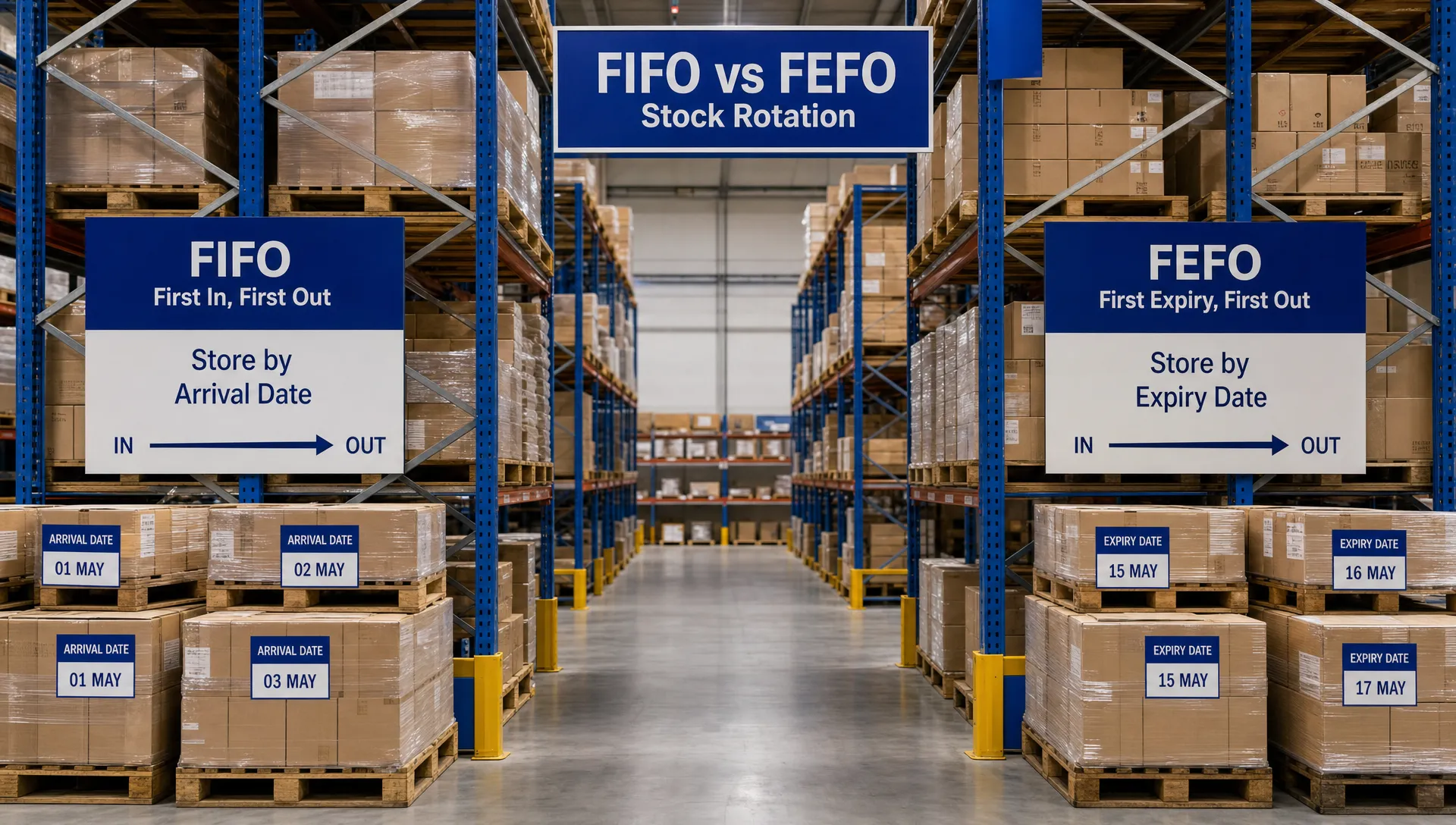
FIFO stands for first in, first out. The oldest stock received into the warehouse is picked or dispatched before newer stock. If 10 pallets arrive on Monday and another 10 arrive on Friday, the Monday stock should leave first.
This is a good default for many product categories because it helps stop older stock sitting at the back of the warehouse. It is especially useful where products do not have strict expiry dates, but age still matters for packaging quality, version control, warranty periods or presentation. At this level, the fifo vs fefo comparison is about whether arrival date or product life should control the next pick.
What FEFO means
FEFO stands for first expired, first out. The stock with the earliest expiry date, use-by date, best-before date or shelf-life deadline is picked first, regardless of when it arrived.
That distinction matters. A newer delivery might contain stock with a shorter date than an older delivery, especially if suppliers send mixed batches or products come from different manufacturing runs. Under FIFO, the older delivery would be picked first. Under FEFO, the shorter-dated goods move first.
For food and drink, health products, cosmetics and some chemical or industrial products, FEFO is often safer because product life is the key constraint. The Food Standards Agency explains the difference between best-before and use-by dates, with use-by dates linked to safety and best-before dates linked to quality.
How the choice affects your warehouse operation
In practice, fifo vs fefo affects much more than which pallet the picker chooses first. It changes how stock is booked in, labelled, located, checked and released for dispatch. If the process is not clear, teams tend to rely on memory or visual checks, which becomes risky as order volume grows.
| Factor | FIFO | FEFO |
|---|---|---|
| Picking rule | Oldest received stock leaves first | Earliest expiry or shelf-life date leaves first |
| Best suited to | Non-perishable goods, packaging, hardware, apparel, printed items | Food, drink, supplements, cosmetics, healthcare products, dated FMCG |
| Main data needed | Goods-in date, batch or receipt reference | Expiry date, best-before date, batch or lot code |
| Main risk if managed badly | Old stock gets buried and becomes obsolete | Short-dated stock expires before it is sold |
| Warehouse impact | Needs clear location control and stock access | Needs stronger date capture, system rules and pick checks |
Neither method is automatically better. The right choice depends on what makes stock lose value in your business. If time in storage is the issue, FIFO may be enough. If product dates drive saleability, FEFO is usually the better fit.
When FIFO is the better fit
FIFO is often the right choice when your products are not perishable but should still move in a fair, controlled order. Many product businesses use it because it is simple, practical and easy to understand across warehouse teams.
On a practical level, the fifo vs fefo decision often starts with how predictable your product life is. If every unit has a long and consistent life, and there is no major difference between one batch and another, FIFO gives you a sensible way to stop stock ageing in storage.
FIFO can be a good fit for products such as homeware, clothing, furniture components, printed marketing materials, electronics accessories and non-dated spare parts. It can also work well for packaging stock, where older cartons, inserts or labels should be used before newer versions are opened.
The biggest advantage is simplicity. Goods-in teams record when stock arrives, the warehouse stores it in a way that gives access to older stock and pickers follow the sequence. This reduces the chance of forgotten pallets, especially when stock is stored in racking or bulk locations.
FIFO is not foolproof, though. It needs accurate booking-in, clear location control and sensible warehouse layout. If newer pallets are placed in front of older pallets and nobody records the change, the process breaks down quickly.
When FEFO is the better fit
FEFO is the better method when the date on the product matters more than the date it arrived. That includes products with use-by dates, best-before dates, expiry dates, shelf-life requirements or customer rules around minimum remaining life.
The fifo vs fefo question becomes more urgent when stock can become unsellable while it is still physically sitting in the warehouse. If a retailer refuses goods with less than a certain number of days of life remaining, the product might be technically in date but commercially unusable for that route.
FEFO is common for FMCG, food and drink, pet products, supplements, cosmetics, cleaning products, medical consumables and other batch-controlled goods. It helps reduce waste by pushing shorter-dated stock out first, while still allowing newer stock to be held for later demand.
This method depends on better data. Your warehouse needs to capture the expiry or best-before date at goods-in, link it to the correct batch or lot and make that information visible when orders are allocated. Manual spreadsheets can work at very low volume, but they become fragile when SKUs, channels and daily order numbers increase.
FEFO also needs commercial rules. For example, you may need to block stock that has less than a defined number of days remaining, reserve longer-dated stock for wholesale customers or choose different date rules for D2C and retail orders.
Can your business use both methods?
Many product businesses do not need a single fifo vs fefo answer across every SKU. A mixed model is often more realistic. One product range may only need FIFO, while another range needs FEFO because it carries shelf-life dates.
For example, a drinks brand might use FEFO for finished bottles and FIFO for point of sale materials. A cosmetics brand might use FEFO for dated products and FIFO for empty gift boxes, mailer packaging or display units. A manufacturer might use FIFO for components but FEFO for adhesives, coatings or other dated materials.
The key is not to leave the choice to individual pickers. The stock rotation rule should be set by SKU or product category, then reflected in the warehouse management system, storage layout and picking instructions.
If you store stock with a third-party logistics provider, ask how they manage different rotation rules for different products. A capable provider should be able to explain how dates, batch codes and stock movements are recorded, not just say that stock is rotated.
How to set up the right stock rotation process
Choosing the method is only the first step. The real work is making it reliable every day, including busy periods, staff changes, promotions, container arrivals and peaks in order volume.
Capture the right data at goods-in
A good fifo vs fefo process starts when stock enters the warehouse. If your team does not capture the right information at goods-in, the picking team cannot fix it later without wasting time.
For FIFO, that usually means recording the delivery date, SKU, quantity, pallet ID, batch reference if relevant and storage location. For FEFO, you also need expiry dates, best-before dates, use-by dates or customer-specific shelf-life information.
This is where a warehouse management system becomes important. Gus Logistics offers pallet and bulk warehousing with real-time WMS tracking, including batch, serial number and best-before date tracking where required. That gives businesses better visibility than relying on handwritten notes or disconnected spreadsheets.
Design locations around the rotation rule
The fifo vs fefo rule has to work in the physical warehouse, not just in the system. If older or shorter-dated stock is difficult to reach, pickers may be tempted to take the closest pallet instead.
For FIFO, racking, lanes and replenishment areas should make older stock easier to access first. For FEFO, locations should support date-based picking and make it clear when stock from different batches is stored near each other.
Bulk storage needs particular care because pallets can be blocked by other pallets if the layout is not planned properly. Racked storage can make individual pallet access easier, but it still needs accurate location scanning and disciplined put-away.
The right storage format depends on SKU count, pallet movement, access frequency and whether you need batch separation. If your current setup is creating avoidable handling, it may be worth reviewing both your rotation method and your storage layout together.
Make picking checks simple
A stock rotation policy should be easy for pickers to follow. If the instruction is buried in a spreadsheet or depends on one experienced person knowing where everything is, the process is too fragile.
For order picking, the system should direct the picker to the right location and the right batch or date. Labels should be clear, stock should be physically separated where needed and exceptions should be easy to flag before an order leaves the building.
For eCommerce brands, this matters because stock rotation connects directly to customer experience. If customers receive short-dated stock without warning, damaged older packaging or inconsistent batches, your customer service team will feel the impact. For businesses that need outsourced pick and pack, Gus Logistics provides order fulfilment support for eCommerce and product brands with integrations across major selling platforms.
Common mistakes to avoid
Most fifo vs fefo problems are not caused by choosing the wrong term. They are caused by weak processes around goods-in, storage and order allocation.
Common issues include:
- Treating all SKUs the same when only some need date-based rotation
- Recording expiry dates on paperwork but not in the warehouse system
- Allowing mixed batches in one location without clear identification
- Picking from the easiest location instead of the correct rotation sequence
- Failing to set rules for short-dated stock before it becomes a problem
Another common mistake is assuming that FEFO always replaces FIFO. It does not. FEFO uses expiry or shelf-life date as the priority, but you may still need FIFO logic within the same date band. If two batches share the same expiry date, the older received batch may be the sensible one to use first.
It is also worth reviewing how returns are handled. Returned stock should not automatically go back into available inventory without checks. Depending on the product, it may need inspection, date verification, batch confirmation, repacking or quarantine before resale.
How a 3PL can help with stock rotation
If fifo vs fefo is becoming hard to manage in-house, it may be a sign that your stock control has outgrown your space, systems or team capacity. That does not always mean outsourcing everything at once. It may mean moving warehousing, fulfilment or transport to a partner that already has the processes in place.
Gus Logistics is a family-run 3PL provider based in Nantwich, Cheshire, supporting eCommerce brands, manufacturers and product businesses across the UK. For stock rotation, the useful part is not just warehouse space. It is the combination of controlled storage, WMS visibility, order picking, returns handling and transport under one operation.
For businesses shipping time-sensitive stock, transport also matters. A good rotation process can still fail commercially if dispatch is unreliable or goods miss delivery windows. Gus Logistics provides same-day and next-day transport services using its own fleet, with access to additional vehicles across the UK and Europe when needed.
Because there are no minimum volume requirements, growing SMEs can get support before logistics becomes unmanageable. That can be especially useful when stock rotation, batch control or warehouse space is starting to distract from sales and product development.
Frequently asked questions
Is FIFO or FEFO better for eCommerce fulfilment? It depends on the product. FIFO often works for non-perishable eCommerce goods, while FEFO is usually better for dated products such as supplements, cosmetics, food, drink or pet products.
Can FEFO be used for products without expiry dates? Usually, FEFO is only useful when there is a meaningful date to manage. If the product has no shelf-life date, FIFO is normally simpler and more practical.
What information does a warehouse need for FEFO? The warehouse needs accurate SKU details, batch or lot numbers, expiry dates or best-before dates, quantities and storage locations. Without this data, FEFO becomes difficult to control reliably.
Does FIFO prevent obsolete stock? FIFO helps reduce the risk of older stock being forgotten, but it does not solve every obsolescence issue. Slow-moving products, packaging changes, seasonal demand and customer-specific rules still need active stock management.
Need help choosing the right stock rotation method?
The right stock rotation method should make your operation easier, not more complicated. If your business needs clearer warehouse control, better date tracking or a 3PL partner that can support storage, fulfilment and transport, Gus Logistics can help.
Call 01270 335014 to discuss your stock rotation and warehousing needs, or get in touch via the contact page to request a quote.
Looking for a Logistics Partner You Can Trust?
From warehousing and order fulfilment to transport and FSDU design - Gus Logistics handles it all from our base in Nantwich, Cheshire. Over 10 years experience, no minimum volumes, no long contracts.
