
How Can I Get Products Relabelled Before They Go on Sale?
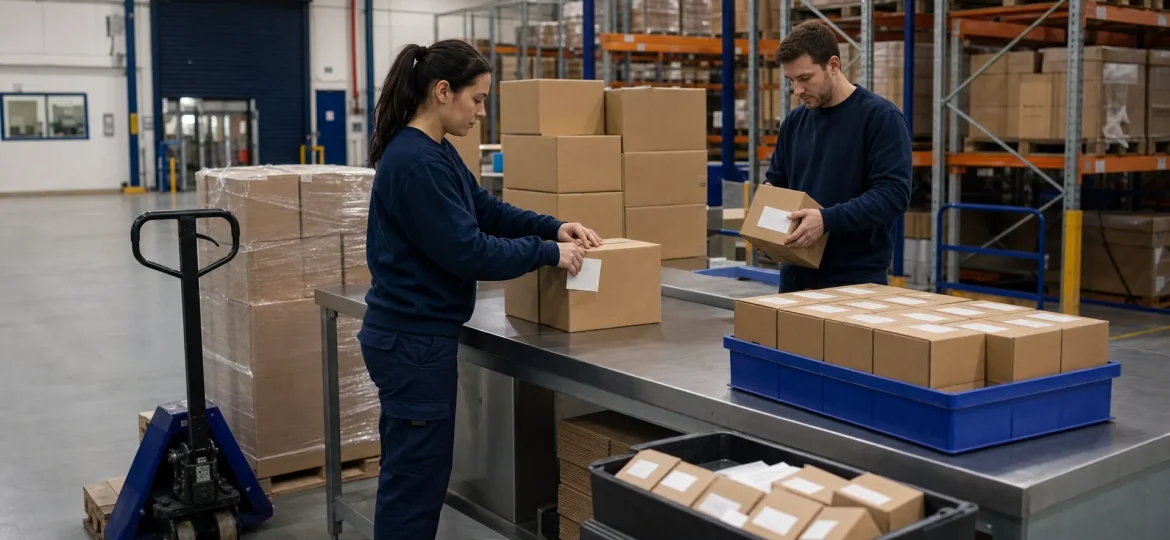
Incorrect labels can stop otherwise saleable stock from reaching customers. If you are comparing product relabelling services UK-wide, the usual route is to use a contract packing provider that can receive the goods, apply approved replacement labels and prepare the stock for its next destination.
The practical task is only part of the job. Before anything moves, agree what needs changing, who approves the label content and how the affected products will stay off sale until checks are complete. That prevents a straightforward correction from becoming a second round of rework.
Can existing products be relabelled?
Often, yes. Relabelling may be suitable when packaging carries an outdated address, an incorrect barcode, old branding or information that needs adapting for a different sales market. It can also help when a retailer requires a particular product identification label.
The first decision is whether to apply a label over the existing information, remove the old label or replace the packaging altogether. An overlabel may be the simplest option, but only if it stays attached, hides any conflicting information and leaves the rest of the pack usable.
Relabelling does not make an unsafe or unsuitable product fit for sale. It is a packaging correction, not a substitute for checking the product itself. Damaged goods, uncertain batch identity or unresolved safety issues need separate investigation before stock is released.
Choosing product relabelling services UK businesses can use
Choose a provider around the work your products actually need. Applying one sticker to a flat cardboard box is different from removing adhesive from glass, opening sealed cartons or matching different labels to several similar product variants.
Ask whether the provider can handle your packaging material, separate affected stock and follow a documented approval process. Establish who supplies the labels and whether printing, old-label removal, repacking and final checks are included in the proposed scope.
Send photographs of the current pack alongside the proposed artwork. A physical sample is useful where surface finish, curves or limited label space could affect the result.
Confirm the legal requirements before approving artwork
Your business should establish the correct wording and obtain any necessary specialist approval before instructing the packing team. Asking an operator to copy a supplied design is not the same as asking them to assess its legal compliance.
The government's product labelling guidance is a useful starting point. Food businesses should also check the separate food labelling and packaging requirements. Other categories, including cosmetics, toys and electrical goods, have their own requirements. Great Britain and Northern Ireland can also require different treatment.
Destination matters too. Homeware sold through British shops should not automatically use the same artwork as goods supplied to furnish manufactured homes in San Antonio. Identify the sales market before approving language, business details or compliance markings.
When assessing product relabelling services UK-wide, distinguish between a contractor applying approved information and a specialist advising you on what that information must contain.
Prepare a written brief for each affected product
The most useful brief describes the finished pack precisely. Avoid instructions such as “replace the barcode” without identifying the existing code, the approved replacement and its position.
Include the following information in a simple job sheet:
| Detail | What to specify |
|---|---|
| Affected stock | Product codes, quantities, batches and current location |
| Required change | Exactly which information must be removed, covered or added |
| Approved artwork | File version, dimensions and person authorised to approve it |
| Label position | Photograph or marked-up pack showing placement |
| Packaging handling | Whether cartons or individual packs need opening and resealing |
| Final destination | Storage, customer orders, retailer delivery or another warehouse |
| Release instruction | Who can authorise the completed stock to go on sale |
Separate instructions by product variant. If two products look almost identical but need different labels, include an identification method that does not rely solely on colour or appearance.
A clear specification makes quotes for product relabelling services UK providers offer easier to compare. It also reduces the risk of one quote covering label application while another includes printing, repacking and checks.
Test the label and approve a finished sample
Approve a physical example before the full run starts, particularly when changing label material, size or position. A digital proof confirms the artwork, but it cannot show whether adhesive sticks properly to your packaging.
Check the sample on the actual surface. Glossy cartons, flexible pouches, curved containers and products stored in chilled conditions can present different challenges. The label should remain legible and attached under the conditions the product will encounter.
For barcodes, check both readability and meaning. A successful scan is not enough if the code identifies the wrong size, flavour or pack quantity. Test it against the intended product record and confirm any retailer-specific requirements. Where a retailer requires formal barcode verification, a basic scanner check is not a substitute.
Existing barcodes also need attention. If the old code must no longer be used, make sure it cannot be picked up accidentally through or beside the replacement label.
Before approving product relabelling services UK-wide, agree what counts as an acceptable finished pack and record the approved sample. Keep mandatory information, batch details and date codes visible wherever required. Do not use relabelling to disguise expired stock or alter dates without a valid, authorised basis.
Keep affected stock on hold until checks are complete
Stock awaiting correction should be clearly separated from stock available for sale. Use both physical identification and the relevant stock-system status so that an order picker cannot dispatch an uncorrected unit by mistake.
Record what arrived, what was processed and what could not be completed. Damaged packaging, missing units and unidentified batches should appear as exceptions rather than disappearing into an adjusted total.
For multi-product jobs, agree how operators will prevent labels or stock from being mixed between runs. That might involve clearing the work area before changing products and checking the next label against its job sheet.
Ask product relabelling services UK providers to explain their checking process, including how often checks occur and how errors are handled. The appropriate level of checking depends on the product, the risk and any customer requirements.
Finally, distinguish product labels from transport labels. A corrected retail pack may still need new outer-carton identification or pallet paperwork. This guide to pallet labels, carton labels and SSCC codes explains how those different identification levels fit together.
What affects relabelling costs and turnaround?
Quantity matters, but handling time often determines how much work is involved. A small batch needing careful label removal and individual resealing may require more labour per unit than a larger batch of accessible cartons.
The main cost factors are the number of labels per product, packaging type, label supply, access to each unit and the checks required. Inbound transport, storage, waste disposal and onward delivery may also need to be priced separately.
When comparing product relabelling services UK-wide, ask for the same scope from every supplier. A low application price is not a useful comparison if another quote includes receiving the stock, opening cartons, printing labels and preparing the finished goods for dispatch.
Turnaround should be agreed against the complete job, not just the time spent applying labels. The provider may need to receive and count stock, wait for artwork approval, source suitable label material and obtain your approval of a sample.
Give the supplier your required delivery date, not only the date you hope relabelling will finish. Allow time for final checks and transport. Ask when the completion estimate becomes firm and what happens if unexpected packaging problems are discovered.
Arrange storage and onward delivery before the work starts
Decide where completed stock should go before sending it for correction. Otherwise, a successful relabelling job can still leave goods waiting for delivery instructions or a retailer booking.
If stock needs to wait for artwork, approval or a scheduled launch, arrange suitable warehouse storage alongside the work. Confirm whether completed and unfinished quantities will be reported separately and when the saleable stock balance will be updated.
For businesses choosing product relabelling services UK-wide, keeping packing, storage and transport coordinated can reduce unnecessary stock movements. It also gives you a clearer handover from goods awaiting correction to goods ready for release.
Gus Logistics provides contract packing in Cheshire, with co-packing services including repacking and POS assembly. Share your proposed relabelling specification with the team so they can confirm the work required, handling arrangements and any associated storage or transport.
Based in Nantwich, Gus Logistics is family-run, has no minimum volume requirements and usually turns quotes around the same working day. A quotation response is separate from the production lead time, which needs to be agreed for your particular job.
Frequently asked questions
Can a replacement label go over the original label? Often, but the finished pack must remain suitable for sale. The replacement needs to adhere properly, prevent conflicting information from showing and avoid obscuring information that must remain visible. Check any product-specific and retailer requirements before approving it.
Do I need to supply the labels? Agree this when requesting a quote. You might supply finished labels or ask whether the contractor can arrange printing from approved artwork. Confirm responsibility for dimensions, material, adhesive and print quality before placing the order.
Can only part of a delivery be relabelled? Yes, provided the affected stock can be identified reliably. Specify the relevant product codes, batches or quantities and keep unaffected goods separate. If the stock cannot be distinguished confidently, investigate before processing it.
How quickly can the work be completed? There is no reliable standard turnaround for product relabelling services UK-wide. Timing depends on quantity, packaging, label availability, approvals and the provider's capacity. Supply a complete brief and ask for a schedule covering receipt, sample approval, processing and dispatch.
Who signs off the corrected products? Name an authorised person in your business to approve the artwork and release instructions. The contractor should follow the agreed specification and report exceptions, but you should not assume that outsourcing application also outsources your product compliance obligations.
Discuss your relabelling requirements
Prepare your product list, quantities, photographs, proposed artwork and required delivery date. These give a packing provider the information needed to assess the job properly.
To discuss relabelling, contract packing, storage or onward delivery with Gus Logistics, call 01270 335014.
Looking for a Logistics Partner You Can Trust?
From warehousing and order fulfilment to transport and FSDU design - Gus Logistics handles it all from our base in Nantwich, Cheshire. Over 10 years experience, no minimum volumes, no long contracts.
