
How Much Does an FSDU Cost and What Affects the Price?
If you are planning a retail promotion, one of the first questions is usually simple: how much does an FSDU cost?
The honest answer is that a free standing display unit does not have one fixed price. A small cardboard display for a short campaign will cost far less than a large, fully printed, pre-filled unit designed for a national retail rollout. The unit itself is only part of the cost too. Design, materials, print, assembly, stock handling, storage and delivery can all affect the final figure.
If you are still clarifying the basics, our guide to what a free standing display unit is explains the main formats and where they are used. This article focuses on pricing, what drives it, and how to get a clearer quote before you commit budget.
Quick answer: what should you budget for an FSDU?
As a planning guide, many FSDU projects sit anywhere from the low hundreds for simple promotional units to much higher figures for complex, permanent or semi-permanent displays. The exact cost depends on the specification, quantity and how much of the process you want handled for you.
The table below gives broad indicative cost bands only. They are not fixed quotes, and they usually exclude product stock, VAT, retailer charges and any unusual compliance requirements.
| FSDU type | Indicative planning range per unit | Typical use | Main cost drivers |
|---|---|---|---|
| Simple cardboard promotional unit | £40 to £150+ | Short promotions, impulse products, seasonal campaigns | Size, print coverage, quantity and assembly method |
| Larger corrugated display unit | £150 to £400+ | Multi-SKU displays, launch campaigns, supermarket promotions | Structural strength, shelf count, product weight and artwork |
| Semi-permanent display | £400 to £1,000+ | Longer campaigns, higher value products, repeat use | Stronger materials, finish, durability and transport protection |
| Permanent custom display | £1,000+ | Long-term retail presence, premium product ranges | Bespoke design, materials, lighting or specialist components |
The biggest mistake is to ask for the cheapest possible unit without looking at the full campaign cost. A low-cost display that is hard to assemble, arrives damaged, fails retailer requirements or cannot hold your product safely may cost more overall than a better specified display.
What is included in an FSDU quote?
An FSDU quote may include only the unit manufacture, or it may include the full process from design through to pre-fill and delivery. This is why two suppliers can appear to give very different prices for what sounds like the same job.
A clear quote should explain what is included and what is not. In most cases, the following elements are worth checking:
| Cost element | What it covers | Why it affects the price |
|---|---|---|
| Structural design | The shape, footprint, shelving and load-bearing structure | More complex or heavier displays need more design and stronger materials |
| Artwork and print | Graphic design, print setup, colour matching and finishing | Full coverage, premium finishes and multiple versions increase cost |
| Prototype or sample | A trial unit before production | Useful for retailer approval, but adds time and cost |
| Manufacturing | Cutting, printing, gluing, folding and finishing | Quantity, material choice and complexity affect unit price |
| Assembly and pre-fill | Building the unit and loading it with product | Saves retailer time, but requires labour, space and quality checks |
| Storage | Holding stock or finished units before dispatch | Campaign timing and volume affect storage needs |
| Delivery | Transport to retailers, depots or stores | Cost depends on locations, deadlines, vehicle type and booking requirements |
Before comparing prices, make sure you are comparing the same scope. A quote for flat-packed units delivered to your premises is not the same as a quote for designed, manufactured, pre-filled and dispatched displays.
The main factors that affect FSDU cost
1. Size and footprint
The larger the unit, the more material it needs. But size is not just about height and width. The footprint matters because retailers often have strict floor-space rules. A display that fits a standard store footprint may be easier and cheaper to approve than an unusual shape.
Bigger units may also need stronger shelves, reinforced side panels and more protective packaging for transport. If your display is intended for high-footfall areas, it must be stable and robust enough to handle real store conditions.
2. Material choice
Cardboard and corrugated board are common for short-term campaigns because they are lightweight, printable and cost-effective. Semi-permanent displays may use stronger board, plastic, metal, wood or a mix of materials.
Material choice affects more than the unit price. It can influence print quality, durability, recyclability, transport cost and how much protection the display needs in transit. If sustainability is part of your retail brief, material selection may need more consideration early in the process.
3. Quantity ordered
FSDUs usually become more cost-effective per unit when ordered in higher volumes, because setup, design and print preparation are spread across more units. A one-off sample or very small run can look expensive because many of the same setup steps still apply.
That said, ordering too many units can create storage costs and waste. The best quantity is not always the largest quantity. It is the quantity that matches confirmed retail locations, campaign timing and stock availability.
4. Print quality and finish
A basic printed unit will normally cost less than one with premium finishes. Extra finishes can include special coatings, metallic effects, high-gloss areas or complex cut-outs. These may be worthwhile for premium products, gifting campaigns or competitive retail spaces, but they should have a clear purpose.
For many brands, the smartest approach is to spend where shoppers will notice it most. Strong front-facing graphics, clear product messaging and good colour consistency often matter more than expensive finishes on areas customers rarely see.
5. Product weight and shelf loading
A display holding lightweight snack packs has different requirements from one holding bottled drinks, jars, tools or boxed electrical products. The heavier the product, the more important structural strength becomes.
Weight also affects packing, palletisation and transport. Pre-filled units carrying heavy stock may need stronger outer packaging, different handling methods or specific delivery vehicles. If you underestimate product weight, the display may fail during assembly, transport or in-store use.
6. Assembly and pre-fill requirements
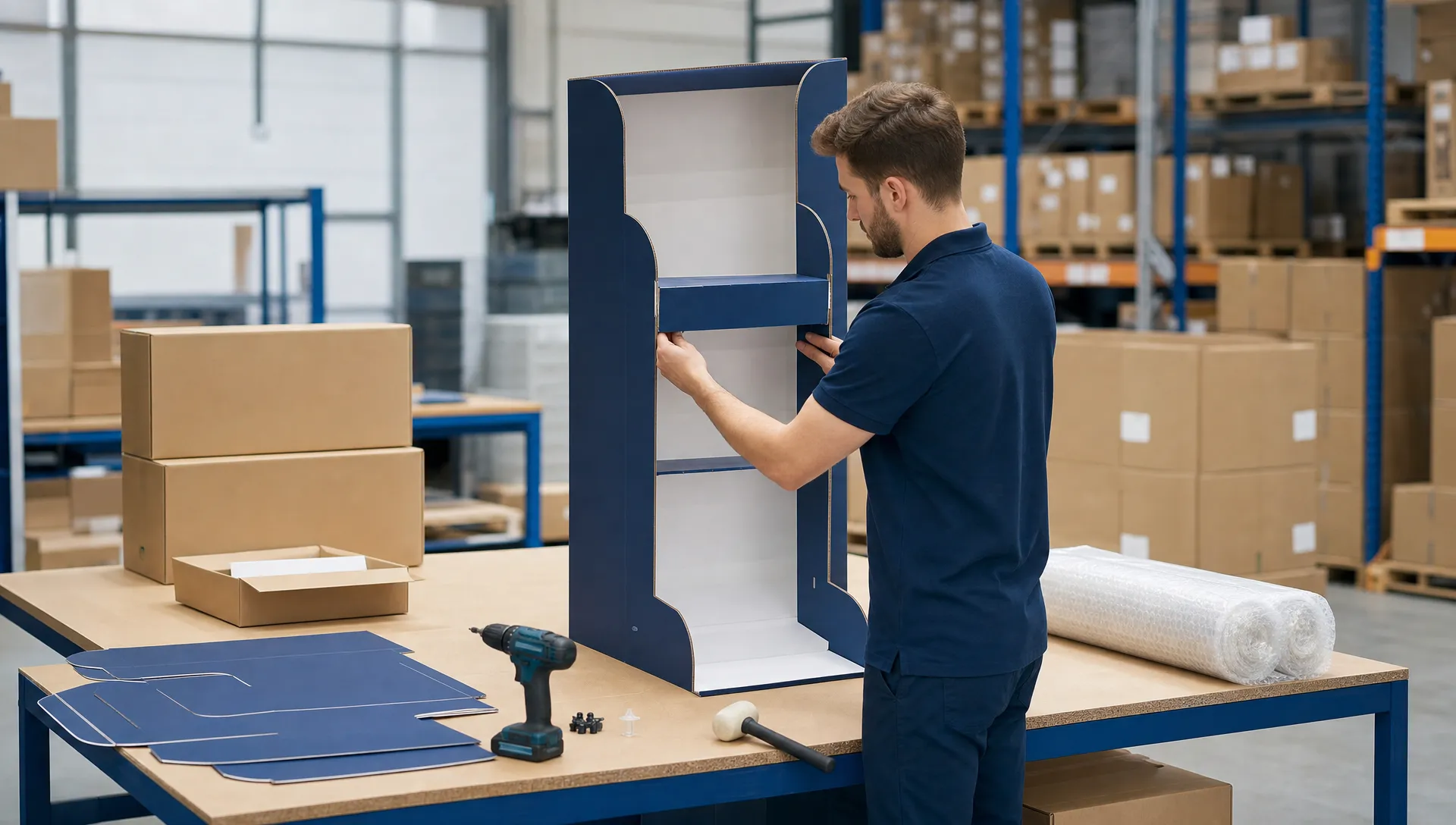
Some FSDUs are sent flat-packed for stores or field teams to assemble. Others are built and filled before they leave the warehouse. Pre-filling usually adds cost, but it can reduce hassle for retailers and improve consistency across stores.
With pre-fill, products can be placed exactly as planned, checked before dispatch and sent out ready for store teams to position. For busy retail campaigns, especially where deadlines are tight, this can be worth the added handling cost.
Gus Logistics provides an end-to-end FSDU design, manufacture, pre-fill and dispatch service for brands that want one partner to manage the practical steps rather than coordinating multiple suppliers.
7. Retailer requirements and approvals
Retailers may specify maximum dimensions, safe loading limits, packaging standards, delivery booking rules and artwork requirements. These details can affect design and cost from the start.
If your campaign crosses borders, involves regulated products or uses licensed artwork, it is sensible to involve the right advisers early. Contracts, intellectual property and compliance requirements can vary significantly between markets, so it is worth getting proper legal or regulatory guidance before a retail campaign goes live.
The more information you can provide about retailer requirements at the quote stage, the less chance there is of redesign work later.
8. Storage and delivery
FSDU costs can rise if finished units need to be stored for weeks before the launch date, delivered to many locations or dispatched in tight delivery windows. Transport is especially important for pre-filled units, because the display must arrive in good condition as well as on time.
If the same partner handles storage and movement, it can be easier to coordinate stock, finished displays and delivery bookings. Gus Logistics supports retail campaigns with transport and delivery services across the UK, using its own fleet and wider vehicle network where needed.
Flat-packed or pre-filled: which is more cost-effective?
Flat-packed FSDUs can be cheaper to ship because they take up less space. They may suit smaller campaigns, simple units or situations where the retailer is happy to assemble and fill the display in-store.
Pre-filled FSDUs usually cost more upfront because they need assembly, product loading, checking and careful packing. However, they can reduce store workload and help make sure every display looks the same when it arrives.
The right choice depends on three questions. Who will assemble the unit? Who is responsible if the display is set up incorrectly? How important is launch-date consistency across stores?
For a small campaign with a simple unit, flat-packed may be perfectly sensible. For a time-sensitive product launch across multiple retail locations, pre-fill and controlled dispatch may provide better value overall.
How to reduce FSDU costs without weakening the campaign
Cutting cost does not have to mean weakening the display. The aim is to remove waste, not remove what makes the display effective.
- Confirm retailer specifications before design starts so you do not pay for redesigns.
- Use a standard footprint where possible to simplify approval and production.
- Design the display around real product dimensions, case sizes and weights.
- Keep premium print finishes for high-impact areas shoppers will actually see.
- Avoid unnecessary custom shapes unless they clearly improve visibility or sales impact.
- Plan storage and delivery early, especially for seasonal or date-sensitive campaigns.
It is also worth thinking beyond the unit price. A slightly more expensive display that is quicker to assemble, easier to replenish and less likely to be damaged can be the better commercial choice.
What information should you provide for an accurate FSDU quote?
The more detail you provide, the faster and more accurate your quote will be. If you only ask for a price for an FSDU without giving product, quantity or retailer details, any answer will be a rough estimate.
Before speaking to a supplier, try to gather the following:
- Product dimensions and weight.
- Number of products or SKUs per display.
- Expected number of display units.
- Retailer or store specifications.
- Whether the units need to be flat-packed or pre-filled.
- Artwork status, such as supplied, needs adapting or needs creating.
- Required delivery date and campaign launch date.
- Delivery points, such as one depot, multiple depots or individual stores.
- Any storage, co-packing or stock handling requirements.
If you are comparing several options, ask each supplier to break the quote down in the same way. That makes it much easier to see whether one quote is genuinely cheaper or simply missing important services.
When is an FSDU worth the investment?
An FSDU is usually worth considering when your product needs more visibility than a standard shelf position can provide. That might be a new launch, a seasonal promotion, a multi-buy offer, a limited edition or a product range that benefits from being grouped together.
The unit needs to justify its cost through better visibility, stronger presentation and easier shopping. If your product is low margin, the display must be simple and cost-controlled. If your product has a higher margin or needs premium positioning, a stronger design and better finish may be worthwhile.
If you are comparing display formats, it can also help to review how FSDUs sit alongside wider point of sale displays such as counter units, shelf trays and other in-store promotional materials.
How Gus Logistics helps brands manage FSDU costs
The most expensive FSDU projects are often the ones with too many disconnected moving parts. One supplier designs the unit, another manufactures it, another stores the product, another fills it, and another arranges transport. Every handover adds room for delay, confusion and extra cost.
Gus Logistics is a family-run 3PL provider based in Nantwich, Cheshire, with over 10 years of experience supporting product businesses across the UK. For FSDU campaigns, the team can support design, manufacture, pre-fill and dispatch, helping brands manage the process from concept to store delivery.
Because Gus Logistics also provides warehousing, co-packing and transport, it can be particularly useful for brands that need practical help as well as the display unit itself. You are not dealing with a call centre. You speak directly to the people handling the work, which makes it easier to clarify timings, stock handling and delivery requirements.
Frequently Asked Questions
What is the average cost of an FSDU? A simple cardboard FSDU may start from the low tens to low hundreds per unit at suitable volumes, while larger or more durable displays can cost several hundred pounds or more. The final price depends on size, materials, print, quantity, assembly, pre-fill, storage and delivery.
Why do FSDU prices vary so much? Prices vary because an FSDU can be anything from a simple short-term cardboard unit to a fully bespoke, semi-permanent retail display. The more complex the structure, print, material and logistics requirements, the higher the cost is likely to be.
Is a cardboard FSDU always the cheapest option? Cardboard is often the most cost-effective material for short campaigns, but it is not always the best choice. Heavy products, long campaigns or premium retail environments may need stronger materials or a more durable structure.
Does pre-filling an FSDU add much cost? Pre-filling adds handling, assembly and quality checking costs, but it can save time in-store and help ensure displays are set up consistently. For larger retail rollouts, it may be better value than sending empty units and relying on store teams to build and fill them.
How can I get a more accurate FSDU quote? Provide product dimensions, product weight, quantity, retailer requirements, artwork details, delivery locations and launch deadlines. The clearer the brief, the easier it is to produce a useful price rather than a broad estimate.
Get a clear FSDU cost for your campaign
If you are planning a retail display campaign and want a practical quote for design, manufacture, pre-fill, storage or dispatch, speak to Gus Logistics. Call 01270 335014 or get in touch via the contact page to discuss your FSDU requirements.
Looking for a Logistics Partner You Can Trust?
From warehousing and order fulfilment to transport and FSDU design - Gus Logistics handles it all from our base in Nantwich, Cheshire. Over 10 years experience, no minimum volumes, no long contracts.
