
How to Fix a Broken Returns Process
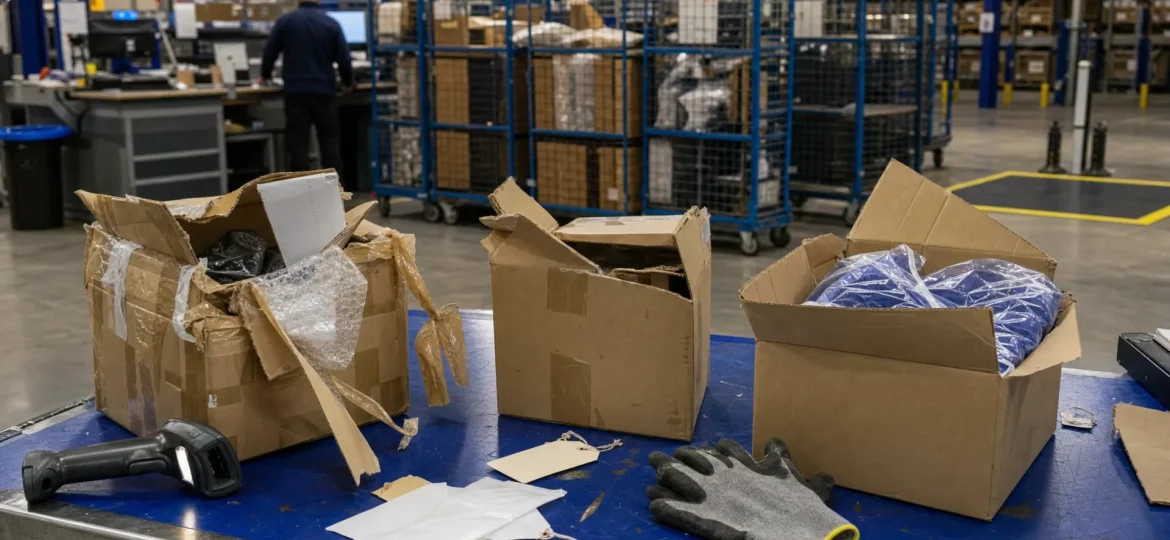
A broken returns process rarely fails in one obvious place. It usually breaks in the gaps between customer service, the warehouse, finance and your sales channels. A parcel comes back without a clear reason. The customer asks for a refund before the item has been inspected. Stock sits in a returns pile for days. Someone updates Shopify but not the warehouse system. The result is slow refunds, inaccurate stock and frustrated customers.
If you want to fix a broken returns process, do not start by buying another tool or rewriting your returns policy in isolation. Start by making the physical and digital journey of every returned item clear, owned and measurable.
This guide walks through the practical steps to rebuild your returns process so your team can handle returns quickly, protect margin and get sellable stock back into circulation.
What a broken returns process looks like
Most businesses know their returns process is struggling before they can prove it with data. The signs show up in customer emails, warehouse delays and stock figures that never quite match reality.
Common symptoms include customers chasing refunds, returned stock being left unprocessed, items going missing after delivery back to the warehouse, unclear decisions about what can be resold and teams disagreeing about who is responsible for each stage.
A broken process is not always caused by poor people or lack of effort. Often, it is caused by unclear handovers. Customer service may approve the return, but the warehouse may not know what to expect. The warehouse may inspect the goods, but finance may not know whether to refund. Stock may be physically back in the building, but not available for sale online.
| Symptom | Likely cause | Business impact |
|---|---|---|
| Customers chasing refunds | No clear refund trigger or service level | More support tickets and lower trust |
| Stock stuck in a returns area | No inspection routine or owner | Sellable goods stay off sale |
| Refunds issued for damaged goods | Poor condition checks | Margin loss and weak accountability |
| Returned items missing from stock | Systems not updated after inspection | Overselling or stock write-offs |
| Repeat returns for the same reason | Return reasons not tracked | The root cause is never fixed |
If you need a broader overview of the stages involved, Gus Logistics has a separate guide explaining what returns management is and how it fits into a wider logistics operation.
Map the return journey before you change anything
Before changing your portal, courier or warehouse layout, write down the current journey of a returned item from the customer’s first request to final outcome.
The aim is not to create a polished flowchart for a meeting. The aim is to expose the unclear points where work gets delayed or duplicated. Ask your customer service team, warehouse team and finance team to describe what actually happens, not what the policy says should happen.
A useful returns map should answer these questions:
- How does the customer request a return?
- Who approves or rejects the request?
- Does the customer receive a return reference?
- Where is the return sent?
- How is the parcel identified when it arrives?
- Who inspects the item?
- What condition grades are used?
- Who decides whether to refund, replace, repair, restock or dispose?
- Which system is updated and when?
- How quickly is the customer told the outcome?
Once this is written down, highlight every stage where there is no clear owner. These are usually the points that create delays. A process cannot be reliable if everyone assumes someone else has picked up the next step.
Give every return a reference and a reason code
Returns become hard to manage when they arrive as anonymous parcels. Even if the customer has included paperwork, the warehouse should not have to play detective before it can process the item.
Every return should have a unique return reference. This may come from your eCommerce platform, your helpdesk, your returns portal or your warehouse management system. The format matters less than the discipline of using it every time.
Alongside the reference, every return should be given a reason code. Do not rely only on free-text notes such as “not suitable” or “customer changed mind”. They are difficult to analyse and inconsistent across teams.
Reason codes should be simple enough for your team to use but specific enough to reveal patterns. For example, “wrong item sent” should not sit in the same bucket as “customer ordered wrong size”. One points to a fulfilment issue. The other may point to product information, sizing guidance or customer choice.
| Return reason | What it may indicate | Follow-up action |
|---|---|---|
| Wrong item received | Picking, labelling or SKU issue | Check fulfilment accuracy and SKU setup |
| Arrived damaged | Packaging or carrier issue | Review packaging and delivery method |
| Not as described | Product page issue | Improve images, descriptions or specifications |
| Ordered wrong size | Sizing guidance issue | Add clearer size information |
| Customer changed mind | Normal trading return | Process according to policy |
| Faulty item | Product or supplier issue | Quarantine and review with supplier |
Reason codes only work if they are used consistently. Keep the list short at first. You can always refine it later once your team has built the habit.
Separate approval from inspection
One of the most common returns mistakes is treating customer approval and warehouse inspection as the same thing. They are different stages.
Approval means the customer is allowed to send the item back under your returns policy or legal obligations. Inspection means the item has arrived and has been checked against your condition rules.
This distinction protects both the customer experience and your margin. A customer may be approved to return an item, but the final refund decision may depend on whether the product is complete, unused, damaged, faulty or outside the expected condition.
For UK consumer sales, your policy also needs to sit within consumer law. The GOV.UK guidance on accepting returns and giving refunds is a useful reference, although you should take proper legal advice if your policy is complex or sector-specific.
Operationally, the key point is simple: do not leave your warehouse team guessing. Give them clear condition rules so they know what action to take when an item is received.
Create simple condition grades
Returned stock should not have only two possible outcomes: refund or reject. In real operations, products often sit somewhere in between. Some can go straight back into stock. Some need repacking. Some need quarantine. Some need supplier review.
A condition grading system helps your team make consistent decisions. It also gives finance and customer service a clearer basis for refunds, replacements and customer updates.
| Grade | Condition | Typical action |
|---|---|---|
| A | Unused, complete and packaging suitable for resale | Restock as sellable |
| B | Product unused but packaging damaged or missing | Repack, relabel or sell through agreed channel |
| C | Opened, incomplete or needs further check | Quarantine for review |
| D | Damaged, faulty or not suitable for resale | Supplier claim, repair, recycle or dispose |
Your grades should reflect the products you sell. Clothing, cosmetics, electricals, food products and homeware all need different inspection rules. If you handle batch numbers, serial numbers or best-before dates, these checks should be part of the returns process rather than an afterthought.
Build a proper returns area in the warehouse
If returned items are placed wherever there is spare space, they will be processed whenever someone has spare time. That is not a process. It is a backlog waiting to happen.
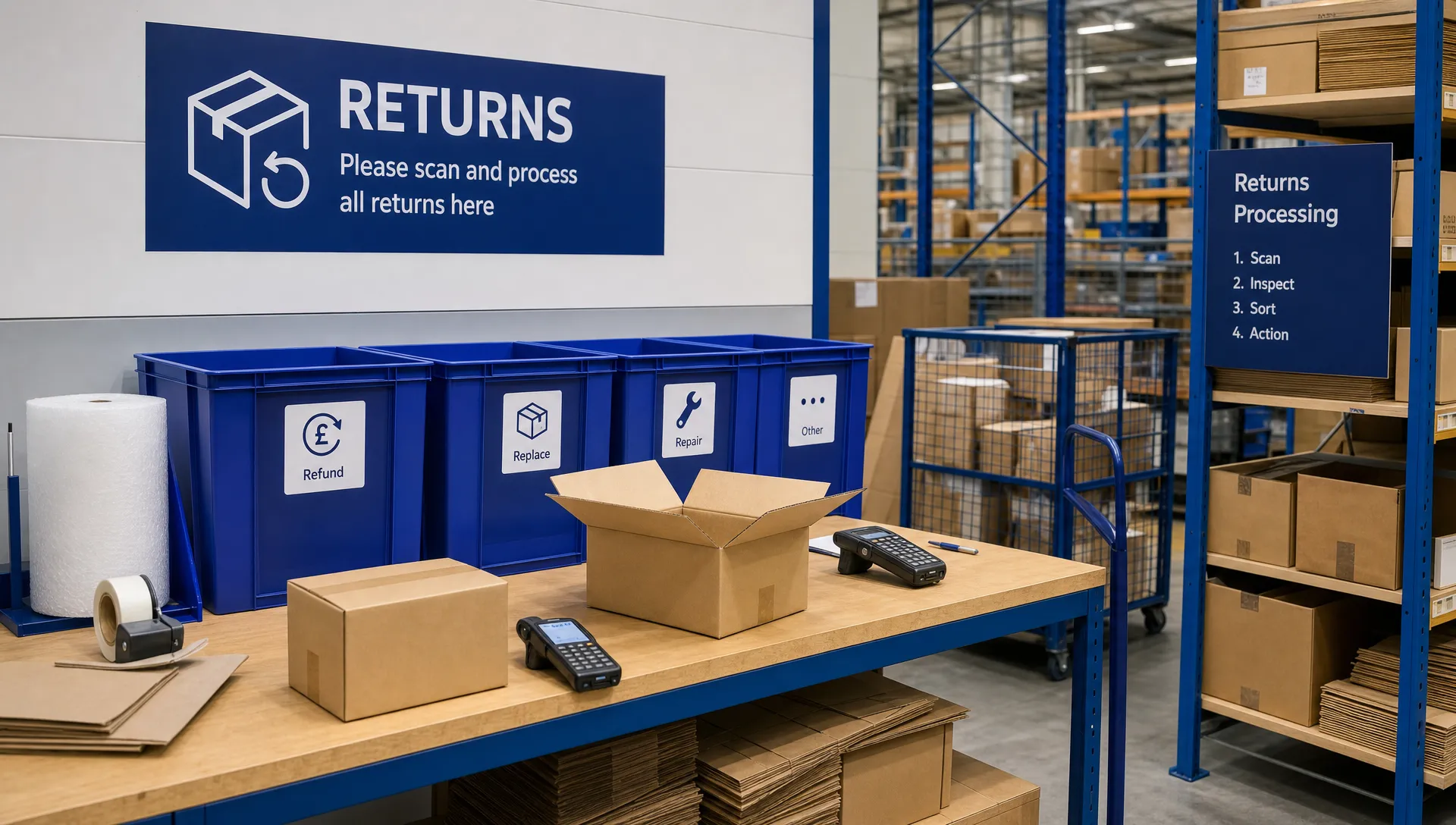
Create a dedicated returns area, even if it is small. The area should make it obvious what stage each item is at. For example, you might have separate zones for received but not checked, awaiting customer service decision, repack required, quarantine and ready to restock.
The physical setup does not need to be expensive. What matters is that returned stock is separated from outbound stock until it has been inspected. This prevents damaged, incomplete or incorrect items being picked for new orders.
For businesses handling pallets, bulk stock or wholesale returns, the same principle applies at a larger scale. Returned pallets should be booked in, identified and held in a controlled area until they have been checked. If you are outgrowing your current space, using a provider with managed pallet and bulk warehouse storage can help keep returns, sellable stock and quarantine stock properly separated.
Connect returns to stock control
A return is not complete when the parcel arrives. It is complete when the correct customer action has been taken and the stock record reflects reality.
This is where many returns processes fail. The warehouse may physically restock an item, but the eCommerce platform may still show it as unavailable. Or finance may refund the customer, but the item may still be sitting in quarantine with no final decision.
Your stock control process should make clear when inventory is updated. In most cases, returned items should not be added back to available stock until inspection is complete. If an item needs repacking or quarantine, that status should be visible rather than hidden in someone’s notes.
For growing brands, this is one of the strongest arguments for integrating fulfilment and returns properly. Gus Logistics supports order fulfilment for eCommerce and product businesses with platform integrations, warehouse tracking and returns handling, which helps reduce the gap between what is physically in the warehouse and what your sales channels show.
If your business sells through trade, retail or wholesale channels, the same discipline applies. Carton quantities, batch details, serial numbers and expiry dates can all affect whether a returned item can be resold. For companies looking for operational support in the North West, Gus Logistics provides B2B fulfilment in Cheshire for businesses that need reliable handling of business orders, stock and returns.
Set clear service levels for each stage
Customers become frustrated when they do not know what is happening. Internally, teams become frustrated when there is no agreed timescale for what “processed” means.
Set realistic service levels for each stage of the returns journey. These do not need to be aggressive. They need to be clear and achievable.
| Stage | What to define | Why it matters |
|---|---|---|
| Return request response | How quickly customer service replies | Reduces customer chasing |
| Return received scan | How quickly parcels are logged after arrival | Confirms the item is in your control |
| Inspection | How quickly condition is checked | Gets stock moving again |
| Refund or replacement decision | When finance or customer service acts | Improves customer experience |
| Restock or quarantine update | When inventory status changes | Protects stock accuracy |
Once service levels are agreed, measure them weekly. You do not need a complicated dashboard at first. A simple report showing returns received, returns processed, average processing time and items still awaiting inspection is enough to expose bottlenecks.
Decide who owns the final decision
A broken returns process often has too many people involved but no single owner. Customer service speaks to the customer. The warehouse sees the item. Finance issues the refund. Buying or product teams may need to inspect faults. Without clear decision rights, awkward returns sit unresolved.
Create a decision matrix that defines who has authority at each stage. For example, the warehouse may be allowed to restock Grade A items without asking customer service. Customer service may be allowed to refund approved returns once the warehouse confirms receipt. Faulty or high-value items may need management approval before refund or supplier claim.
The aim is not to remove judgement. The aim is to stop every return becoming a one-off debate.
It is also worth defining escalation rules. A low-value item with damaged packaging should not require the same process as a high-value electrical item reported as faulty. Your team should know when to move quickly and when to pause for review.
Use returns data to fix the causes, not just the symptoms
A smooth returns process is valuable, but the best returns operation also helps reduce avoidable returns in the first place.
Review your reason codes regularly. If the same SKU is repeatedly returned as “not as described”, your product page may need better images or clearer specifications. If returns often say “wrong item received”, the issue may be SKU labelling, picking accuracy or product similarity in the warehouse. If products arrive damaged, packaging or carrier choice may need attention.
Returns data should be shared with the teams that can act on it. Customer service alone cannot fix poor packaging. The warehouse alone cannot fix unclear product descriptions. Finance alone cannot fix a supplier quality issue.
If return rates are a wider concern, Gus Logistics has a practical guide on how to reduce eCommerce return rates that covers product information, stock accuracy, packaging and fulfilment errors in more detail.
Know when to outsource returns handling
Some businesses can handle returns well in-house, especially when order volumes are low and the product range is simple. But as volume grows, returns can start to pull time away from sales, purchasing, customer service and dispatch.
Outsourcing can make sense when returns are creating warehouse backlogs, stock accuracy problems or customer service pressure. It can also help if you need better systems, more space or a team that already handles returns as part of fulfilment.
A good 3PL should not treat returns as an inconvenience. Returns are part of the customer journey and part of stock control. Ask any provider how they receive returns, identify items, inspect condition, update inventory, handle quarantine stock and communicate outcomes.
Gus Logistics provides returns management alongside fulfilment, warehousing, transport and co-packing services. As a family-run 3PL based in Nantwich, Cheshire, the team works with eCommerce brands, manufacturers and product businesses across the UK. Customers speak directly to the people handling their stock and freight, with no call centres.
Because Gus Logistics has no minimum volume requirements, businesses do not need to wait until operations are unmanageable before asking for support. That can be especially useful for SMEs that are growing quickly but still need flexible logistics support.
A 30-day plan to fix your returns process
If your returns process feels messy, do not try to redesign everything in one week. Focus on the changes that remove confusion first.
| Timeframe | Priority | Outcome |
|---|---|---|
| Week 1 | Map the current returns journey and identify unclear handovers | You know where the process is breaking |
| Week 2 | Introduce return references, reason codes and condition grades | Returns become easier to track and assess |
| Week 3 | Create a dedicated returns area and update stock rules | Returned items stop disappearing into the warehouse |
| Week 4 | Set service levels and start weekly reporting | Delays become visible and manageable |
After the first month, review the data. Look for the biggest delay, the most common return reason and the highest-value stock sitting unresolved. Fix those first. Returns improvement is not about perfection. It is about removing the repeat problems that cost time, margin and customer trust.
Frequently Asked Questions
What is the fastest way to fix a broken returns process? Start by mapping the current process and assigning clear ownership for each stage. Then introduce return references, reason codes, condition grades and a dedicated returns area so items can be tracked from arrival to final outcome.
Should refunds be issued before returned items are inspected? That depends on your policy, product type and legal obligations. Operationally, many businesses separate return approval from warehouse inspection so they can confirm the item has arrived and check its condition before taking the final action.
How can returns improve stock accuracy? Returns improve stock accuracy when items are scanned or logged on arrival, inspected before being made available for resale and updated in the correct system. Returned stock should not be added back to sellable inventory until its condition is confirmed.
When should a business outsource returns management? Outsourcing is worth considering when returns are delaying refunds, creating warehouse backlogs, causing stock errors or taking too much time from your internal team. A 3PL can handle returns as part of a wider fulfilment and warehousing process.
Get support with returns, fulfilment and warehousing
If returns are slowing your team down or leaving stock stuck in limbo, Gus Logistics can help you build a more reliable process. From returns handling and restocking to order fulfilment, pallet storage and UK-wide transport, the team supports growing product businesses with practical logistics services from Nantwich, Cheshire.
To talk through your returns process, call 01270 335014 or get in touch via the Gus Logistics contact page.
Looking for a Logistics Partner You Can Trust?
From warehousing and order fulfilment to transport and FSDU design - Gus Logistics handles it all from our base in Nantwich, Cheshire. Over 10 years experience, no minimum volumes, no long contracts.
