
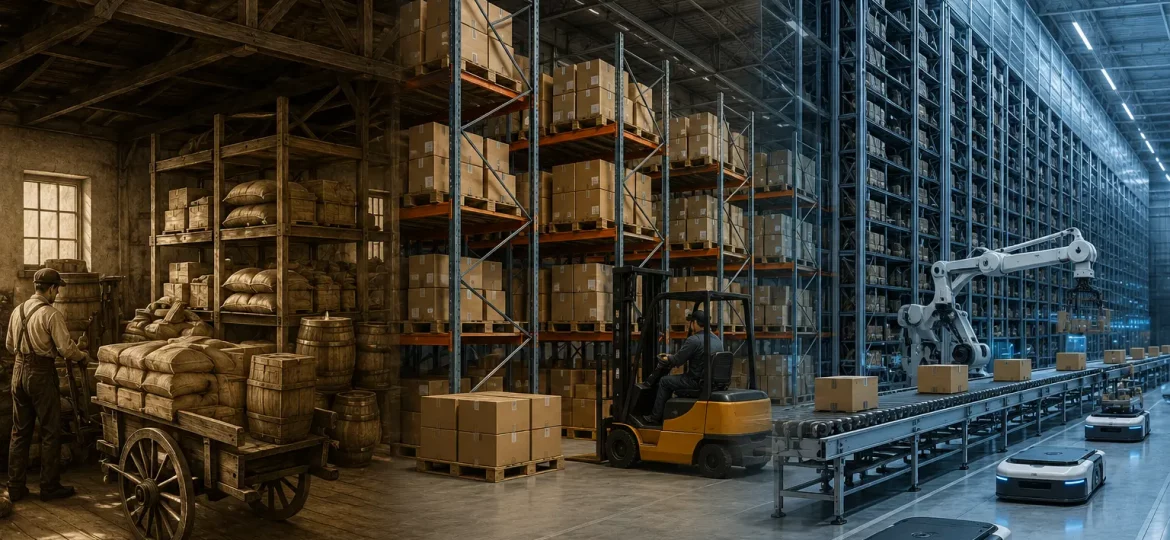
The Evolution of Warehouse Storage: From Ancient Granaries to Automated Fulfilment
Warehousing is one of those industries that looks straightforward until you start pulling on the thread. The basic proposition – store things safely, find them again quickly, get them out when needed – hasn’t changed in thousands of years. What has changed, repeatedly and dramatically, is the infrastructure, technology, and commercial logic that sits behind it.
Understanding how warehouse storage has evolved isn’t just interesting history. It’s useful context for any business making decisions about how to store and manage stock today – because the pressures driving the next generation of warehousing are the same ones that have always driven it: cost, speed, accuracy, and scale.
If you want to understand how modern warehousing and storage works in practice for UK businesses right now, our storage service page covers what to look for and what to expect.
Ancient Warehousing: The Problem of Surplus
The earliest warehouses weren’t built for commerce – they were built for survival. The fundamental problem was the same one that still drives warehousing decisions today: production and consumption don’t happen at the same time, so you need somewhere to put things in between.
In ancient Mesopotamia, large centralised storehouses were used by temple administrations to manage grain, oil, and textiles – essentially the tax receipts of the ancient world. The British Museum holds clay tablet records from Sumerian warehouses dating back to around 3000 BC, detailing inventory levels with a precision that would look familiar to anyone working in modern stock management.
Ancient Egypt’s granaries served a similar function at a civilisational scale. The Joseph story in the Old Testament – storing seven years of surplus grain against seven years of famine – is essentially a description of strategic inventory management. The Egyptians built dedicated grain storage facilities near the Nile, positioned for easy loading and transport, with records maintained by scribes. The logic of location, access, and record-keeping hasn’t fundamentally changed.
The Roman Empire scaled this up significantly with the horrea – large public warehouses built near ports, rivers, and military supply routes. The Horrea Galbae in Rome covered around 21,000 square metres and stored grain, wine, oil, and other goods from across the empire. Roman engineers understood the value of proximity to transport infrastructure in a way that still shapes where modern distribution centres get built.
Medieval Warehousing: Trade Networks and Merchant Guilds
As European trade expanded through the Middle Ages, warehousing evolved from a state function into a commercial one. Merchant guilds in major trading cities built warehouses to support growing networks of exchange across the continent.
The Hanseatic League – the trading alliance that dominated commerce across Northern Europe from the 13th to the 17th centuries – developed some of the most sophisticated warehouse infrastructure of the medieval period. The Kontor warehouses in cities like Bruges, Hamburg, and London were purpose-built for specific commodities, with standardised storage practices and security arrangements that protected the goods of multiple merchants simultaneously.
This period established something important: the idea of a third-party warehouse serving multiple clients under standardised terms. The model that modern 3PL warehousing is built on has its roots in medieval merchant infrastructure.
The physical structures of the period were also more sophisticated than is often assumed. Multi-storey stone buildings with thick walls for temperature regulation, internal hoists for moving goods between floors, and separate areas for different commodity types were all common features of larger medieval warehouses.
The Industrial Revolution: Scale, Speed, and Mechanisation
The Industrial Revolution changed warehousing more fundamentally than any period before or since. Factory production created volumes of goods that previous storage infrastructure simply couldn’t handle, and the expansion of rail networks meant those goods needed to move faster and further than ever before.
Several developments during the 18th and 19th centuries shaped the modern warehouse:
Rail-connected warehouses. The growth of the railway network created a new logic for warehouse location – proximity to rail sidings rather than just rivers and ports. The great bonded warehouses of Victorian Manchester, Liverpool, and Leeds were built specifically to receive goods arriving by rail and hold them pending customs clearance or onward distribution. Many of these buildings still stand today, converted into offices and apartments.
Mechanical handling. Steam-powered cranes, hydraulic lifts, and early conveyor systems began to replace manual handling for heavy goods. This increased throughput and reduced the labour required to move goods within a warehouse – the same logic that drives automation investment today.
Racking systems. Fixed shelving gave way to adjustable racking that could be reconfigured for different product types. The ability to use vertical space more efficiently – storing more in the same footprint – became increasingly important as urban land costs rose.
Insurance and liability frameworks. The legal and commercial frameworks around warehouse liability developed significantly during this period. Warehouse receipts became financial instruments that could be traded, allowing goods in storage to serve as collateral for credit – a development that helped fund the rapid expansion of industrial commerce.
The 20th Century: Standardisation and the Container Revolution
If the Industrial Revolution created the conditions for modern warehousing, the 20th century created the infrastructure that made global supply chains possible.
The single most significant development was the standardised shipping container, introduced commercially in the 1950s by Malcom McLean. Before containerisation, loading and unloading a ship required armies of dock workers handling individual crates, barrels, and sacks – a process so labour-intensive that port time often exceeded sailing time on short routes. A standard container that could move seamlessly between ship, rail, and truck without being unpacked transformed the economics of global trade.
The World Shipping Council estimates that containerisation reduced shipping costs by around 90% compared to pre-container break-bulk methods – a reduction that made it economically viable to manufacture goods on one continent and sell them on another, which in turn created the global supply chains that modern warehousing exists to serve.
Alongside containerisation, the 20th century brought:
The forklift truck. Widely adopted from the 1940s onwards, the forklift made pallet-based storage practical at scale. Pallets and forklifts together created the standard unit of warehouse storage that still dominates most facilities today.
Warehouse Management Systems. From the 1970s onwards, computer-based systems began replacing paper-based stock records. Early WMS software was expensive and limited, but it established the principle of real-time inventory visibility that is now a baseline expectation for any serious warehousing operation.
Automated Storage and Retrieval Systems (AS/RS). Computer-controlled systems that could automatically place and retrieve goods from high-density storage emerged in the 1970s and 1980s, particularly in industries like automotive and pharmaceutical where precision and speed were critical.
The eCommerce Era: Fulfilment at Consumer Speed
The rise of eCommerce from the late 1990s onwards imposed demands on warehousing that the industry had never previously faced. The fundamental shift was from B2B distribution – moving pallets of goods to retail stores on predictable schedules – to B2C fulfilment: picking, packing, and despatching individual consumer orders within hours, around the clock, with complete accuracy.
This is a genuinely different operational challenge. A warehouse serving retail stores can load full pallets of a single product onto a truck. A warehouse serving eCommerce consumers needs to pick one item from thousands of different SKUs, pack it appropriately, generate a shipping label, and hand it to a courier – potentially thousands of times a day, with each order unique.
The companies that adapted fastest built significant competitive advantages. Amazon’s fulfilment network is the most discussed example, but the broader shift changed expectations across the industry. Next-day delivery went from a premium service to a baseline expectation. Same-day delivery, once unthinkable at scale, became operationally viable in major urban areas.
For smaller businesses, the response was increasingly to outsource fulfilment to specialist 3PL providers rather than attempt to build the infrastructure in-house. Our order fulfilment service exists precisely because most growing eCommerce businesses are better served by a specialist partner than by managing their own warehouse operation.
Modern Warehousing: Technology Layers on a Familiar Foundation
The technology landscape in warehousing has changed significantly over the last decade, but it’s worth being clear about what has and hasn’t changed at a fundamental level.
The core activity – receive goods, store them accurately, retrieve them quickly, despatch them correctly – is the same as it was in a Roman horrea. What technology does is make each of those steps faster, more accurate, and more transparent.
IoT and real-time visibility. Sensors tracking temperature, humidity, location, and movement throughout a warehouse provide data that was previously unavailable or prohibitively expensive to collect. For temperature-sensitive products, pharmaceutical goods, or high-value inventory, this kind of monitoring is now a standard expectation rather than a premium feature.
Robotics and automation. Autonomous mobile robots (AMRs) that navigate warehouse floors to bring goods to picking stations, automated conveyor and sortation systems, and robotic arms handling repetitive pick-and-pack tasks are now commercially viable at scales that would have been uneconomic a decade ago. The UK Warehousing Association has consistently highlighted automation investment as the fastest-growing area of capital expenditure across the sector.
AI-driven demand forecasting. Machine learning models that predict demand fluctuations, optimise stock positioning, and flag potential shortfalls before they become problems are increasingly accessible to businesses that wouldn’t previously have had the data infrastructure to use them.
WMS integration. Modern Warehouse Management Systems integrate directly with eCommerce platforms, ERPs, and courier networks in ways that were technically complex and expensive to achieve even five years ago. Real-time stock visibility through a client portal – knowing exactly what you have, where it is, and what’s been despatched – is now a standard feature of a well-run 3PL operation.
What This Means for Businesses Choosing a Warehouse Partner Today
The history of warehousing is essentially a story of infrastructure catching up with commercial ambition. Every major development – from Roman horrea to containerisation to eCommerce fulfilment – was driven by businesses needing to move and store more goods, more reliably, at lower cost per unit.
For a business choosing a warehousing partner today, the practical questions haven’t changed much from what a medieval merchant would have asked: Is the location right for my distribution needs? Can they handle my volumes now and as I grow? Do they have the systems to give me visibility of my stock? Can I trust them with my goods?
What has changed is the baseline expectation. A modern warehouse partner should offer real-time stock visibility through a client portal, direct integration with your sales channels, flexible scaling without punitive minimum volume commitments, and a clear process for handling returns and exceptions.
At Gus Logistics, our facility at Cheshire Green Employment Park in Nantwich gives us fast access to the M6, M56, and M62 – the same logic of transport proximity that drove the location of Roman horrea and Victorian bonded warehouses. The technology has changed; the geography still matters.
If you’re weighing up whether to outsource your storage and fulfilment, our post on why outsourcing logistics gives SMEs a competitive advantage in 2026 covers the commercial case in plain English. And if cost is the main question, our plain English guide to 3PL pricing breaks down every cost component you should expect to see in a quote.
Talk to Us About Your Storage Requirements
Gus Logistics is a family-run 3PL based in Nantwich, Cheshire. We offer flexible pallet storage, pick and pack fulfilment, same-day and next-day transport, and co-packing – all under one roof, with no minimum volumes and same-day quotes as standard.
If you’re looking for a warehouse storage partner in Cheshire or the wider North West, get in touch here or call us on 01270 335014 . We’ll get back to you the same working day.
Ready to Find the Right Storage Solution?
Get in touch today for a tailored warehouse storage quote - usually back to you the same working day.
