
What Is Buffer Stock and When Does Your Business Need It?
If your sales move faster than your suppliers can replenish you, buffer stock can be the difference between steady trading and a run of disappointed customers. It is the extra stock you hold above expected demand so you can keep selling when orders spike, deliveries slip or a promotion performs better than planned. The challenge is that extra stock is not free. It takes up warehouse space, ties up cash and can become obsolete if you hold the wrong products for too long. For an eCommerce brand, manufacturer or growing product business, the question is not whether more stock feels safer. The useful question is whether the risk of running out is greater than the cost of holding more. This guide explains what it means in plain English, when it makes commercial sense and how to store it without creating a warehouse problem.
What Is Buffer Stock?
At its simplest, it is spare inventory held to protect your business from uncertainty. If you expect to sell 500 units before your next delivery arrives, but you keep 650 units on hand because suppliers are sometimes late, the extra 150 units are your protection.
That does not mean every extra box in the warehouse is planned inventory. A healthy buffer stock level is deliberate, measured and linked to real risks such as supplier delays, seasonal demand, marketplace sales spikes or longer import lead times. It should be attached to specific SKUs, not applied blindly across your full product range.
For example, a skincare brand may hold extra units of its bestselling moisturiser before a retail promotion, but it may not need the same extra cover for a slow-moving gift set. A food product business may need more stock ahead of a supermarket campaign, but only if shelf life, batch control and best-before tracking are under control.
How It Differs From Safety Stock, Overstock and Dead Stock
The terms are often used loosely, but they are not always the same thing. Safety stock is usually a more calculated reserve based on demand variation and lead time risk. Overstock is excess inventory beyond what the business can realistically sell in a sensible period. Dead stock is inventory that no longer sells, often because it is obsolete, damaged, expired or no longer in demand.
In day-to-day operations, buffer stock is often the practical extra layer you hold to keep trading when normal plans are disrupted. It can be part of your safety stock approach, but it should not drift into overstock. If you want to go deeper into the calculation side, Gus Logistics has a separate guide on how much safety stock an eCommerce business should hold.
| Term | Plain English meaning | Main risk if unmanaged |
|---|---|---|
| Safety stock | Calculated reserve for demand or lead time uncertainty | Too little cover during delays |
| Overstock | More stock than you can sell in a sensible period | Cash tied up and wasted space |
| Dead stock | Stock that no longer sells or cannot be sold | Write-offs and operational clutter |
| Planned reserve stock | Extra cover held for a specific risk or event | Becoming excessive if not reviewed |
When Does Your Business Need It?
Buffer stock is most useful when a stockout would cost more than the extra storage and capital tied up in holding more units. That might mean lost online sales, cancelled wholesale orders, poor marketplace performance or missed retail delivery windows.
It is usually worth considering if you recognise several of these signs:
| Business signal | What it suggests | Practical response |
|---|---|---|
| Bestsellers keep selling out before replenishment arrives | Demand is higher or less predictable than expected | Hold extra cover on key SKUs only |
| Supplier lead times vary from order to order | Your replenishment plan is exposed to delay | Build in extra stock for affected suppliers |
| You sell through several channels at once | Stock can disappear faster than one channel shows | Centralise stock visibility before adding more |
| Promotions create sharp sales spikes | Forecasts based on normal weeks are not enough | Plan temporary extra cover before launch |
| Imported goods face shipping delays | Replenishment is harder to control | Increase cover on high-risk products |
| Retailers require fixed delivery dates | Late supply can damage the relationship | Hold reserve stock for committed orders |
The aim is not to make your warehouse full. The aim is to protect the products that matter most to revenue, customer experience and contractual commitments.
How to Set the Right Level
The right buffer stock level starts with evidence, not guesswork. Look at your sales history, supplier performance and upcoming demand drivers. A product that sells steadily all year does not need the same approach as a seasonal item that sells heavily during summer, Christmas or a planned promotion.
A simple starting point is to compare your average demand and lead time with your worst-case demand and lead time:
Extra cover = (maximum daily sales x maximum lead time) - (average daily sales x average lead time)
This formula will not be perfect for every business, but it gives you a useful baseline. You can then adjust it based on margin, shelf life, supplier reliability, storage cost and how painful a stockout would be.
For products with expiry dates or batch control requirements, be more cautious. Extra stock only helps if it can still be sold in time and rotated properly. If you hold products with best-before dates, FEFO stock rotation may matter more than simply increasing quantity.
Where Should You Store It?
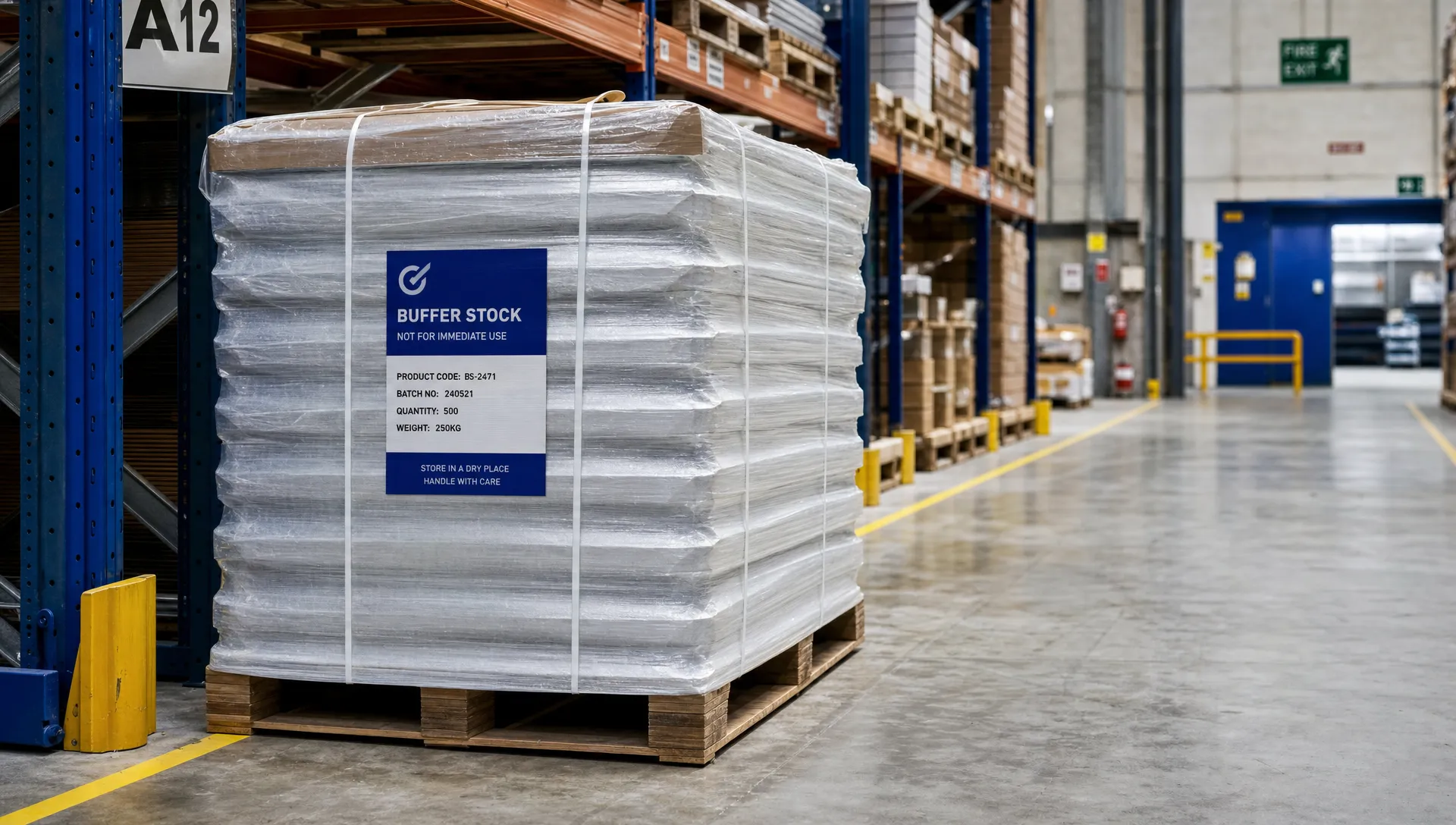
Extra inventory can quickly become a problem if your current space was only designed for normal trading levels. Boxes end up in packing areas, pallets block aisles and stock becomes harder to find. At that point, the extra cover that was meant to protect your business starts slowing the operation down.
If your buffer stock needs racked pallet storage, floor storage or better stock visibility, working with a 3PL can be more practical than taking on a larger unit yourself. Gus Logistics provides pallet and bulk warehouse storage in Nantwich, Cheshire, with real-time WMS tracking through a client portal. Batch, serial number and best-before date tracking are also available where products need tighter control.
Storage should also match how the stock will move. Reserve pallets for a retail campaign, fast-moving eCommerce stock and slow-moving bulk items may all need different locations, access routes and picking arrangements.
How It Affects Order Fulfilment and Stock Visibility
Holding extra stock is only useful if it is visible to the people and systems taking orders. If Shopify, Amazon, eBay or your wholesale team are all working from different numbers, you can still oversell even when there is stock in the building.
Buffer stock should be linked to one clear available-to-sell figure. Some businesses keep part of the reserve unavailable for normal online orders so it can protect wholesale commitments, retail deliveries or marketplace performance. Others release it gradually as replenishment dates become clearer.
This is where fulfilment processes matter. Gus Logistics offers order fulfilment and pick and pack services that integrate with 60+ platforms including Shopify, Amazon, eBay, WooCommerce and Magento. With late cut-offs up to 10pm and next-day dispatch available, stock planning can be connected to the way orders are actually picked, packed and sent.
Common Mistakes to Avoid
A good policy should reduce risk without hiding bigger stock control problems. If you simply buy more because stockouts keep happening, you may be masking issues with forecasting, supplier reliability, sales channel visibility or warehouse accuracy.
The most common mistakes include:
- Holding the same extra quantity for every SKU, regardless of sales speed or margin
- Ignoring expiry dates, seasonal demand or product life cycles
- Failing to review supplier lead times after delays or improvements
- Letting reserve stock sit in locations that are hard to count or access
- Treating warehouse space as unlimited and forgetting the handling cost
A good buffer stock policy should be reviewed regularly, especially after busy periods, supplier changes, retail promotions or new marketplace launches. If a product no longer sells quickly, reduce the cover before it becomes overstock. If a bestseller repeatedly runs out, raise the cover or change your reorder point.
How Gus Logistics Can Help
If your business needs more reliable space, better visibility or support with both storage and dispatch, Gus Logistics can help you manage stock without building a larger in-house operation. The company is a family-run 3PL provider based in Nantwich, Cheshire, supporting eCommerce brands, manufacturers and product businesses across the UK.
The service covers pallet and bulk warehousing, order fulfilment, returns management, co-packing, contract packing and same-day or next-day transport. There are no minimum volume requirements, quotes are usually turned around the same working day and customers speak directly to the people handling their freight rather than a call centre.
For growing businesses, that flexibility matters. You may only need extra pallet space ahead of peak season, or you may want ongoing fulfilment support as order volumes grow. Either way, the stock needs to be stored, tracked and moved in a way that supports sales rather than blocking them.
Frequently Asked Questions
Is buffer stock the same as safety stock? Not always. Safety stock is usually a calculated reserve based on demand and lead time variation. Buffer stock is often used more broadly to describe extra inventory held to protect against disruption, although the two terms can overlap.
Which products should have extra cover? Start with bestsellers, high-margin products, items with unreliable suppliers and SKUs linked to firm retail or wholesale commitments. Avoid adding extra cover to slow-moving products unless there is a clear reason.
Can a small eCommerce business use this approach? Yes. Smaller businesses often benefit from focusing on a small number of critical SKUs rather than increasing stock across the whole range. This keeps the approach affordable and easier to manage.
How often should I review buffer stock levels? Review them after major promotions, peak trading periods, supplier changes and product range changes. If demand or lead times have shifted, your reserve levels should change too.
Should I store reserve inventory separately? Sometimes. If the stock is being held for wholesale orders, retail campaigns or committed deliveries, separating it in your warehouse system can stop it being accidentally sold through normal channels.
Need Help Storing and Managing Stock?
If you are running out of space, struggling with stock visibility or planning for busier trading periods, Gus Logistics can help you store, track and move inventory more efficiently. Call 01270 335014 or get in touch via the contact page to discuss your requirements.
Looking for a Logistics Partner You Can Trust?
From warehousing and order fulfilment to transport and FSDU design - Gus Logistics handles it all from our base in Nantwich, Cheshire. Over 10 years experience, no minimum volumes, no long contracts.
