

What Is Safety Stock and How Much Should an Ecommerce Business Hold?
If your best-selling SKU sells faster than expected, or a supplier delivery arrives late, safety stock is the buffer that keeps orders moving instead of leaving customers waiting. For an eCommerce business, the challenge is not simply holding more stock. It is holding the right amount, enough to protect sales without tying up too much cash or warehouse space.
This guide explains what the term means, how to calculate a sensible buffer and how to review it as your sales patterns change. The aim is practical stock control, not a perfect spreadsheet that nobody uses in the real world.
What is safety stock?
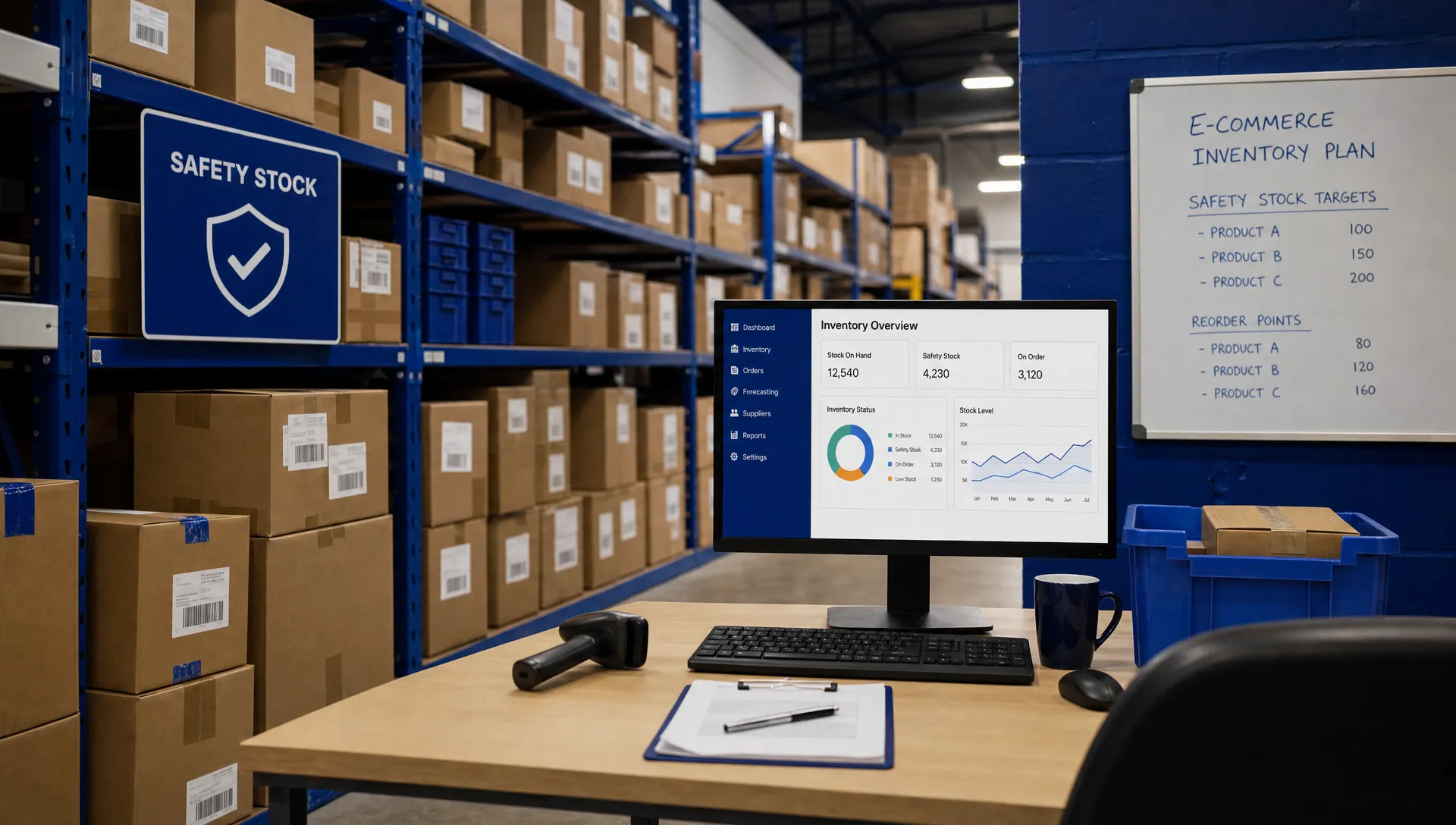
Safety stock is extra inventory held above the quantity you expect to sell during a normal replenishment cycle. It protects you against the two most common causes of stockouts: demand being higher than forecast and replenishment taking longer than planned.
It is not the same as working stock. Working stock is the inventory you expect to sell before your next supplier delivery arrives. The buffer sits behind that working stock, ready for the days when orders spike, a container is delayed, a supplier short-ships or goods-in takes longer than usual.
For an eCommerce business, safety stock should be set at SKU level rather than as one blanket percentage across the whole range. Your best-selling lines, seasonal products and long-lead-time imports do not carry the same risk as slow-moving accessories or easily replenished UK-made items.
Why eCommerce businesses need a stock buffer
Online retail can change quickly. A product can sell steadily for weeks, then suddenly take off because of a paid advert, influencer mention, marketplace promotion or competitor stockout. If your stock planning only covers average sales, you may run out as soon as demand moves above normal.
Supplier lead times are another risk. Even reliable suppliers can be affected by production delays, transport issues, customs checks or missed booking slots. If you sell on multiple channels, such as your website, Amazon and eBay, the risk is higher because sales can come from several places at once.
A good buffer also protects your customer experience. When stock is available, your warehouse or 3PL can keep picking, packing and dispatching without awkward backorder emails. If you are already struggling with stock accuracy across channels, it is worth reading Gus Logistics' guide on how to avoid overselling when stock runs low.
How much safety stock should an eCommerce business hold?
There is no single correct number. The right amount depends on your demand pattern, supplier reliability, lead time, storage cost, product margin and how damaging a stockout would be. A high-margin hero product usually deserves a stronger buffer than a low-margin product that sells twice a month.
Start by splitting your products into practical groups. You do not need a complex system to make better decisions, but you do need to stop treating every SKU the same.
| Product type | Stock risk | Sensible approach |
|---|---|---|
| Fast-selling core lines | Lost sales and poor customer experience if unavailable | Hold a measured buffer and review often |
| Seasonal or promoted products | Demand can rise suddenly | Increase the buffer before campaigns or peak periods |
| Long-lead-time imports | Replenishment delays can last weeks | Hold more protection if cash and space allow |
| Slow-moving products | Cash can become trapped in stock | Keep the buffer low and reorder carefully |
| High-value items | Overstocking can hurt cash flow | Use tighter forecasting and clear reorder rules |
This grouping helps you focus cash where availability matters most. It also stops you filling shelves with products that are unlikely to sell quickly.
A simple safety stock formula you can use
A practical starting point is this formula:
Safety stock = (maximum daily sales x maximum lead time) - (average daily sales x average lead time)
For example, imagine one SKU sells 20 units per day on average, but can sell 35 units per day during busy periods. Your supplier usually delivers in 7 days, but has taken up to 12 days in the past.
(35 x 12) - (20 x 7) = 280 units
In this example, the buffer would be 280 units. That may feel high, so treat the calculation as a decision point rather than an instruction. If the product is profitable, hard to replenish and central to your range, the number may be justified. If it is bulky, low-margin or at risk of becoming obsolete, you may choose a lower buffer and accept a little more stockout risk.
Connect your buffer to the reorder point
A buffer only works if it is linked to a clear reorder point. Your reorder point tells you when to buy more stock, not just how much stock you would like to have.
The basic formula is:
Reorder point = expected demand during lead time + buffer stock
If you normally sell 20 units per day and your supplier lead time is 7 days, your expected demand during lead time is 140 units. If your chosen buffer is 80 units, your reorder point is 220 units. When available stock reaches 220 units, you place the next order.
This is where many eCommerce businesses get into trouble. They look at total units in the warehouse, but some stock may already be allocated to orders, held for wholesale customers or unsuitable because of batch dates. A reliable warehouse process should show what is genuinely available to sell.
What happens if you hold too little?
Holding too little stock creates obvious problems. You lose sales, customers may switch to a competitor and marketplace rankings can suffer if products are unavailable during important trading periods. Your team also spends more time firefighting, answering customer queries and chasing suppliers.
The issue can be worse during peak trading. Black Friday, Christmas, bank holiday promotions and retailer campaigns all put pressure on stock availability. If you have been caught short before, Gus Logistics' article on how to reduce stockouts during busy periods covers practical steps for improving readiness before demand rises.
Too little safety stock can also create higher transport costs. Businesses often pay for urgent replenishment, split deliveries or last-minute courier options because the original stock plan was too tight.
What happens if you hold too much?
Too much stock can be just as damaging, especially for growing SMEs. Cash sits in products instead of being available for marketing, product development or supplier payments. Storage costs increase and your warehouse becomes harder to operate because teams need to work around slow-moving stock.
Overstocking also increases the risk of dead stock. This is stock that no longer sells at a useful pace, whether because demand was overestimated, packaging changed, the product became outdated or a season passed. If this is a recurring issue, the guide to reducing dead stock is a useful next read.
For products with best-before dates, batch numbers or seasonal packaging, excess inventory can become a bigger problem than a temporary stockout. The goal is controlled availability, not simply a fuller warehouse.
How warehousing changes your safety stock decision
Your warehouse setup affects how much protection you need. If stock records are unreliable, you may feel forced to hold a bigger buffer because nobody fully trusts the numbers. Better warehouse visibility can reduce that uncertainty.
With organised warehouse storage and stock control support, you can make decisions using clearer information about what is in stock, where it is located and whether it is available to sell. Gus Logistics offers racked and floor storage, real-time WMS tracking via a client portal and stock tracking options such as batch, serial number and best-before date control.
Fulfilment processes matter too. If your warehouse integrates with your sales channels, order data and inventory updates can move more quickly between systems. Gus Logistics provides order fulfilment and pick and pack services with integrations across 60 plus platforms including Shopify, Amazon, eBay, WooCommerce and Magento.
The better your stock visibility, the more confidently you can set your buffer. You may still choose to hold plenty of protection for key SKUs, but that choice will be based on real risk rather than guesswork.
A practical review process for growing businesses
Set your buffer, then review it. Demand changes, supplier performance changes and your product range changes. A number that was sensible six months ago may be too cautious or too risky today.
A simple monthly review works well for many SMEs. Look at your top sellers, recent stockouts, slow-moving items, current lead times and upcoming promotions. Then adjust the buffer for the products that matter most.
Use these questions as a practical check:
- Which SKUs caused lost sales or customer service problems last month?
- Which products are taking up space without selling quickly enough?
- Have supplier lead times changed recently?
- Are any promotions, retail launches or seasonal peaks coming up?
- Is available stock accurate across all sales channels?
If the answer to several questions is unclear, the issue may not be the formula. It may be the quality of your stock data, warehousing process or replenishment routine.
When should you increase or reduce the buffer?
Increase the buffer when a product is selling faster than forecast, supplier lead times are becoming less reliable, a major promotion is planned or the item is difficult to replace quickly. You may also raise it before seasonal peaks if previous sales data supports the decision.
Reduce the buffer when sales are slowing, the product is being replaced, storage costs are becoming difficult to justify or replenishment has become faster and more reliable. If the product is high value or bulky, even a small reduction can free up cash and space.
The most important point is to make changes deliberately. Safety stock should not grow by accident because nobody wants to challenge old reorder settings.
How Gus Logistics can support better stock control
For many growing eCommerce businesses, the stock calculation is only one part of the challenge. You also need somewhere to store inventory, systems that show accurate availability and fulfilment processes that keep orders moving.
Gus Logistics is a family-run 3PL provider based in Nantwich, Cheshire, supporting eCommerce brands, manufacturers and product businesses across the UK. The team provides pallet and bulk warehousing, order fulfilment, returns management, transport and co-packing services, with no minimum volume requirements.
Because the business is located near the M6, M56 and M62, it is well placed for UK-wide distribution. Just as importantly, customers speak directly to the people handling their freight rather than a call centre.
Frequently asked questions
Is safety stock the same as minimum stock? Not exactly. Minimum stock is often the lowest level you want to reach before action is needed. A buffer is the extra quantity held to protect against demand spikes and replenishment delays. In practice, the two are often connected through your reorder point.
Should every SKU have the same buffer? No. Fast sellers, seasonal products and long-lead-time items usually need different rules from slow-moving or easy-to-replenish products. Setting one blanket percentage across your range is simple, but it can lead to both stockouts and overstocking.
How often should an eCommerce business review stock buffers? Monthly is a good rhythm for many SMEs, with extra reviews before peak trading, major promotions or supplier changes. High-volume products may need closer monitoring.
Can a 3PL help decide how much stock to hold? A 3PL can support better decisions by improving stock visibility, warehouse accuracy and fulfilment processes. The final commercial decision should still consider your cash flow, margins, supplier terms and appetite for stockout risk.
Need help storing and managing eCommerce stock?
If you are reviewing stock levels, planning for growth or looking for a more reliable warehousing partner, Gus Logistics can help you put clearer processes around storage, fulfilment and dispatch.
Call 01270 335014 to speak to the team, or get in touch via the contact page to discuss your requirements.
Looking for a Logistics Partner You Can Trust?
From warehousing and order fulfilment to transport and FSDU design - Gus Logistics handles it all from our base in Nantwich, Cheshire. Over 10 years experience, no minimum volumes, no long contracts.
