

Pallet Labels, Carton Labels and SSCC Codes – A Guide for UK Suppliers
A retailer delivery can be delayed by a label that scans perfectly but identifies the wrong load. If you have been asked to supply sscc pallet labels, you need more than a barcode printer: you need a unique identifier, accurate shipment records and a label that meets the receiving warehouse's specification.
This guide explains the difference between pallet and carton labels, how SSCC codes work and what to check before goods leave your warehouse. The starting point is simple: follow the customer's current supplier requirements, then make sure the physical load, its labels and your shipment data agree.
Pallet labels and carton labels: what is the difference?
A pallet label identifies or describes a palletised load. A carton label identifies or describes an individual case. Neither term, by itself, tells you which barcode standard to use.
An SSCC, or Serial Shipping Container Code, identifies a specific logistics unit. That unit might be a pallet, a carton shipped independently or another package handled as one unit through the supply chain.
| Label or identifier | What it does | Typical use |
|---|---|---|
| Pallet label | Carries information about a palletised load | Receiving, routing and warehouse handling |
| Carton label | Carries information about an individual case | Case identification, picking and receiving |
| SSCC | Uniquely identifies one logistics unit | Linking a physical pallet or shipping carton to shipment records |
| GTIN | Identifies a trade item at a particular packaging level | Identifying a product or traded case configuration |
| Internal warehouse label | Identifies stock within your own operation | Location control and internal stock movements |
A warehouse's internal label is not automatically suitable for a supermarket distribution centre. Likewise, a product barcode does not uniquely identify the particular pallet carrying that product.
How sscc pallet labels work
The GS1 definition of an SSCC describes it as an identifier for a logistics unit. Its purpose is to distinguish that unit from every other unit, not to describe everything inside it.
For example, two pallets containing identical products still need different SSCCs. Two copies of the label attached to the same pallet carry the same SSCC because they identify the same physical unit.
The value of sscc pallet labels comes from connecting that unique number to a reliable record of the pallet's contents, destination and shipment.
Understanding the 18-digit number
An SSCC contains 18 digits:
- An extension digit, which increases the available numbering capacity.
- A GS1 Company Prefix, allocated through GS1.
- A serial reference, assigned to distinguish the logistics unit.
- A check digit, calculated from the preceding digits.
The lengths of the company prefix and serial reference vary, but the full SSCC remains 18 digits. The extension digit is not a product type or pallet-content code.
Use a properly allocated GS1 numbering range or agree who will assign compliant identifiers on your behalf. A randomly generated 18-digit number is not necessarily a valid, globally unique SSCC.
The check digit helps detect certain input errors. It does not prove that the number is unique or that the pallet contains the right goods.
What does “(00)” mean on the label?
In a GS1-128 barcode, Application Identifier 00 tells the receiving system that the following data is an SSCC.
The human-readable text normally shows (00) followed by the 18-digit identifier. Those parentheses are for people reading the label; they are not encoded as literal characters in the barcode.
A barcode that looks plausible can still fail if it uses the wrong format or lacks the required GS1 encoding. Choose label software that supports GS1-128 rather than assuming any ordinary Code 128 barcode will work.
Get the retailer's specification before designing labels
There is no single carton or pallet label layout that every UK retailer accepts. GS1 provides standards, but individual receiving operations can specify additional information, placement rules and electronic messaging requirements.
Before creating templates, obtain the current supplier manual and confirm which requirements apply to your delivery route. Supplying a retailer's distribution centre can involve different instructions from delivering to a store or wholesaler.
Clarify the required barcode format, label dimensions, number of copies and positions. Also check whether purchase order numbers, supplier references, destination codes, batch numbers or dates must appear on the label.
Ask whether an advance shipping notice, usually called an ASN, is required and when it must be submitted. Delivery bookings and ASNs are separate processes, even when both are needed for the same shipment.
For businesses preparing to supply UK supermarkets, these operational requirements belong in the launch plan, not just the final dispatch checklist.
Correct sscc pallet labels are only part of compliance: the receiver may also expect accurate case labels, shipment data and delivery references.
Link carton contents to the pallet record
The identifier on the pallet must connect to what is actually on it. A useful pallet record includes the product or case identifiers, quantities and any relevant batch or best-before information.
Imagine an order containing 48 cartons, packed as two pallets of 24 cartons each. Each pallet receives its own SSCC, with its record showing the 24 cartons assigned to that unit. Using the same SSCC on both pallets would make them indistinguishable at receipt.
For a mixed pallet, record the different products and quantities under the pallet's SSCC. Do not assume mixed products or mixed batches are allowed simply because your software can record them; check the customer's rules first.
Does every carton need an SSCC?
Not necessarily. A traded case may carry a GTIN identifying that case configuration. A carton handled as an independent logistics unit may require its own SSCC. Some customers require both kinds of identification for different purposes.
Your SKU, the case GTIN and the pallet SSCC are different identifiers. Keep their relationships clear in your warehouse records rather than using one interchangeably with another.
When comparing warehousing and storage services, ask how pallet identities are linked to stock records and maintained through picking and dispatch. Gus Logistics offers real-time WMS tracking through a client portal, with batch, serial number and best-before tracking available.
If an ASN is required, its pallet identifiers and contents must match the sscc pallet labels on the shipment that actually leaves the warehouse.
Print labels that can be scanned reliably
Check the barcode, not just the printed text
Use the GS1 Logistic Label Guideline alongside the receiver's specification when setting up your label template.
The practical checks include adequate barcode size, clear space around the bars and strong contrast between the barcode and its background. Avoid shrinking a completed label to fit a smaller printer or stretching a barcode image to fill a template.
Use suitable label stock for the journey. A label that peels away from stretch wrap or becomes unreadable in damp conditions is not dependable, even if it passed a desk-based check.
Test printed labels with a suitable scanner. For a new template or a demanding retailer specification, barcode verification provides a more thorough assessment of print quality and conformity than a successful scan alone.
With sscc pallet labels, both the encoded value and the human-readable number should match the assigned identifier in your shipment record.
Position labels where the receiver can reach them
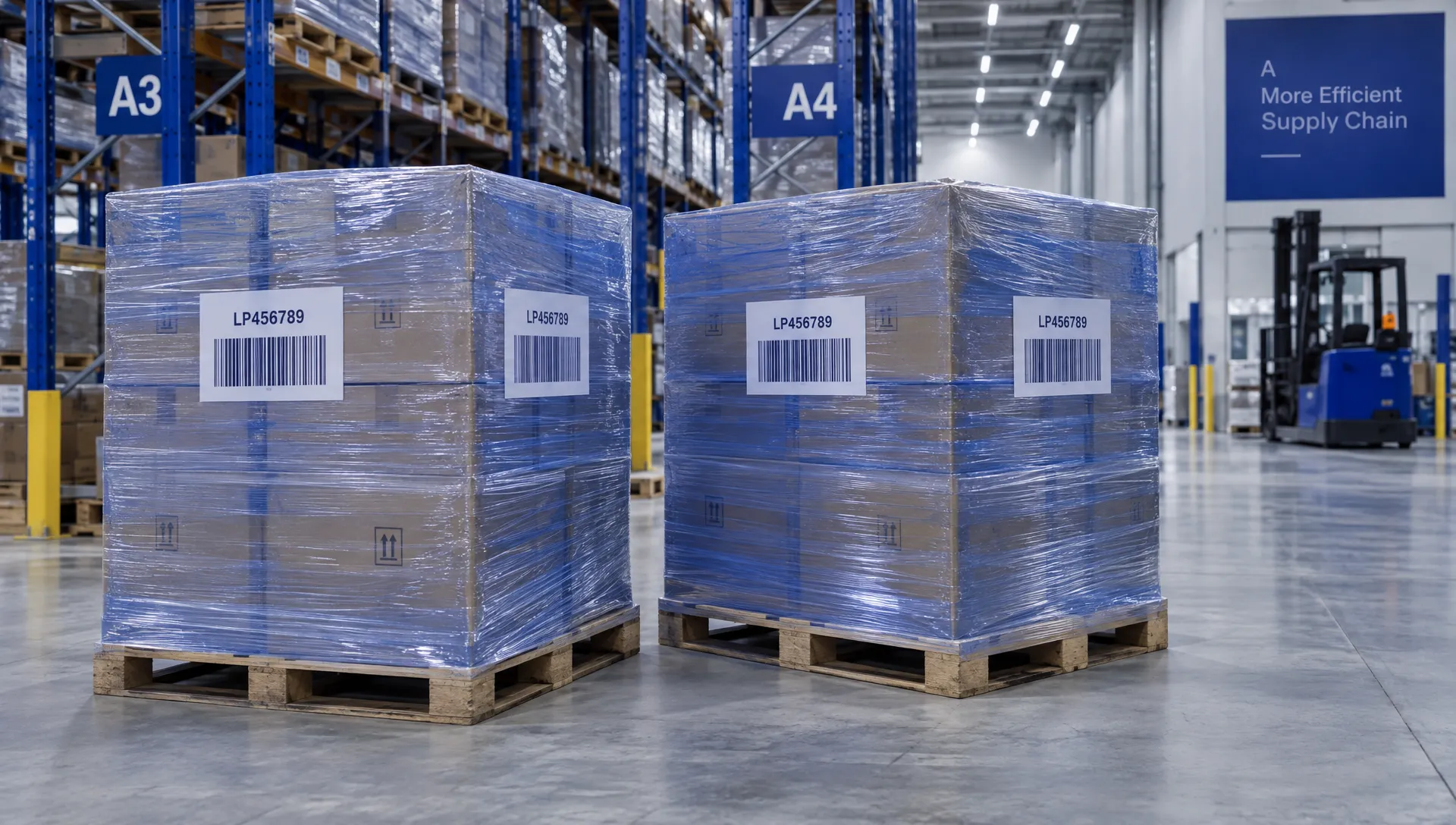
GS1 guidance recommends pallet barcode placement between 400 mm and 800 mm from the pallet base, with the barcode at least 50 mm from a vertical edge. Low pallets need an appropriate position for their height, and customer-specific instructions must also be checked.
For pallets, labels on two adjacent sides are recommended so the unit can be identified from different approaches. These are copies of the same identifier, not separate SSCCs.
Keep labels flat and visible. Avoid corners, folds, strapping and surfaces likely to be damaged during handling. After wrapping, confirm that the final exposed labels remain accessible and readable.
For cartons, follow the specified face and orientation. Do not position a barcode across a seam or where tape will cover it.
Avoid the mistakes that cause receiving problems
Most labelling problems fall into three groups: the wrong identifier, an unreadable label or a mismatch between the load and the data.
| Mistake | Why it causes problems | Practical prevention |
|---|---|---|
| Reusing one SSCC on different pallets | The receiver cannot distinguish the units | Allocate a unique identifier to each logistics unit |
| Printing an ordinary barcode instead of the required GS1-128 format | The system may not interpret the data correctly | Use a GS1-capable template and test it |
| Leaving old labels visible | Staff may scan an obsolete identifier | Remove or fully obscure outdated identification |
| Changing pallet contents without updating records | The shipment record no longer matches the goods | Reconcile the final load before dispatch |
| Sending an ASN containing different SSCCs | The physical delivery cannot be matched correctly | Build the message from the final shipment record |
| Covering labels during wrapping | Barcodes become inaccessible or distorted | Check label visibility after packing is complete |
A further risk is allocating numbers manually without a controlled record. Even a small operation needs a clear way to prevent duplicates and record which unit received each identifier.
Do not reallocate an SSCC for at least 12 months after shipment, or longer where customer requirements or applicable rules demand it.
Treat sscc pallet labels as controlled identifiers, not disposable stickers that can be copied between loads for convenience.
Carry out a final pre-dispatch check
Make one person responsible for confirming that the finished shipment is ready. Separate checks by different teams can miss the connection between the goods, their labels and the electronic records.
A practical release check should confirm:
- Customer requirements: The current supplier specification has been used for this order and delivery route.
- Physical contents: Products, quantities and relevant batch or date details match the final shipment record.
- Identifiers: Each logistics unit has the correct unique SSCC, with matching copies wherever required.
- Print and placement: Labels scan, remain visible after wrapping and follow the required positions.
- Shipment information: Any ASN, booking reference and delivery paperwork agree with the final load.
- Change control: Any last-minute substitution, split or rebuild has been reflected in the records and labels.
If a pallet is split into new logistics units, those new units need their own SSCCs. If an unchanged pallet simply needs a damaged label replaced, reprint its existing identifier rather than creating a new identity unnecessarily.
For repeat orders, keep approved templates under version control. A previously accepted layout should not be altered casually by someone changing printer settings.
A final scan of sscc pallet labels against the dispatch record helps catch a wrongly attached label before the vehicle leaves.
Where a fulfilment partner fits into the process
Outsourcing does not remove the need to understand your customer's requirements. It changes who performs the work and makes clear responsibilities more important.
Agree who allocates SSCCs, maintains label templates, records pallet contents and submits any required ASN. Also establish what happens when an order changes after labels have been printed.
Gus Logistics is a family-run provider based in Nantwich, Cheshire, supporting UK product businesses with warehousing, pick and pack, co-packing and transport. Its B2B fulfilment services in Cheshire are a relevant starting point for discussing how retailer orders should move from stored stock to prepared deliveries.
Provide the receiving customer's manual and a sample order when making an enquiry. That allows the required labelling, data handling and dispatch steps to be discussed specifically rather than assumed.
Frequently asked questions
Are SSCC labels legally required on every UK pallet? There is no blanket requirement for every pallet movement to use an SSCC. Requirements depend on the customer, supply-chain arrangement and any applicable sector rules. A retailer may make SSCC labelling a condition of supply.
Is an SSCC the same as a product barcode? No. A GTIN identifies a trade item, while an SSCC identifies a particular logistics unit. Two identical pallets can contain the same product GTINs but must have different SSCCs.
Can I print sscc pallet labels myself? Yes, provided you have a properly allocated numbering range, suitable GS1-capable software and printing equipment that meets the required specification. You also need a controlled process for assigning identifiers and linking them to shipment records.
Can two labels on the same pallet show the same SSCC? Yes. Copies on different sides of the same pallet identify the same unit. The problem is using that identifier on a different pallet.
Does the SSCC contain the product list? No. The SSCC is an identifier. Product quantities, batches and other details sit in records or messages linked to it.
Category: Logistics
Discuss your retailer fulfilment requirements
Need help coordinating stock handling, order preparation and UK dispatch? Share your retailer's supplier requirements with Gus Logistics and discuss a practical plan for your deliveries. Call 01270 335014 to speak directly with the team.
Looking for a Logistics Partner You Can Trust?
From warehousing and order fulfilment to transport and FSDU design - Gus Logistics handles it all from our base in Nantwich, Cheshire. Over 10 years experience, no minimum volumes, no long contracts.
