
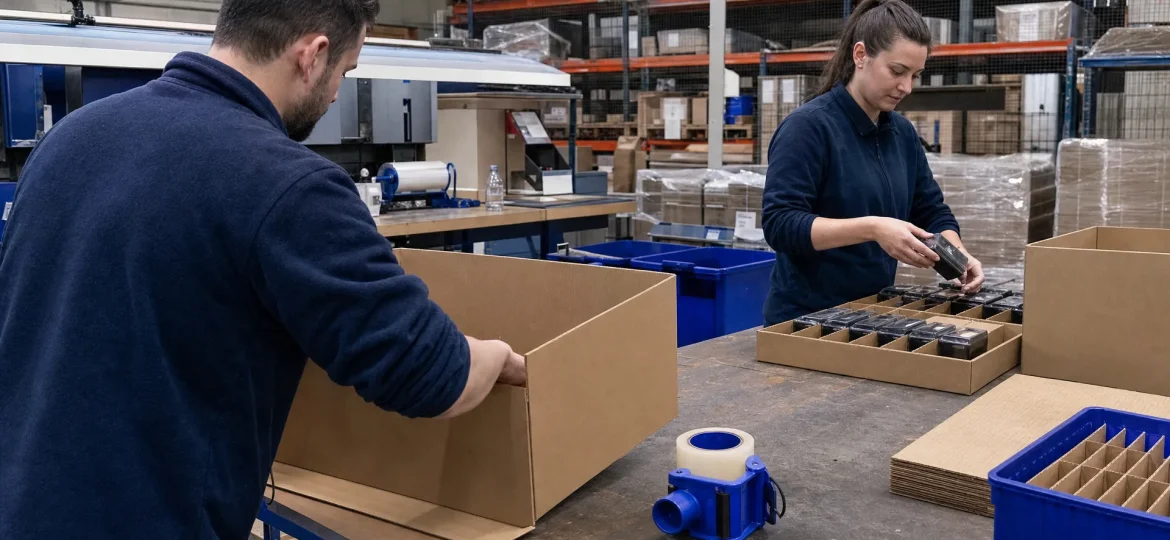
How Can I Get My Products Packed Into Retail-Ready Boxes?
A retailer has agreed to stock your products, but they need to arrive in boxes that store staff can put straight onto the shelf. Retail ready packaging services can help you turn loose stock or standard shipping cartons into correctly packed, shelf-ready cases. The starting point is the retailer’s specification, not simply choosing a box that looks right.
You will usually need a packaging supplier to provide suitable boxes and a contract packing partner to assemble, fill, check and prepare them for delivery. Sometimes one supplier coordinates both. This guide explains what to ask for, what to test and how to avoid paying for a production run that does not meet the retailer’s requirements.
Establish what the retailer means by retail-ready
Retail-ready packaging, often shortened to RRP, generally means packaging designed to move products through distribution and onto the shop floor with minimal handling. Shelf-ready packaging, or SRP, usually describes a case or tray that can go directly onto a shelf after its transport section is removed. The terms often overlap, so ask for the retailer’s actual requirements rather than relying on the terminology.
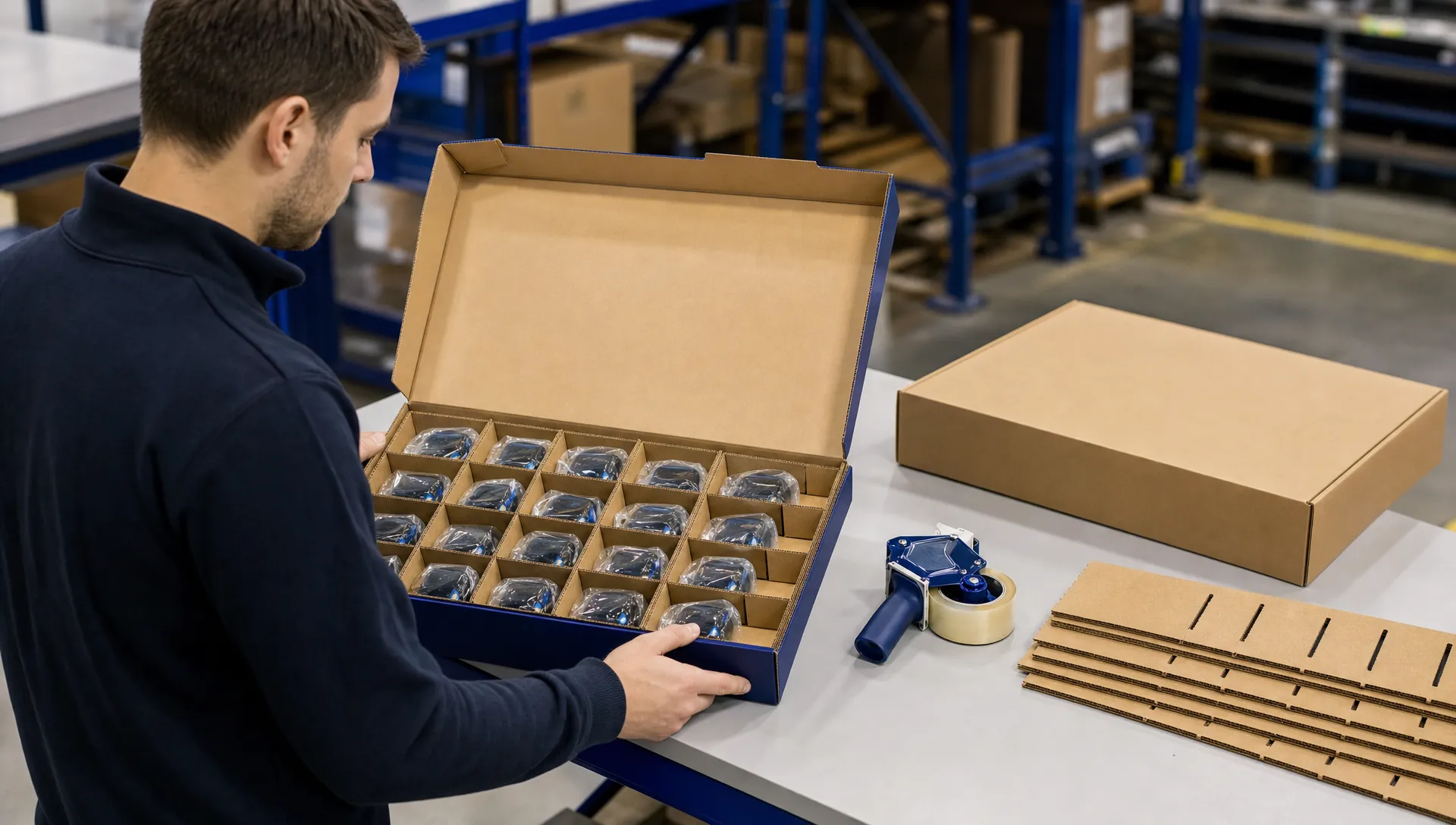
A tear-open corrugated case containing several individually packaged products is one example. Staff remove the lid or front panel, then place the loaded tray on the shelf instead of unpacking each item separately.
That is different from putting each product into its own consumer-facing box. It is also different from a freestanding display unit. If the request is for a floor-standing promotional unit, you need to plan for filling and delivering a promotional display, rather than just producing shelf trays.
What do retail ready packaging services cover?
The work can involve several suppliers, and unclear responsibilities are a common source of delays. Establish who owns each stage before agreeing prices or delivery dates.
| Stage | What needs to be agreed |
|---|---|
| Structural design | Box dimensions, opening method, product arrangement and transport protection |
| Packaging supply | Material, print, quantities, production lead time and delivery of empty boxes |
| Contract packing | Assembly, filling, labelling, checks and handling of rejected items |
| Distribution preparation | Outer cases, pallet configuration, delivery labels and retailer booking requirements |
A box manufacturer may supply printed packaging without filling it. A contract packer may work with boxes you provide, but should not be assumed to offer structural design, printing or specialist product handling.
Ask for a clear division of responsibility. In particular, confirm who orders the packaging, approves changes and pays for replacement materials if the specification changes. If several suppliers are involved, nominate one person in your business to control the approved version of the pack.
Prepare a brief based on the retailer’s specification
Before requesting retail ready packaging services, obtain the retailer’s current packaging and delivery requirements. These may come from its buying team, supplier portal or distribution team. Check that the documents apply to your product category and intended delivery route.
Your packing brief should cover:
- Product details: Each product code, dimensions, weight, orientation and any handling restrictions, supported by physical samples where possible.
- Pack quantity: Units per tray, trays per outer case and whether different products or variants can share a pack.
- Shelf requirements: Maximum footprint, available height, required facing direction and how much of the product must remain visible.
- Packaging details: Box specification, approved artwork, opening method, labels and any internal dividers or protective materials.
- Stock controls: Batch separation, serial numbers or best-before dates where relevant, plus instructions for damaged or short-delivered stock.
- Delivery requirements: Destination, required arrival date, pallet rules, booking process and any retailer-specific paperwork.
Separate confirmed requirements from assumptions. For example, “six products per tray” is useful only if the retailer has accepted that quantity and the loaded tray fits the shelf.
Include a simple acceptance standard too: what the finished pack should look like, which defects mean rejection and who can authorise a change. Photographs of an approved sample make this much easier to communicate.
Choose a format that works in transport and on the shelf
A retail-ready box has two jobs. It must protect the products during movement and become a practical display when opened. Improving one at the expense of the other can create problems further down the line.
A low-front tray might give customers a clear view of the product but provide insufficient support during transport. A strong closed case might travel well but take too long to open, or leave torn edges across the product name.
Ask the supplier to explain the trade-offs between tear-open cases, trays with removable covers and cases with separate lids. Check whether products stay upright as the tray empties, not just when it is full.
When comparing retail ready packaging services, assess the loaded pack rather than an empty box sample. Product weight, shape and surface finish can all affect how the finished case behaves.
Approve artwork, labels and product information together
Structural approval and artwork approval are separate tasks. A box can fit perfectly while carrying the wrong product description, case quantity or barcode.
Check the consumer unit and outer case separately. Confirm which codes belong on each, where labels should sit and whether scanning remains practical after the box is sealed or opened. GS1 UK provides guidance on product identification and barcodes, but the retailer’s own requirements still need checking.
For brands selling through shops and eCommerce, update product photographs and online pack quantities when the packaging changes. If a launch also requires a Webflow or Framer site update, website design and development support from BeBranded can help align the digital presentation with the new physical pack.
Keep one approved artwork version and record its approval date. Your retail ready packaging services brief should identify that version explicitly, so the packing team does not have to choose between conflicting files.
Test a finished pack before approving the full run
Approve a physical, filled sample before committing to volume. A flat drawing cannot show whether a tear strip works properly or whether the last product in a tray falls over.
Start with opening. Ask someone unfamiliar with the pack to open it using the intended method. Watch for excessive force, loose cardboard, sharp edges or a need to use a knife close to the products.
Then check shelf fit and replenishment. Measure the loaded tray against the agreed shelf space, confirm that products face the right way and remove units gradually to see how the remaining stock behaves. Where possible, involve the retailer or store staff before approving the design.
Transport protection needs its own check. Review how the case will be handled, stacked and delivered, then agree proportionate testing with the packaging supplier. Any formal test requirements should come from the retailer or an appropriate packaging specialist.
Record the results and keep an approved reference sample. If the box, product or packing arrangement changes later, decide whether another trial is needed rather than assuming the original approval still applies.
Compare quotes on the complete job
A low packing rate is not necessarily a low project cost. One quote may include assembly and checks while another assumes you will supply fully prepared boxes, labels and pallet materials.
Ask suppliers to show the main cost elements separately so you can compare the same scope.
| Cost area | Question to ask |
|---|---|
| Design and setup | Are samples, tooling, print setup and revisions included? |
| Packaging materials | Who supplies boxes, dividers, labels and protective materials? |
| Packing labour | Does the rate cover assembly, filling, sealing and agreed checks? |
| Exceptions | How are damaged goods, shortages and rework charged? |
| Storage and delivery | Are inbound handling, finished stock storage and dispatch included? |
For retail ready packaging services, compare the total cost per accepted finished case, not simply the labour charge per unit. Confirm minimum charges, material order quantities and what happens to unused packaging after the job.
Consider material use and transport efficiency together. A lighter case is not an improvement if it leads to damaged products or needs extra wrapping. Equally, an oversized box may waste shelf space and reduce the number of cases that fit on a pallet. Ask how the separated packaging components can be recycled through the retailer’s waste arrangements.
Control the handover from packing to delivery
Agree how incoming stock will be counted and checked before packing starts. If your supplier sends fewer units than expected, or mixed batches arrive without clear identification, the final output may differ from the planned quantity.
The packing team also needs instructions for exceptions. State whether damaged products should be photographed, isolated or returned, and identify who can authorise substitutions or changes to case quantities. Unapproved substitutions can create problems even when the finished box looks acceptable.
Before dispatch, reconcile the goods received, cases completed, rejected products and stock remaining. Keep any batch or date information connected to the finished cases where required.
Retail ready packaging services should also be planned around the retailer’s delivery process. Confirm who books the delivery, produces the required labels and supplies any advance shipment information. A vehicle arriving on the right day is not enough if the delivery needs a booking reference or a particular pallet configuration.
Work backwards from the required arrival date, allowing time for approvals, material supply, packing and transport. Avoid setting the packing deadline before the packaging supplier has confirmed when materials will arrive.
Arrange packing, storage and dispatch with Gus Logistics
Once your retailer requirements and packing brief are clear, Gus Logistics can discuss the practical work involved. Its contract packing service in Cheshire includes re-packing, POS assembly and related packing support for product businesses.
For a project involving retail ready packaging services, share the retailer specification, product samples, proposed boxes, quantities and deadline. Explain whether you already have a packaging manufacturer or still need to establish who will supply the materials. Specialist handling requirements should be discussed before stock is sent.
If goods need to be held before packing or released in stages afterwards, pallet and bulk storage can form part of the plan. Gus Logistics provides racked and floor storage with real-time WMS tracking through a client portal, with batch, serial number and best-before date tracking available.
Based in Nantwich, Cheshire, Gus Logistics also provides transport services. Discuss packing, storage and delivery together so responsibility for each handover is clear. There are no minimum volume requirements, although the practical scope and price still need agreeing for your particular job.
Frequently asked questions
Can my existing stock be repacked into shelf-ready boxes? Often, yes, provided the products are suitable and the proposed packaging meets the retailer’s requirements. Supply product samples and details of the current packaging so the packing partner can assess the work before quoting.
Do I need to buy the boxes myself? That depends on the agreed service. Some packing partners work with customer-supplied materials, while others may coordinate supply. Confirm who is responsible for design, purchasing, quality checks and surplus materials before placing an order.
Can different products go into the same retail-ready case? They can if the retailer accepts the mixed assortment and the packing instructions define it clearly. Specify the quantity and position of each product, then check how the assortment affects identification, stock control and replenishment.
How long do retail ready packaging services take? Timing depends on material availability, approvals, packing complexity and production capacity. Ask for a schedule covering samples, packaging supply, packing and delivery rather than relying on a single estimated turnaround time.
Discuss your retail packing requirements
Have your retailer specification, product details, quantities and required delivery date ready. Call Gus Logistics on 01270 335014 to discuss contract packing, storage and transport, and establish what needs to happen before your products can arrive ready for the shelf.
Looking for a Logistics Partner You Can Trust?
From warehousing and order fulfilment to transport and FSDU design - Gus Logistics handles it all from our base in Nantwich, Cheshire. Over 10 years experience, no minimum volumes, no long contracts.
