
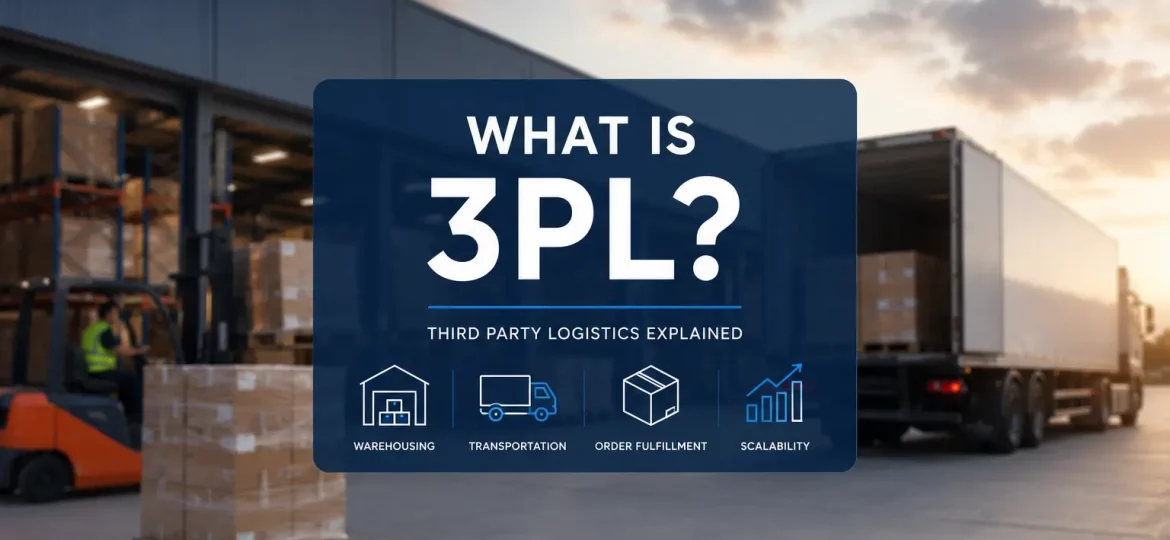
What is 3PL? A Plain English Guide to Third-Party Logistics
If you’ve been running a product-based business for any length of time, you’ve probably come across the term 3PL. It gets thrown around a lot in logistics and e-commerce circles, but the explanations are often either too vague to be useful or buried in jargon that assumes you already know what you’re looking at.
This guide covers what 3PL actually means, what a 3PL provider does, how to know whether you need one, and what to look for when you’re choosing a partner. No filler, no jargon – just a clear explanation of how third-party logistics works and whether it’s the right move for your business.
What Does 3PL Stand For?
3PL stands for third-party logistics. It refers to the practice of outsourcing some or all of your logistics operations – storage, order fulfilment, packing, and delivery – to a specialist external company rather than managing those functions yourself.
The “third party” part simply refers to the fact that a separate business is involved: you’re the first party, your customer is the second party, and the logistics provider is the third. You sell the product. The 3PL handles everything that happens between your product leaving its manufacturer and arriving at your customer’s door.
It sounds straightforward, and in principle it is. But the range of what different 3PL providers actually offer varies enormously – which is why understanding what the term covers is worth doing before you start comparing suppliers.
What Services Does a 3PL Provider Offer?
The core services offered by a 3PL provider typically include some or all of the following:
Warehousing and Storage
Your stock is held in the 3PL’s warehouse rather than your own premises. This removes the need to lease, staff, and manage your own storage space. For most growing businesses, warehousing is the first logistics function they look to outsource – the costs and operational demands of running your own facility quickly become significant as order volumes grow.
At Gus Logistics, we offer flexible pallet and warehouse storage in Nantwich, Cheshire – with no minimum volume requirements and no long-term contracts to tie you in.
Order Fulfilment
When a customer places an order, the 3PL picks the correct items from stock, packs them, and dispatches the parcel. This is the operational core of most 3PL relationships and the part that absorbs the most time for businesses managing it in-house. Done well, it’s invisible to your customers – orders arrive on time, correctly packed, and in good condition. Done badly, it’s the source of the complaints, returns, and negative reviews that damage growing brands.
Our order fulfilment service covers the full process – receiving stock, storing it, picking and packing individual orders, and dispatching same-day or next-day depending on your requirements.
Pick and Pack
Pick and pack is the operational process within order fulfilment – picking individual items from warehouse locations and packing them into appropriate packaging for dispatch. It sounds simple but accuracy matters enormously at scale. One mis-pick in a hundred orders might seem acceptable until you’re shipping a thousand orders a week and dealing with ten complaints and returns every day.
Contract Packing and Co-Packing
Some 3PL providers – including Gus Logistics – also offer contract packing services, where products are assembled, bundled, or repacked into retail-ready formats before being stored or dispatched. This is particularly useful for brands that manufacture in bulk and need product prepared for individual sale, or for promotional bundles and gift sets that need to be assembled before peak periods.
If this is relevant to your business, our contract packing service in Cheshire covers a range of packing formats and volumes.
Transport and Delivery
Many 3PL providers either operate their own transport fleet or have established carrier relationships that give their clients access to better delivery rates and service levels than they could negotiate independently. This can cover everything from same-day and next-day parcel delivery through to pallet movements and multi-drop distribution.
Our transport service handles same-day and next-day deliveries across the UK, operating from our Nantwich base in the heart of the North West.
Returns Management
Returns are one of the most time-consuming parts of running an e-commerce operation – and one of the most frequently overlooked when businesses first start thinking about outsourcing. A good 3PL will handle inbound returns, inspect items, restock where appropriate, and process refunds or exchanges according to your instructions. Getting this right protects your customer relationships and keeps your stock data accurate.
FSDU Design and Retail Display
Some 3PL providers that serve brands distributing into physical retail also offer display unit services. At Gus Logistics, this is a significant part of what we do – designing, manufacturing, pre-filling, and delivering free standing display units (FSDUs) directly to store locations across the UK. If you’re distributing into supermarkets, convenience retail, or specialist retail chains, this end-to-end service removes a significant layer of operational complexity. You can read more about how FSDUs work in our what is a FSDU guide.
1PL, 2PL, 3PL, 4PL – What’s the Difference?
You’ll sometimes see these terms used alongside each other, so it’s worth a quick explanation.
A 1PL (first-party logistics) business manages its own logistics entirely in-house – its own vehicles, its own warehouse, its own drivers. Large manufacturers and retailers sometimes operate this way.
A 2PL (second-party logistics) arrangement involves a business outsourcing a single logistics function – typically transport – to a specialist carrier. The business still manages its own warehousing and fulfilment but uses an external carrier for delivery.
A 3PL (third-party logistics) provider takes on a broader range of functions – typically warehousing, fulfilment, and transport – under a single outsourced arrangement. This is the most common model for growing e-commerce brands and product businesses.
A 4PL (fourth-party logistics) provider sits one step further back – acting as a supply chain manager that coordinates multiple logistics providers on your behalf rather than operating the logistics directly. 4PL arrangements are typically used by larger enterprises with complex, multi-territory supply chains.
For most UK product businesses and e-commerce brands, 3PL is the relevant model – and the one this guide focuses on.
Who Uses 3PL?
The short answer is: businesses of almost every size, across almost every sector. The common thread is that they sell physical products and have reached a point where managing logistics in-house is costing more – in time, money, or operational headaches – than outsourcing it would.
In practice, the businesses that benefit most from 3PL tend to fall into a few categories:
Growing e-commerce brands that started fulfilling orders from a spare room or small unit and have outgrown that model. The tipping point is usually somewhere between 50 and 200 orders a day – beyond that, in-house fulfilment starts to consume too much management time and space.
Brands distributing into retail that need their products prepared, packed, and delivered to store locations at scale – particularly where retailer compliance requirements make the logistics more complex than a simple parcel dispatch.
Seasonal businesses that need to scale up rapidly for peak periods – Christmas, summer, back-to-school – without hiring additional warehouse staff or leasing additional space for a few months of the year.
Businesses launching a new product line that want to test the market without committing to a long-term warehousing and fulfilment infrastructure.
We’ve written in more detail about the advantages of outsourcing for smaller businesses in our post on why outsourcing logistics gives SMEs a competitive advantage, and on why small e-commerce brands are moving away from in-house fulfilment.
What Are the Benefits of Using a 3PL?
You only pay for what you use
Running your own warehouse means paying for space, staff, equipment, and systems whether you’re shipping ten orders a day or a thousand. A 3PL charges on usage – storage by the pallet, fulfilment by the order. When your volumes drop, your costs drop with them. When you scale up, the infrastructure is already there.
Your time goes back into your business
Logistics operations are relentless. Orders come in every day, stock needs managing, deliveries need booking, returns need processing. For most product business owners, these tasks are consuming hours every week that could be spent on product development, sales, and marketing. Outsourcing to a 3PL hands that operational burden to people who do it full time.
You get access to better carrier rates
A 3PL provider ships a far higher volume of parcels than any individual client could on their own. That volume buys better rates from carriers – rates that get passed on to clients. For businesses shipping significant volumes, the savings on delivery costs alone can offset a significant portion of the 3PL fee.
Your fulfilment can scale without friction
Landing a new retail contract, running a successful promotional campaign, or hitting peak season can cause in-house fulfilment operations to buckle under the volume. A 3PL has the space, the staff, and the systems to absorb those peaks without the disruption that comes from scrambling to find additional resource at short notice.
Your customers get a more consistent experience
Professional fulfilment operations run to tighter accuracy and dispatch time standards than most in-house operations can sustain. That consistency – the right product, in the right packaging, arriving when it was supposed to – is what keeps customers coming back and keeps reviews positive.
What Should You Look for in a 3PL Partner?
Not all 3PL providers are the same, and choosing the wrong one is an expensive mistake to unpick once your stock is sitting in their warehouse. Here’s what to look for before you commit.
No minimum volume requirements – many larger 3PL providers have minimum monthly order commitments that don’t work for growing businesses. If you’re not yet shipping at scale, look for a provider that charges on actual usage rather than a floor commitment.
No long-term contracts – a 3PL that’s confident in its service doesn’t need to lock you in. Flexibility matters, particularly in the early stages of a relationship.
Clear, transparent pricing – ask for a full breakdown of how costs are calculated: storage per pallet, pick and pack per order, inbound receiving fees, returns handling. Hidden fees and opaque pricing structures are a red flag.
Location relative to your customers – where your 3PL’s warehouse is located affects your delivery costs and transit times. A warehouse in the Midlands or North West gives good access to the UK’s motorway network and population centres.
Direct communication – you want a direct line to the people actually handling your stock, not a call centre. Particularly when something goes wrong, the ability to speak to someone who knows your account and can resolve a problem quickly is worth a lot.
Experience with your sector – a 3PL that has handled products similar to yours – in terms of size, weight, fragility, or retailer compliance requirements – will make fewer mistakes and anticipate problems you haven’t thought of yet.
For a broader look at how to evaluate a logistics partner, our post on how to partner with a logistics company covers the process in detail.
Is 3PL Right for Your Business Right Now?
The honest answer is that it depends on where you are. If you’re shipping fewer than 20 or 30 orders a day and fulfilment is taking you an hour or two a week, the economics of outsourcing probably don’t stack up yet. Keep the operation in-house, keep your costs low, and revisit when volumes grow.
If you’re regularly spending significant time on packing and dispatch, running out of storage space, struggling to keep up during peak periods, or losing sleep over the accuracy of orders going out the door – those are all signs that a 3PL relationship would free up time and reduce operational risk at a cost that makes sense.
The UK 3PL market is substantial and growing – valued at approximately $31 billion in 2025 – which reflects how many businesses of every size have reached the same conclusion. The question isn’t whether 3PL works. It’s whether the timing is right for you.
How Gus Logistics Works as a 3PL Partner
Gus Logistics is a family-run 3PL provider based in Nantwich, Cheshire. We’ve been operating for over ten years, handling warehousing, order fulfilment, contract packing, transport, and FSDU display services for businesses across the UK.
We work without minimum volume requirements and without long-term contracts. You get direct access to the people running your account, transparent pricing from day one, and a service that scales with your business rather than ahead of it.
Our warehouse sits at Cheshire Green Employment Park on the edge of Nantwich – well positioned for distribution across the North West and the wider UK motorway network. You can read more about our role in the regional supply chain in our post on the logistics lifeline of the North West.
If you want to understand what working with us would look like for your specific operation, take a look at our warehouse operations case study or our pick and pack case study for a North West candle company
to see how the service works in practice.
Call 01270 335014 or email hello@guslogistics.co.uk – we’re happy to talk through your requirements and turn a quote around the same working day.
Looking for a Logistics Partner You Can Trust?
From warehousing and order fulfilment to transport and FSDU design - Gus Logistics handles it all from our base in Nantwich, Cheshire. Over 10 years experience, no minimum volumes, no long contracts.
