
What Is B2B Dropshipping?
If you are asking what is B2B dropshipping, you are probably looking for a way to sell more trade orders without taking on more warehouse space, more staff, or more delivery admin.
The idea sounds simple: you sell the product, and someone else stores it and sends it to the business customer. In practice, B2B dropshipping needs more control than most people expect. Trade buyers care about stock accuracy, delivery dates, pallet labels, order paperwork, proof of delivery, and consistency. If those details are weak, the model can create more problems than it solves.
This guide explains what B2B dropshipping means, how it works, where it fits, and when it makes sense to involve a logistics partner.
What is B2B dropshipping?
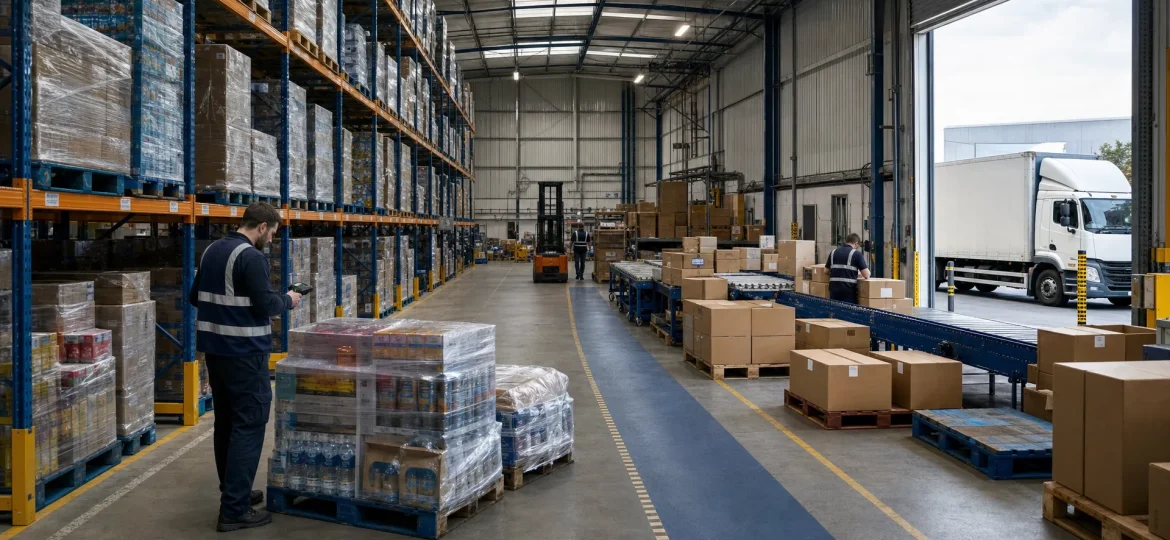
B2B dropshipping is a supply chain model where one business sells products to another business, but does not physically handle the stock before it is delivered. Instead, a supplier, manufacturer, wholesaler, or logistics partner stores the goods and ships them directly to the buyer, branch, retailer, installer, or other business location.
In a typical B2B setup, the selling business controls the customer relationship and order process. The fulfilment partner or supplier handles the operational work behind the scenes, such as storage, picking, packing, palletising, labelling, dispatch, and delivery updates.
For example, a trade supplier might sell products through an online portal, but use a warehouse partner to hold stock and dispatch orders directly to contractors. A brand might take wholesale orders from retailers, while a 3PL picks, packs, and sends those orders from a central warehouse. A manufacturer might allow distributors to sell its products without each distributor having to hold inventory in their own building.
The key point is this: B2B dropshipping is not just a shortcut for avoiding stock. It is a way of separating sales from physical logistics, but it only works well when stock control, communication, and delivery planning are reliable.
How B2B dropshipping works in practice
The exact process depends on who owns the stock and who fulfils the order, but most B2B dropshipping operations follow a similar flow.
- The seller lists products in a trade catalogue, ordering portal, marketplace, or sales system.
- A business customer places an order, often with agreed pricing, payment terms, or a purchase order.
- The order is sent to the supplier, warehouse, or 3PL handling the dispatch.
- Stock is checked, reserved, and picked from the warehouse.
- The goods are packed as parcels, cartons, cases, or pallets depending on the order size.
- The shipment is dispatched to the business customer, retailer, branch, or site address.
- Tracking details, proof of delivery, and any returns information are shared back with the seller.
That flow looks straightforward, but B2B orders often carry extra requirements. The buyer might need delivery on a certain day, goods-in paperwork, carton labels, pallet labels, batch references, serial number tracking, or agreed carrier instructions. These details matter because the buyer is usually using the goods for resale, installation, production, or retail display.
How is B2B dropshipping different from B2C dropshipping?
B2C dropshipping usually focuses on individual consumers. Orders are often single items or small parcels sent to home addresses. B2B dropshipping is more operationally demanding because the buyer is a business and the order may affect their own customers, production schedule, or retail availability.
| Area | B2C dropshipping | B2B dropshipping |
|---|---|---|
| Buyer type | Individual consumer | Business, retailer, installer, distributor, branch, or site |
| Order size | Usually single items or small baskets | Cartons, cases, mixed SKUs, pallets, or repeat bulk orders |
| Delivery expectations | Fast parcel delivery and tracking | Accurate delivery windows, booking slots, proof of delivery, and delivery instructions |
| Packaging | Consumer-friendly packaging | Trade packaging, carton labels, pallet labels, or retailer-compliant packing |
| Paperwork | Basic order confirmation and tracking | Purchase orders, delivery notes, batch details, invoices, or compliance documents |
| Returns | Consumer returns and refunds | Damages, refused deliveries, RMA processes, or stock reconciliation |
The bigger the order, the more expensive a mistake becomes. Sending one wrong item to a consumer is frustrating. Sending the wrong pallet to a retailer or trade customer can affect sales, warehouse space, labour planning, and customer trust.
Where B2B dropshipping makes sense
B2B dropshipping is useful when a business wants to expand its product range or customer base without immediately investing in extra warehouse capacity. It can also help businesses test new products, serve new regions, or support trade customers with direct-to-site deliveries.
It often works well for product businesses that already have reliable suppliers or stock-holding partners. A manufacturer might dropship to its distributor's customer. A wholesaler might support resellers by shipping directly under agreed terms. An eCommerce brand might use a 3PL to send wholesale orders to retailers while still selling direct to consumers through its website.
The model can also suit businesses with seasonal peaks. Instead of building a warehouse operation for the busiest few months of the year, they can use outsourced logistics capacity to handle higher order volumes. That said, the arrangement must be planned early. Waiting until stock has already arrived, orders are delayed, or retailers are chasing deliveries usually makes the transition harder.
B2B dropshipping is less suitable when suppliers cannot provide accurate stock data, when lead times are unpredictable, or when the seller has no control over packaging and customer communication. It may also be a poor fit for products that need specialist handling unless the fulfilment partner is set up for those requirements.
Benefits and risks of B2B dropshipping
The appeal is clear: less physical handling, lower need for warehouse space, and the ability to sell a wider range of products. But those benefits are only real if the operation is properly controlled.
| Benefit or risk | What it means in practice |
|---|---|
| Lower storage pressure | You may not need to hold every product in your own premises, which can reduce space and staffing pressure. |
| Wider product range | You can offer more SKUs without buying and storing everything yourself. |
| Faster market testing | New products can be offered to trade customers before committing to large stock positions. |
| Less handling | Goods can move from the stock holder to the buyer without being routed through your own site. |
| Stock visibility risk | If data is not accurate, you can sell items that are unavailable or delayed. |
| Delivery control risk | Poor carrier performance or unclear delivery instructions can damage your customer relationship. |
| Margin leakage | Storage charges, pick fees, packaging, failed deliveries, and returns can reduce profit if not tracked. |
| Brand experience risk | If packaging, paperwork, or communication is poor, the buyer blames the seller, not the hidden fulfilment partner. |
It is also worth remembering that physical storage may still be part of the wider solution. Even if you do not want to run your own warehouse, you may need space for buffer stock, returns, packaging, samples, or slow-moving lines. Some businesses use flexible temporary storage to bridge capacity gaps, and for US companies assessing that route, suppliers offering shipping containers for sale with nationwide delivery can be a useful comparison point.
The main lesson is simple: B2B dropshipping reduces some operational pressure, but it does not remove the need for good logistics planning.
The operational details that matter most
The businesses that succeed with B2B dropshipping usually treat it as a proper logistics model, not a side arrangement. The details below are where many setups either become reliable or start to break down.
Stock ownership and stock accuracy
First, be clear about who owns the stock. In some arrangements, the supplier owns it until it is sold. In others, the seller owns the stock but stores it with a 3PL. There are also hybrid models where core lines are owned by the seller and extended-range lines are shipped by suppliers.
Stock accuracy is critical. If your sales team or website shows stock that is not available, you risk taking orders you cannot fulfil. For B2B customers, this can create serious disruption because they may already have committed to their own customers or scheduled jobs around that delivery.
Order flow and system integration
Manual order forwarding might work for a handful of orders per week, but it becomes risky as volume grows. A good setup should allow order data to move cleanly from your sales channel to the fulfilment partner. That reduces re-keying, missed orders, and delays.
If you outsource picking, packing, and dispatch, choose a partner with a clear order fulfilment process and systems that can support your sales channels. For eCommerce-led B2B sellers, integrations can make the difference between a scalable operation and a constant admin burden.
Storage and inventory control
Even in a dropshipping model, warehousing still matters. Goods need to be stored safely, picked accurately, and tracked properly. If you sell products with batch numbers, serial numbers, or best-before dates, your warehouse process needs to capture that information.
For brands holding their own inventory with a logistics partner, pallet storage and bulk warehousing can give more control than relying entirely on suppliers. It also makes it easier to manage mixed product ranges, seasonal stock, and wholesale order preparation from one location.
Packaging, labelling, and paperwork
B2B customers may need specific delivery notes, carton labels, pallet labels, or booking references. Retailers and wholesalers can be particularly strict about how goods arrive. A missed label or incorrect pallet configuration can slow down goods-in, trigger chargebacks, or cause a refused delivery.
Agree the standards before orders start moving. That includes who provides packaging, what information appears on delivery paperwork, how damaged goods are handled, and how urgent order changes are communicated.
Delivery planning and proof of delivery
B2B delivery is often more complex than sending a small parcel to a home address. Deliveries may go to warehouses, building sites, retail stores, distribution centres, or multiple branches. Some locations need booking slots, tail-lift vehicles, Moffett delivery, or timed arrivals.
That is why transport should be planned as part of the dropshipping model, not added at the last minute. A partner offering same-day and next-day transport can help when urgent orders, stock transfers, or retailer deadlines need more than a standard parcel carrier.
B2B dropshipping, wholesale fulfilment, and 3PL: what is the difference?
These terms often overlap, which can make decision-making confusing. The simplest way to separate them is to look at who sells the goods, who owns the stock, and who handles the logistics.
| Model | How it usually works | Best fit |
|---|---|---|
| B2B dropshipping | A seller takes the order, while a supplier, manufacturer, or 3PL ships directly to the business buyer. | Businesses wanting to sell to trade customers without handling every order in-house. |
| Wholesale fulfilment | A brand or wholesaler sends bulk orders to retailers, distributors, or business buyers, often from its own stock. | Brands with regular trade orders, retail customers, or palletised shipments. |
| 3PL fulfilment | A third-party logistics provider stores stock and handles picking, packing, dispatch, returns, and sometimes transport. | Growing businesses that want control over stock and service levels without running their own warehouse. |
A 3PL arrangement is not always pure dropshipping because the seller may own the stock. However, from the customer's point of view, the result can look similar: the order is sold by one business and delivered directly from another location.
This is often the practical route for SMEs. Instead of depending entirely on suppliers, they hold selected stock with a logistics partner and outsource the operational work. That gives more control over availability, packaging, dispatch cut-offs, and customer experience.
When should you use a 3PL for B2B dropshipping?
You may not need a 3PL if your supplier can reliably store, pick, pack, dispatch, and communicate order updates to the standard your customers expect. But if you are losing time chasing suppliers, correcting stock errors, managing late deliveries, or handling warehouse tasks yourself, a 3PL can bring structure to the process.
A 3PL is especially useful when you want to combine several logistics needs in one place. For example, you might need eCommerce order fulfilment, B2B wholesale dispatch, pallet storage, returns handling, co-packing, or urgent transport. In that situation, using separate suppliers for every task can create more admin than it saves.
Gus Logistics supports growing product businesses with UK logistics services from Nantwich, Cheshire. The team handles order fulfilment and pick and pack, pallet and bulk warehousing, same-day and next-day transport, co-packing, and FSDU support for retail brands. The business is family-run, with no call centres, so customers speak directly to the people handling their freight.
For sellers using multiple channels, Gus Logistics integrates with 60+ platforms including Shopify, Amazon, eBay, WooCommerce, and Magento. For stock-holding businesses, real-time WMS tracking via a client portal can help keep inventory visible. For transport, Gus Logistics operates its own fleet and also has access to a wider UK and Europe vehicle network.
If you are comparing outsourced options, it is worth reviewing the full range of logistics services in the UK rather than looking at dropshipping in isolation. The best setup may combine warehousing, fulfilment, transport, and returns management depending on how your customers buy.
Questions to ask before starting B2B dropshipping
Before committing to any supplier or logistics partner, ask practical questions. The answers will tell you whether the model is strong enough to protect your customer relationships.
| Question | Why it matters |
|---|---|
| Who owns the stock at each stage? | This affects cash flow, insurance, liability, and stock planning. |
| How often is stock data updated? | Out-of-date stock information leads to overselling and delayed orders. |
| What are the order cut-off times? | Clear cut-offs help you set realistic delivery promises. |
| Can the partner handle B2B labels and paperwork? | Business buyers often need more than a basic parcel label. |
| What delivery services are available? | Pallets, timed deliveries, multi-drop routes, and urgent transport may be needed. |
| How are damages and returns handled? | You need a process before problems happen, not after. |
| What reporting is available? | Good data helps you understand costs, performance, and stock movement. |
If a potential partner cannot answer these clearly, proceed carefully. Dropshipping only works when responsibilities are understood by everyone involved.
Is B2B dropshipping right for your business?
B2B dropshipping can be a strong option if you want to expand without building a larger in-house operation. It can help you test new ranges, serve trade customers, reduce handling, and scale more flexibly. But it is not a magic fix for poor supplier communication, inaccurate stock, or weak delivery processes.
The model is most effective when you have clear commercial terms, reliable stock visibility, strong fulfilment processes, and delivery options that match your customers' expectations. If those foundations are in place, B2B dropshipping can support growth without forcing you to take on unnecessary warehouse overhead.
If those foundations are missing, the first step is not to sell more. It is to design a logistics setup that can cope with the orders you want to win.
Frequently Asked Questions
Is B2B dropshipping legal in the UK? Yes, B2B dropshipping is a legitimate business model when it is supported by proper supplier agreements, accurate product information, clear delivery terms, and appropriate invoicing. You should also take professional advice on tax, contracts, and compliance where needed.
Is B2B dropshipping the same as using a 3PL? Not always. Dropshipping often means a supplier ships goods on your behalf, while a 3PL usually stores and fulfils stock that you own. In practice, many B2B operations use a 3PL to create a controlled dropship-style delivery process.
Do I need a warehouse for B2B dropshipping? Not necessarily. If your supplier holds and ships the stock, you may not need your own warehouse. However, many businesses still need storage for core stock, returns, packaging, or faster-moving products.
Can B2B dropshipping work for palletised orders? Yes, but it needs proper planning. Pallet dimensions, weights, labels, delivery booking slots, vehicle access, and proof of delivery all need to be agreed before orders are dispatched.
When should I move from supplier dropshipping to outsourced fulfilment? Consider outsourced fulfilment when you need better stock control, faster dispatch, consistent packaging, multi-channel integration, or more reliable delivery performance than your suppliers can provide.
Need practical support with B2B fulfilment?
If you are exploring B2B dropshipping, wholesale fulfilment, warehousing, or transport, Gus Logistics can help you understand what setup is practical for your products, volumes, and customer expectations.
To discuss your logistics requirements, call 01270 335014 or get in touch via the contact page.
Looking for a Logistics Partner You Can Trust?
From warehousing and order fulfilment to transport and FSDU design - Gus Logistics handles it all from our base in Nantwich, Cheshire. Over 10 years experience, no minimum volumes, no long contracts.
