
Case Picking vs Each Picking vs Pallet Picking – What’s the Difference?
If you sell products online, supply retailers or do both, the way your warehouse picks orders affects handling costs, stock accuracy and dispatch speed. The question behind case picking vs each picking is straightforward: should the warehouse select individual items or complete cartons? Pallet picking adds a third option, moving a whole pallet as one load. The right approach depends on what customers order, how products arrive and the quantities your warehouse records.
Category: Order Fulfilment
Case, each and pallet picking at a glance
Picking means retrieving the stock needed to fulfil an order. These three methods describe the quantity handled, not necessarily the delivery method or sales channel.
| Picking method | What the warehouse selects | Common use | Main consideration |
|---|---|---|---|
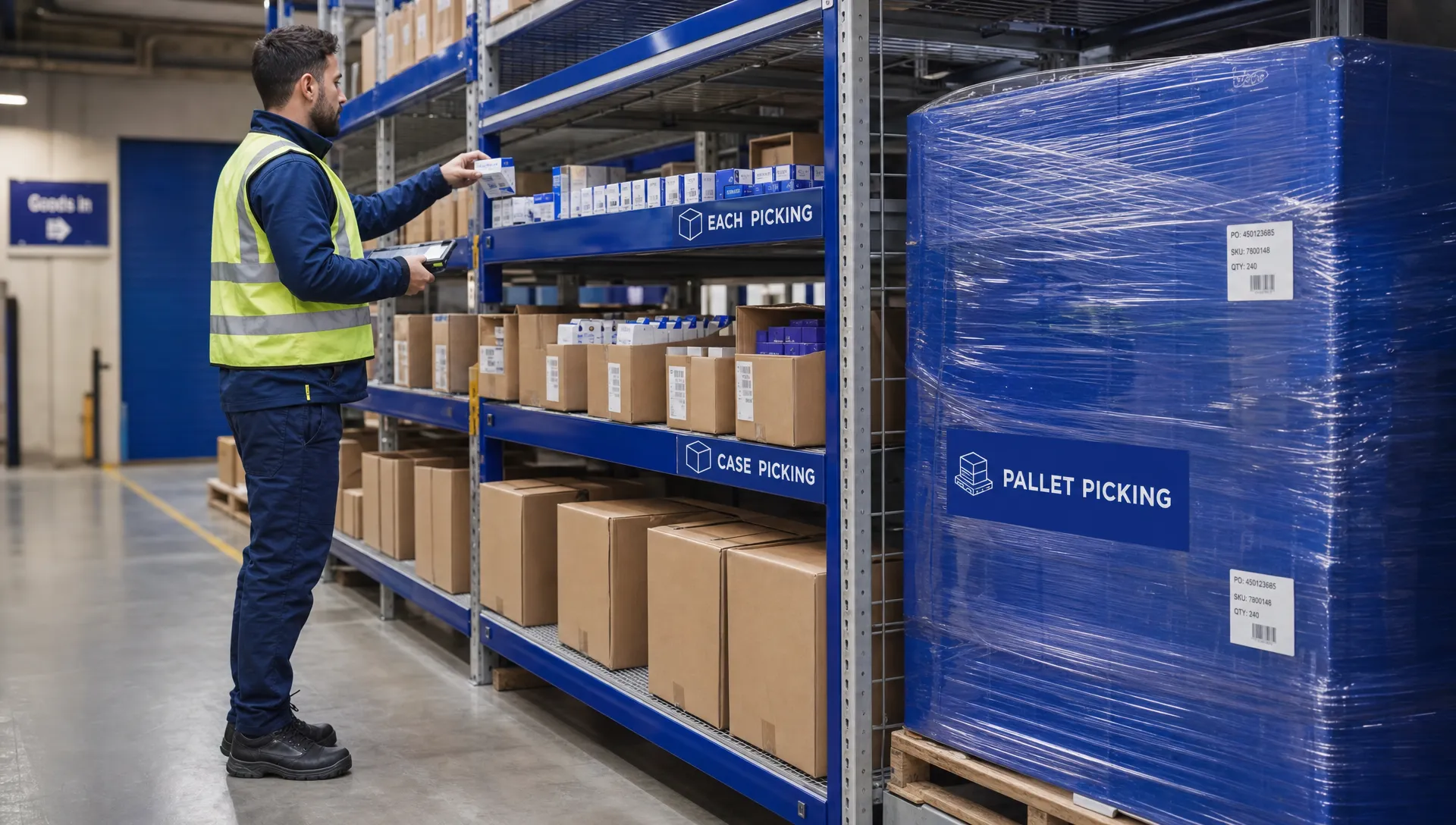
| Each picking | Individual saleable units | eCommerce orders, samples and small trade orders | More item-level handling and checking |
| Case picking | Complete cases containing a defined quantity | Wholesale orders and retail replenishment | Case quantities must match the order |
| Pallet picking | A complete pallet already held in stock | Bulk replenishment and large wholesale orders | The pallet contents must match the customer's requirements |
For example, imagine a product packed in cases of 12, with 48 cases on a full pallet. An order for two units normally needs each picking. An order for 36 units could be fulfilled as three complete cases. An order for 576 units could use one full pallet, provided its contents, condition and stock details are suitable.
When comparing case picking vs each picking, start with the quantity customers actually order, not simply whether they are consumers or businesses. A trade customer might order individual units, while an online customer might buy a complete case.
Understanding case picking vs each picking in the warehouse
Each picking: selecting individual saleable units
Each picking, also called unit picking or piece picking, involves selecting individual saleable units from a storage location. A warehouse worker might collect one candle, two bottles or three boxed accessories, then pass them for checking and packing.
An “each” is the unit your business sells and tracks. It could be one bottle or a pre-packed set sold under a single product code. It does not always mean one physical object.
This method suits orders with small quantities or several different products. It also allows customers to buy quantities that are not multiples of a full case.
The trade-off is handling. Workers may need to open outer cartons, replenish picking shelves and check several items for one order. Packaging must then protect the individual products during delivery.
Case picking: selecting complete cartons
Case picking involves retrieving complete cases rather than opening them to select individual units. If a retailer orders five cases of the same product, the warehouse can pick those five cartons as complete handling units.
A practical distinction in case picking vs each picking is that a case contains a known quantity, but “one case” is not a universal measure. One product might have six units per case and another might have 24.
Some products also have inner packs within an outer carton. Your order instructions should make clear whether the customer wants an inner pack or the full outer case.
Case picking can reduce handling when customers consistently order in complete-case quantities. It still requires checks for the correct product, quantity and any relevant batch or best-before date. A sealed carton is not automatically suitable for parcel delivery either, so dispatch packaging requirements need checking separately.
Pallet picking: retrieving a complete stored pallet
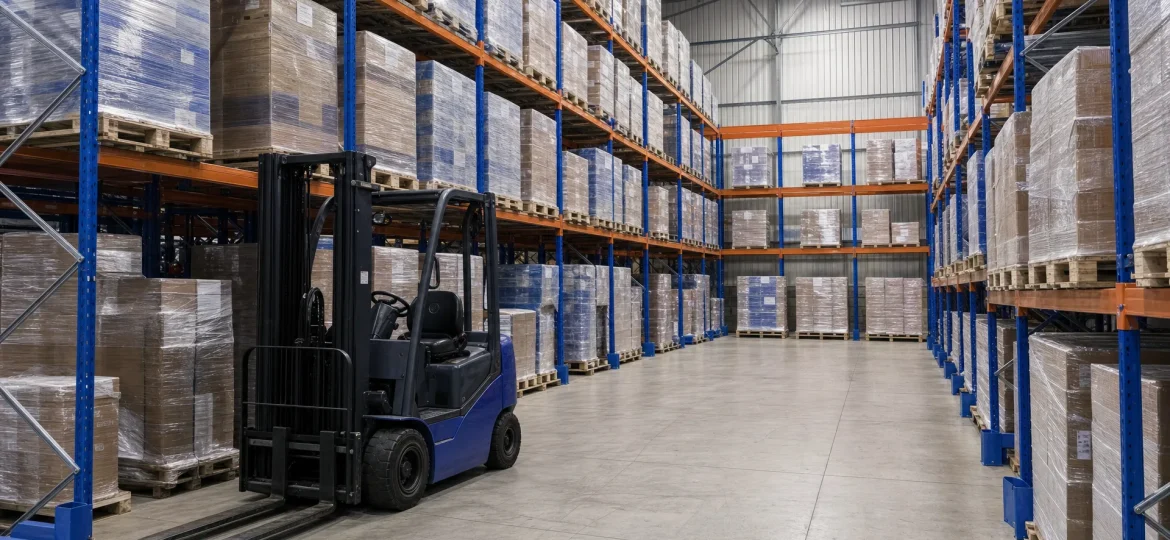
Pallet picking means retrieving an entire pallet already held in storage for an order. The goods remain together rather than being selected carton by carton.
It suits orders that match the quantity and contents of an available pallet. The warehouse still needs to verify the stock, pallet condition and any customer requirements before dispatch.
Building a mixed pallet is different from picking a full pallet. If workers select cases of several products and assemble them onto a new pallet, the picking work is usually case picking followed by pallet building. The fact that the order leaves on a pallet does not make it a full-pallet pick.
That distinction matters in a case picking vs each picking comparison because the shipping format alone does not reveal how much warehouse work an order requires.
Can one order use more than one picking method?
Yes. Many product businesses need a combination, particularly when they sell through both eCommerce and wholesale channels.
Using the earlier example, an order for 30 units could be picked as two complete cases of 12 plus six individual units. A larger order might require a full pallet and several additional cases. The warehouse needs clear instructions for handling those combinations.
An integrated approach also depends on replenishment. Individual picking shelves may need topping up from reserve cases or pallets. That movement takes time and should be considered when planning capacity and comparing costs.
For case picking vs each picking, the practical goal is to use complete packs where appropriate without restricting the quantities customers can buy. Customer packaging rules, stock rotation requirements and product condition may affect the choice.
Businesses supplying retailers should also establish whether an order can combine batches and how cartons must be presented. A discussion about B2B fulfilment in Cheshire should cover these order-level requirements, not just total monthly volume.
What changes the cost of each method?
Selecting one complete case can involve less work than selecting its contents individually. However, there is no universal price ranking that applies to every warehouse or product.
The cost depends on the full process: accessing the stock, checking it, moving it to packing and preparing it for collection. A heavy case may need different handling from a small carton. A full pallet might need inspection, wrapping or additional dispatch preparation.
A useful case picking vs each picking cost comparison should therefore use representative orders rather than headline picking rates alone.
Ask providers to explain the following charges:
- Picking: Whether the rate applies per order, order line, individual unit, case or pallet, and how mixed orders are charged.
- Replenishment: Whether moving reserve stock into picking locations is included or charged separately.
- Packing: Whether cartons, protective materials, labels and pallet preparation are included.
- Additional work: How retailer-specific preparation, batch requirements or other agreed tasks affect the quote.
Send sample orders showing product codes, quantities and packing requirements. Include both routine orders and awkward combinations, such as two complete cases plus three loose units. This makes quotes easier to compare without assuming that different providers use the same definition of a “pick”.
The stock records that make picking work
Record quantities in consistent units
A warehouse management system needs a reliable relationship between individual units, cases and pallets. If one case contains 12 units, receiving ten cases should represent 120 units in the stock record, whether the system displays that stock as units, cases or both.
Problems arise when an order requests “12” but nobody has agreed whether that means 12 units or 12 cases. Product codes, packaging identifiers and order data must distinguish those quantities clearly.
For each product, confirm the saleable unit, units per inner pack, units per outer case and any standard pallet quantity. Record product dimensions and weights as well. If a supplier changes the case quantity, update the warehouse before the new stock arrives.
Keep stock rotation and storage in the decision
The choice is not only about quantity. An order might need a particular batch or a minimum remaining shelf life, which could rule out an otherwise convenient full pallet.
For case picking vs each picking, accurate pack quantities and stock controls matter more than choosing one method for every order. Breaking cases must not obscure the batch or best-before information needed for the remaining units.
Storage also needs to support access. Reserve pallets and individual picking locations serve different purposes. When reviewing pallet and bulk storage options, explain how often stock will leave as full pallets, complete cases or individual units.
How to choose the right approach for your business
Start with a recent order sample that reflects normal trading, including wholesale orders if you sell through more than one channel. Identify how many orders require individual units, complete cases, full pallets or a combination.
Then check whether the packaging supports those orders. If customers regularly buy six units but your supplier delivers cases of 24, the warehouse needs a clear process for opening cases and protecting the remaining stock. If retailers order only complete cases, storing everything for individual access may create unnecessary work.
Your case picking vs each picking decision should follow this order profile, rather than a preference for whichever method sounds fastest. Seasonal demand and new sales channels may change the mix over time.
Agree the operating rules with your warehouse or 3PL before stock arrives: what constitutes a case, when cartons may be opened and which customer requirements take priority. Broader pick and pack best practices can then help improve layout, checking and day-to-day execution.
Frequently asked questions
Is each picking the same as pick and pack? Not exactly. Each picking describes selecting individual saleable units. Pick and pack describes the wider process of selecting goods and packing them for dispatch, which can include individual units or complete cases.
Is case picking always cheaper than each picking? No. It can reduce handling when orders match complete-case quantities, but the total cost also depends on access, weight, checks, replenishment and dispatch preparation. Compare sample orders on the same basis.
Does a delivery on a pallet count as pallet picking? Not necessarily. A pallet assembled from separately selected cases involves case picking and pallet building. Full-pallet picking means retrieving a complete pallet already held in stock.
Can the same stock supply eCommerce and wholesale orders? Yes, provided the warehouse can manage the different quantities and customer requirements. In case picking vs each picking, a shared stock pool needs accurate pack quantities, clear replenishment rules and consistent stock records.
Discuss your picking requirements with Gus Logistics
Gus Logistics is a family-run 3PL provider based in Nantwich, Cheshire, supporting businesses across the UK with order fulfilment, pallet and bulk warehousing, co-packing and transport. There are no minimum volume requirements.
Its warehouse services include real-time WMS tracking through a client portal, with batch, serial number and best-before date tracking available. Bring examples of your eCommerce and trade orders, supplier pack quantities and retailer requirements so the discussion focuses on the work your business actually needs.
Call Gus Logistics on 01270 335014 to discuss your order profile, storage requirements and fulfilment options.
Looking for a Logistics Partner You Can Trust?
From warehousing and order fulfilment to transport and FSDU design - Gus Logistics handles it all from our base in Nantwich, Cheshire. Over 10 years experience, no minimum volumes, no long contracts.
