
How Much Warehouse Space Does 100 Pallets Actually Need?
If you are trying to find warehouse space for 100 pallets, the frustrating answer is that 100 pallet spaces do not automatically equal one simple floor area. The true requirement depends on pallet size, stackability, how often stock needs to be accessed, whether you need picking and packing and how much safe working room the warehouse operation needs.
The useful answer is to separate pallet footprint from usable warehouse space. A calculator might tell you the minimum floor area your pallets occupy, but a real warehouse has aisles, goods-in space, dispatch space, handling equipment and safety routes. If you are choosing between leasing your own unit and outsourcing storage, those details make a big difference to cost and practicality.
The short answer: warehouse space for 100 pallets
The basic maths is simple: 100 standard UK pallets placed directly on the floor cover 120 square metres, or about 1,292 square feet. That is a footprint calculation, not a usable warehouse layout. A working warehouse needs clearance around pallets, safe routes for people and equipment, space for goods coming in and space for orders leaving.
As a practical planning guide, most businesses should think in ranges rather than one fixed number:
| Storage scenario | Approximate floor area to allow | What this assumes |
|---|---|---|
| Pure pallet footprint only | 120 sq m, about 1,292 sq ft | Calculation only, not a working layout |
| Compact floor storage | 150 to 220 sq m, about 1,615 to 2,368 sq ft | Low access, compatible pallets, simple movement |
| Mixed pallet access | 220 to 320 sq m, about 2,368 to 3,444 sq ft | More aisles, more SKUs, regular stock movement |
| Storage plus picking or staging | 300 sq m or more, about 3,229 sq ft or more | Packing, goods-in, returns or outbound order staging |
These figures are working estimates, not a substitute for a measured layout. If your stock can go into racking, the amount of floor used per pallet position can reduce because height is being used. If your stock is awkward, fragile, heavy or accessed daily, the real requirement can increase quickly.
Start with the pallet footprint
The right warehouse space for 100 pallets starts with pallet dimensions. A standard UK pallet is normally 1,200 mm by 1,000 mm, giving a footprint of 1.2 square metres. A Euro pallet is normally 1,200 mm by 800 mm, giving a footprint of 0.96 square metres.
| Pallet type | Footprint per pallet | Footprint for 100 pallets |
|---|---|---|
| Standard UK pallet | 1.2 sq m, about 12.9 sq ft | 120 sq m, about 1,292 sq ft |
| Euro pallet | 0.96 sq m, about 10.3 sq ft | 96 sq m, about 1,033 sq ft |
That calculation only works if goods sit neatly within the pallet edge. If cartons, drums, bags or displays overhang, use the largest actual dimensions of the loaded pallet. A pallet that is technically 1,200 mm by 1,000 mm but overhangs by 100 mm on each side will take more space and may be unsuitable for some racking configurations.
Why pallet footprints are only the starting point
The safe warehouse space for 100 pallets also has to include what happens around the pallets. Staff need room to inspect stock, handling equipment needs room to turn and goods need somewhere to wait before they are put away or dispatched.
If pallets are crammed into a unit with no proper aisle plan, the result is usually slower work, more handling and a higher risk of damage. You might save floor area on paper, but lose time every time stock has to be moved to reach the pallets behind it.
Safety matters too. The Health and Safety Executive provides guidance for warehousing and workplace transport, including the importance of safe movement around storage areas. In practical terms, that means aisles, pedestrian routes, loading areas and access to doors cannot be treated as spare space.
Four factors that change the number
For many businesses, warehouse space for 100 pallets changes because the stock is not just sitting still. It is arriving, being checked, moved, picked, replenished, dispatched or returned. The more active the stock is, the more working space you need around it.
Pallet height and stackability
If pallets can be safely stacked two-high or placed in pallet racking, you may need less floor area than a one-high floor storage layout. If the goods are fragile, unstable, heavy or have weight limits, you may need every pallet to sit on its own footprint.
Stackability is not just about the product. Packaging strength, pallet condition, load weight and insurance requirements can all affect what is sensible. A warehouse provider should ask about these details before quoting because a low-cost layout that damages goods is not really low cost.
Stock access and rotation
One hundred pallets of one slow-moving SKU can be stored far more tightly than 100 pallets split across 60 SKUs that need picking every day. If you need first-in, first-out rotation, batch control, serial number tracking or best-before date management, you need a layout that allows the right stock to be reached without excessive rehandling.
This is where businesses often underestimate space. The issue is not only how many pallets you have. It is how many pallets need to be reachable at the same time.
Goods-in, dispatch and returns
Pallets rarely arrive and leave one at a time in a perfectly even pattern. You may need temporary space for deliveries awaiting checks, pallets awaiting collection, courier cages, packaging materials, returns or stock that needs relabelling.
If your operation includes eCommerce dispatch, the storage area may also need pick faces, packing benches, consumables and finished order staging. Those areas can be just as important as the pallet locations themselves.
Handling equipment and aisle requirements
A warehouse using manual pallet trucks does not operate in the same way as one using reach trucks, counterbalance forklifts or articulated trucks. Aisle widths vary by equipment type, pallet size, load weight and racking configuration.
Rather than guessing, ask the warehouse provider how they plan to handle your goods. The answer should cover equipment, aisle access, loading arrangements and how pallets are tracked once inside the building.
Worked examples for 100 pallets
Any calculation for warehouse space for 100 pallets should start with how the stock behaves. The table below shows why the same pallet count can lead to different operational requirements.
| Business situation | Likely storage approach | Main space pressure |
|---|---|---|
| Manufacturer holding finished goods | Bulk floor storage or racking | Efficient pallet storage and outbound loading |
| Importer with mixed SKUs | Accessible pallet locations | Aisles, stock checks and selective access |
| eCommerce brand dispatching daily | Pallet storage plus pick faces | Picking, packing and courier staging |
| Retail supplier building displays | Storage plus co-packing area | Assembly space, packaging and outbound staging |
The manufacturer may only need simple pallet storage if goods leave in full pallets. The eCommerce brand may need more usable space because goods have to be broken down, picked, packed and dispatched as individual orders. The retail supplier may need room for point of sale display assembly or pre-filled display units before distribution.
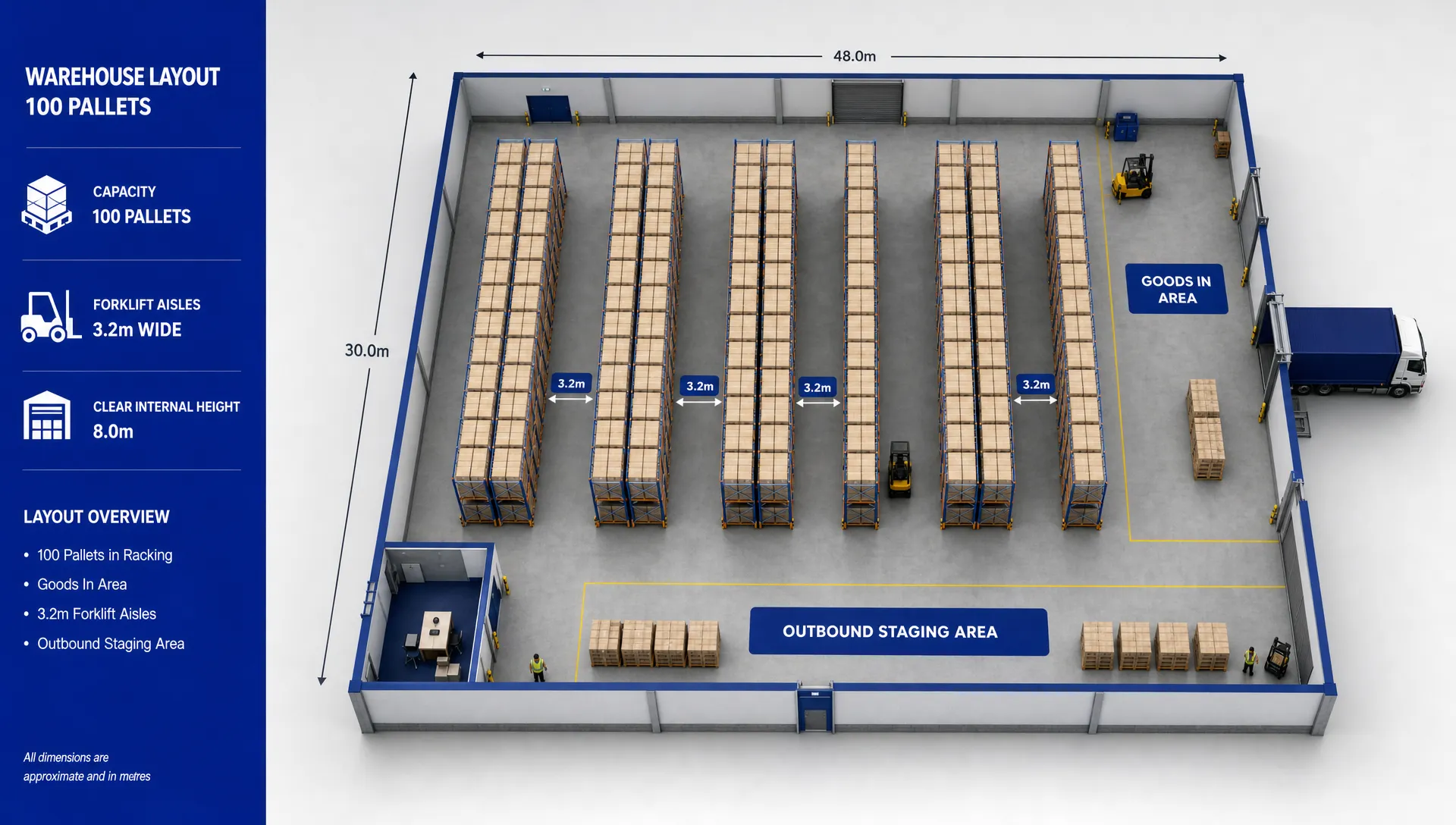
This is why a quote based only on pallet count can miss the real operational need. The better question is not just how many pallets fit, but how those pallets need to move through the warehouse.
Racked storage changes the question
When pallet racking is available, warehouse space for 100 pallets is better described as 100 pallet positions rather than a simple block of floor area. Racking uses vertical height, so the floor footprint can be smaller than storing every pallet one-high on the floor.
Racking is not always the automatic answer. It depends on pallet weight, pallet condition, load height, product type, fire routes, sprinkler requirements and the handling equipment used. Some goods are better suited to racked storage because every pallet can be accessed individually. Other goods work well in bulk storage if they are stable, stackable and move in larger batches.
For businesses comparing options, a provider offering both floor and racked storage can be useful because the layout can be matched to the stock rather than forced into one method. Gus Logistics provides pallet and bulk warehousing with racked and floor storage options, plus real-time WMS tracking via a client portal. Batch, serial number and best-before date tracking are also available where required.
Should you lease your own unit or use a 3PL?
If you only need warehouse space for 100 pallets, leasing your own warehouse can be more commitment than you expect. The rent is only one part of the cost. You may also need racking, handling equipment, warehouse staff, insurance, utilities, security, software, packaging storage and transport arrangements.
Leasing can make sense if you have a stable operation, predictable stock levels and the management time to run the site properly. It can be less attractive if your stock fluctuates, you are growing quickly or you mainly need flexible space without hiring a warehouse team.
A 3PL can be a practical alternative because you are buying a managed service rather than an empty building. If you are searching for warehouse options near your operation, look for more than square footage. Ask how goods are received, tracked, stored, picked, dispatched and returned.
For eCommerce brands, storage often sits alongside order fulfilment and pick and pack. Connecting those services can reduce double handling because stock does not need to move between a storage unit and a separate fulfilment operation.
What to prepare before asking for a quote
When asking for warehouse space for 100 pallets, the quickest way to get an accurate answer is to share operational detail rather than only the pallet count. A good warehouse provider will want to understand the work behind the storage.
Prepare the following information before requesting a quote:
- Pallet type, including UK pallet, Euro pallet or another size
- Average and maximum pallet height
- Average and maximum pallet weight
- Number of SKUs across the 100 pallets
- Whether pallets are stackable
- How often pallets need to be accessed
- Inbound delivery frequency and typical load size
- Outbound order pattern, including full pallets, cases or individual units
- Batch, serial number or best-before tracking requirements
- Any picking, packing, labelling, rework or returns handling needed
- Seasonal peaks or expected growth over the next 6 to 12 months
This information helps the provider decide whether your stock is best suited to racked storage, bulk floor storage or a mixed layout. It also helps avoid underquoting, where the monthly storage price looks attractive but the operation later becomes slow, awkward or expensive to run.
How Gus Logistics can help
For a business that needs warehouse space for 100 pallets today but may need more or less later, flexibility can be more valuable than renting a fixed unit. Gus Logistics is a family-run 3PL provider based in Nantwich, Cheshire, supporting eCommerce brands, manufacturers and product businesses across the UK.
The location gives practical access to the M6, M56 and M62, which is useful for businesses distributing across the North West and wider UK. The service is designed around real operational support rather than call centres, so customers speak directly with the people handling their freight and stock.
Gus Logistics can support pallet and bulk storage, order fulfilment, returns management, same-day and next-day transport, co-packing and FSDU work. There are no minimum volume requirements, which can be helpful if you need professional storage and fulfilment support without committing to a large fixed warehouse footprint.
If your operation needs late dispatch, Gus Logistics also offers order fulfilment with integrations for 60+ platforms including Shopify, Amazon, eBay, WooCommerce and Magento, with late cut-offs up to 10pm and next-day dispatch available.
Frequently asked questions
How many square feet do 100 standard UK pallets occupy? One hundred standard UK pallets occupy about 1,292 square feet as a footprint only. A usable warehouse layout will normally need additional space for aisles, goods handling, staging and safe movement.
Can 100 pallets fit in a small industrial unit? They can, depending on the unit size, access, ceiling height, door layout, handling equipment and whether the pallets need frequent access. A unit that fits the footprint may still be unsuitable for daily warehouse operations.
Is racked storage better than bulk storage for 100 pallets? Racked storage is often better when you need individual pallet access, stock rotation or clear tracking. Bulk storage can work well for stable, stackable goods that move in larger batches.
Do I need extra space for eCommerce fulfilment? Yes, if pallets are being broken down into individual orders. You will usually need space for pick faces, packing benches, packaging materials, courier sorting, dispatch staging and returns.
What if my pallet count changes every month? Flexible 3PL storage can be more practical than leasing fixed space if your stock levels rise and fall. It allows your storage and fulfilment setup to adjust as demand changes.
Need help working out your pallet storage requirement?
If you are planning a move, taking on more stock or comparing outsourced warehousing, Gus Logistics can help you work out the right setup before you commit to space you may not need.
Call 01270 335014 or get in touch via the Gus Logistics contact page to discuss your pallet storage, fulfilment or transport requirements.
Looking for a Logistics Partner You Can Trust?
From warehousing and order fulfilment to transport and FSDU design - Gus Logistics handles it all from our base in Nantwich, Cheshire. Over 10 years experience, no minimum volumes, no long contracts.
