

How to Fix Recurring Late Deliveries From Your Warehouse
Late deliveries from your warehouse are frustrating because they rarely fail in one obvious place. A courier may miss a collection, but the real delay might have started hours earlier with a stock discrepancy, a slow picking process, a late order import or a dispatch cut-off nobody is actively managing.
If it happens once, it is an operational problem. If it keeps happening, it is a system problem.
The good news is that recurring late deliveries can usually be fixed without guessing. You need to separate warehouse delays from carrier delays, measure the right points in the process and remove the bottlenecks that keep pushing orders past their promised dispatch time.
First, define what “late” actually means
Before changing anything, agree what counts as late in your business. This sounds basic, but many teams use the same word for several different problems.
An order can be late because it was picked after the internal deadline. It can be late because it sat packed on a bench waiting for a courier label. It can be late because the carrier collected on time but missed its delivery service level. Or it can be late because the customer was promised a delivery date that the warehouse was never realistically set up to meet.
For warehouse-led delays, focus on four timestamps:
| Timestamp | What it tells you | Why it matters |
|---|---|---|
| Order received by warehouse | When the warehouse could first act | Shows whether platform imports or order files are delayed |
| Pick started | When warehouse work actually began | Reveals backlogs, staffing issues or poor prioritisation |
| Order ready for dispatch | When the warehouse finished the job | Separates warehouse performance from courier performance |
| Carrier collection scan | When the order left the building | Shows missed collections, late manifests or transport problems |
If you do not have these timestamps, that is the first issue to solve. You cannot fix recurring late deliveries from your warehouse if you only see the final customer complaint.
Find the pattern behind the delays
Late deliveries usually follow a pattern. Look at the last 30 to 60 days of delayed orders and group them by cause, not by who shouted loudest.
| Pattern you see | Likely root cause | First fix to test |
|---|---|---|
| Orders placed after lunch miss next-day dispatch | Cut-off time is too late for current capacity | Bring the customer-facing cut-off in line with warehouse reality |
| Delays happen after stock arrives | Slow put-away, missing labels or poor booking-in process | Improve inbound checks and location control |
| Delays affect only certain SKUs | Hard-to-pick stock, awkward packaging or stock accuracy issues | Relocate, relabel or rework the affected SKUs |
| Orders are packed but not collected | Carrier collection slot, manifesting or transport issue | Review collection times and backup transport options |
| Late deliveries spike during promotions | Demand forecast and staffing mismatch | Share campaign dates earlier and build extra capacity |
Do not try to fix every possible problem at once. Start with the delay type that affects the most orders or the most valuable customers.
Check whether your cut-off time is realistic
A late delivery often starts with an over-ambitious promise. If your website says orders placed by 5pm will be delivered tomorrow, your warehouse must have enough time to import the order, allocate stock, pick, pack, label, manifest and hand it over to the carrier before collection.
That promise becomes fragile if orders are downloaded manually, stock is not where the system says it is or your carrier collects before the final wave has been completed.
A practical fix is to set two cut-offs:
- Customer cut-off: The latest time a customer can place an order and still receive the advertised delivery option.
- Warehouse cut-off: The latest time the warehouse can receive a clean, paid and stock-available order for same-day dispatch.
- Carrier cut-off: The final point at which the parcel or pallet must be manifested and ready for collection.
These three times should work backwards from the courier collection, not forwards from what your sales team would like to offer.
If your warehouse can genuinely process later orders, a later cut-off can be a competitive advantage. Gus Logistics supports order fulfilment for growing eCommerce businesses with integrations across 60+ platforms, late cut-offs up to 10pm and next-day dispatch. The key is that the systems, warehouse team and transport plan all need to support the promise.
Fix order flow before blaming the warehouse floor
Many recurring delays begin before anyone touches a product. Orders may be held in a sales channel, payment system or manual spreadsheet. If your warehouse only receives order files at fixed times, customers may think they ordered early enough while the warehouse actually received the job too late.
Look closely at how orders reach the warehouse. Manual exports, email attachments and copied CSV files create hidden delay. They also make it harder to see which orders are urgent, which are held due to stock issues and which need special handling.
A better process gives the warehouse live or frequent order visibility, with clear rules for exceptions. At minimum, your team should know:
- Which orders are eligible to ship today.
- Which orders are missing stock, payment or address data.
- Which sales channels have priority cut-offs.
- Which orders require extra packing, labelling or documentation.
If you sell through Shopify, Amazon, eBay, WooCommerce, Magento or multiple channels at once, system integration matters. It reduces manual handling and gives the warehouse more of the day to do the physical work.
Improve stock accuracy and location control
Late deliveries from a warehouse are often caused by missing stock that is not technically missing. It may be in the building, but in the wrong location, unbooked after delivery, hidden behind other pallets or labelled in a way that slows picking.
This is especially common when a business has grown quickly. What worked with a few shelves and a spreadsheet becomes unreliable when you have more SKUs, more sales channels and more inbound deliveries.
The fix is not just “count stock more often”. Stock accuracy depends on good receiving, clear locations and disciplined movements. Every product should have a known location, every inbound delivery should be checked before it is made available to sell and stock adjustments should have a reason attached.
If your current space is making that difficult, it may be time to review whether your warehouse setup still fits your business. A provider offering warehouse storage with real-time stock visibility can help reduce the manual searching and rechecking that pushes orders past dispatch deadlines.
Businesses also need to consider location. A warehouse that is cheap but poorly placed can add time to every outbound movement, especially for UK-wide distribution. If you are comparing options locally, this guide to finding warehouses near me explains what to look for beyond square footage alone.
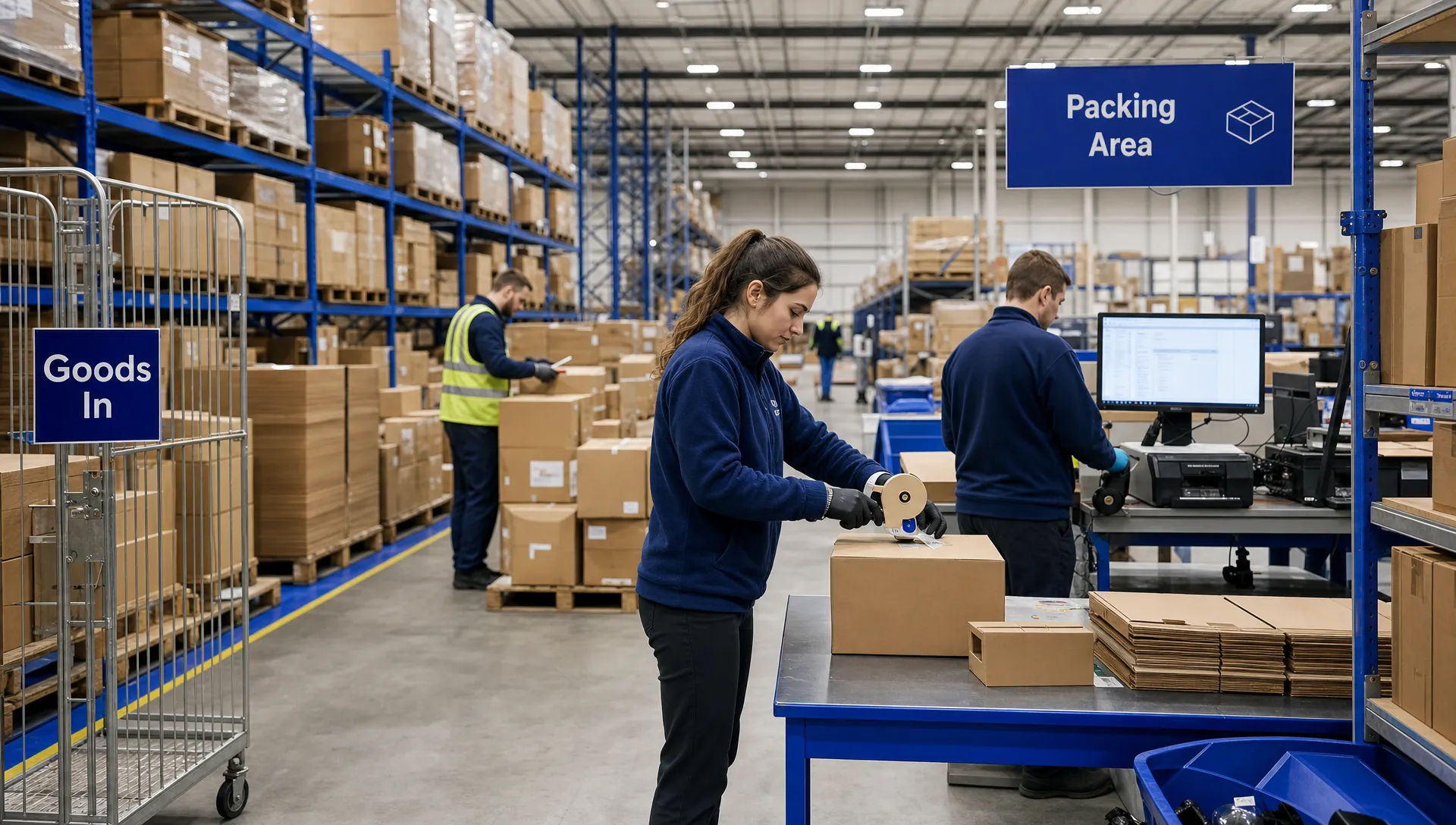
Build a dispatch control routine
Recurring late deliveries are easier to prevent when someone owns the dispatch position throughout the day. This does not have to be complicated. It can be a simple routine that makes delays visible before they become customer complaints.
A good dispatch control routine includes:
- Morning review: Check overnight orders, aged orders and anything held from the previous day.
- Midday check: Confirm whether today’s order volume is on track for the carrier collection.
- Pre-cut-off check: Identify urgent orders, problem SKUs and anything still waiting to be picked.
- Collection check: Confirm manifests, labels and handover before the driver leaves.
- End-of-day review: Record any orders that missed dispatch and the reason why.
The final point is important. “Too busy” is not a useful reason. Better reasons are “stock not booked in”, “address exception”, “carrier collected early”, “order imported late” or “picking backlog in Zone B”. Specific reasons create fixes.
Match warehouse capacity to demand peaks
If late deliveries only happen during peak weeks, product launches or retailer promotions, the issue may be capacity rather than process. The warehouse may run well at normal volume but fail when order numbers double, bulky stock arrives or extra packing requirements appear.
This is common for SMEs because growth often arrives unevenly. One campaign performs better than expected, one retailer places a larger order or one container lands later than planned. The warehouse team then has to handle inbound stock, existing dispatches and urgent outbound orders at the same time.
To reduce late deliveries during peaks, share demand information as early as possible. Promotions, seasonal launches, planned retail drops and expected container arrivals should be visible to the warehouse before they happen. If you outsource, your 3PL should ask for this information and explain what capacity they can support.
For in-house teams, check whether the bottleneck is labour, packing space, stock put-away, label printing, carrier collection size or management visibility. Adding more people will not fix a shortage of packing benches or a carrier collection that is too small for the volume.
Review courier and transport performance separately
Not every late delivery is the warehouse’s fault. Once an order leaves the building on time, carrier performance becomes a separate issue. That said, the warehouse still influences delivery speed through service selection, manifest accuracy, loading order and collection readiness.
Separate your reporting into “late dispatch” and “late in transit”. If the warehouse is regularly ready on time but deliveries still miss their promise, look at the delivery service, collection time, trunking route, pallet network cut-offs or courier claims process.
For urgent, bulky or high-value consignments, standard parcel services may not be the right fit. Gus Logistics provides same-day and next-day transport services through its own fleet and wider vehicle network, which can help when a time-sensitive delivery needs more control than a standard carrier route.
Put temporary safeguards in place for customers
While you fix the root cause, protect your customers from repeated disappointment. If a product line, warehouse zone or carrier route is causing delays, make short-term changes rather than hoping the issue settles down.
Practical safeguards include moving vulnerable SKUs earlier in the pick wave, reducing the advertised cut-off temporarily, upgrading delivery for affected customers or pausing a delivery promise on products that need extra handling.
Customer communication also matters. A customer who is told early that an order has been delayed is usually easier to retain than a customer who has to chase after the delivery date has passed. Make sure your customer service team can see accurate dispatch status, not just generic tracking information.
When to consider changing your warehouse setup
If you have fixed obvious process issues but late deliveries keep returning, your current warehouse model may no longer fit the business.
That does not always mean outsourcing everything immediately. It may mean moving stock to a better location, using overflow storage for peak periods, outsourcing certain channels or using a 3PL for products that need faster dispatch.
However, a change is worth considering if you regularly see these signs:
- Your team spends more time chasing orders than improving operations.
- Stock is frequently available to sell but hard to find in the warehouse.
- Dispatch cut-offs keep moving earlier because the operation cannot keep up.
- Promotions create backlogs that take days to clear.
- Carrier collections are missed because goods are not ready.
- Customer reviews mention delivery delays even when demand is predictable.
At that point, the cost of staying as you are may be higher than the cost of changing. Late deliveries affect repeat orders, marketplace performance, retailer relationships and staff morale.
A 30-day plan to reduce recurring late deliveries
If you need a practical starting point, use the next month to gather evidence and make targeted improvements.
| Timeframe | What to do | What success looks like |
|---|---|---|
| Week 1 | Pull delayed orders and categorise the reason for each delay | You know whether the main issue is warehouse, stock, system or carrier related |
| Week 2 | Check cut-offs, order imports and carrier collection times | Delivery promises match what the operation can realistically achieve |
| Week 3 | Fix the biggest warehouse bottleneck, such as stock location, pick wave timing or packing capacity | Fewer orders miss the dispatch deadline |
| Week 4 | Review results, update customer promises and agree ongoing reporting | Late deliveries are tracked before complaints arrive |
Keep the plan simple. The aim is not to redesign your whole supply chain in 30 days. It is to stop accepting late deliveries as normal and make the causes visible enough to control.
How Gus Logistics can help
Gus Logistics is a family-run 3PL provider based in Nantwich, Cheshire, supporting eCommerce brands, manufacturers and product businesses across the UK. For businesses dealing with recurring late deliveries from their warehouse, the most useful support is often a combination of order fulfilment, stock visibility, warehousing and transport.
The team provides pick and pack fulfilment, pallet and bulk storage, returns management, co-packing and same-day or next-day transport. Customers speak directly to the people handling their freight, with no call centres, and quotes are usually turned around the same working day.
Because Gus Logistics is located close to the M6, M56 and M62, it is well placed for UK-wide distribution from the North West. For businesses that need to move away from manual processes or an overstretched in-house setup, its cloud-based logistics systems, client portal and WMS tracking can help bring order status and stock movement under better control.
Frequently Asked Questions
What is the most common cause of late deliveries from a warehouse? The most common cause is usually late dispatch rather than the final courier journey. Orders often miss delivery promises because they are imported late, picked too slowly, delayed by stock issues or not ready when the carrier arrives.
How do I know whether the warehouse or carrier is causing the delay? Track the order received time, pick start time, ready for dispatch time and carrier collection scan. If the order leaves the warehouse late, it is a warehouse process issue. If it leaves on time but arrives late, review the carrier service and transport plan.
Can a later order cut-off fix late deliveries? A later cut-off only helps if the warehouse has the systems, staffing, stock accuracy and transport collection to support it. Otherwise, it can make delays worse by creating promises the operation cannot meet.
Should I move to a 3PL if my warehouse keeps dispatching late? A 3PL may help if recurring delays are caused by limited space, poor stock visibility, manual order handling, lack of transport options or demand peaks your current setup cannot absorb. The decision should be based on evidence, not one bad week.
What should I ask a warehouse provider before switching? Ask how they track order status, what platforms they integrate with, how they manage stock accuracy, what cut-offs they can support and how they handle late orders or carrier exceptions.
Need help fixing late deliveries from your warehouse?
If recurring late deliveries are affecting your customers, reviews or retail relationships, Gus Logistics can help you review the practical causes and build a more reliable logistics setup.
Call 01270 335014 to speak directly with the team, or get in touch via the contact page to discuss order fulfilment, warehousing, transport or wider 3PL support.
Looking for a Logistics Partner You Can Trust?
From warehousing and order fulfilment to transport and FSDU design - Gus Logistics handles it all from our base in Nantwich, Cheshire. Over 10 years experience, no minimum volumes, no long contracts.
