
How to Improve Delivery Times Without Raising Costs
If delivery times are slipping, the obvious answer can feel expensive: upgrade every parcel to a faster courier service, add more warehouse staff or pay for emergency transport when things go wrong.
Those options can work, but they are rarely the first place to look. Many delivery delays are caused by small operational problems that happen before a parcel ever reaches the courier. Late picking, unclear cut-offs, poor stock accuracy, slow packing, missing paperwork and rushed handovers can all add hours or days to the customer experience.
To improve delivery times without raising costs, you need to shorten the journey from order received to order delivered by removing waste from the process. That usually means better planning, clearer data and fewer avoidable delays, not simply spending more.
Start by measuring the real delivery timeline
A delivery promise is not just the time a courier takes to travel from A to B. For most product businesses, the full delivery timeline includes everything from the customer placing an order to the parcel or pallet arriving at its destination.
Break the process into stages:
- Order received
- Stock confirmed
- Pick task created
- Goods picked
- Items packed and labelled
- Carrier or transport booked
- Goods collected or loaded
- Delivery completed
- Proof of delivery recorded
Once you look at the full chain, you can see where time is actually being lost. A courier may deliver next day, but if orders sit unprocessed for half a day before picking starts, the customer still experiences a slower service.
Measure each stage for a typical week. You do not need complex software to start. A simple report showing order time, dispatch time and delivery completion time can quickly reveal patterns. Look for repeated delays by sales channel, SKU, warehouse zone, carrier, postcode area and day of the week.
Tighten your cut-off times before paying for faster services
Many businesses lose time because their published cut-off times do not match warehouse reality. A website may promise same-day dispatch for orders placed before 3pm, but if stock checks, picking waves or courier collections make that impossible on busy days, the promise creates pressure and late orders.
A realistic cut-off is not necessarily an earlier cut-off. It is a cut-off the operation can hit consistently.
Review three things:
| Area to check | Why it affects delivery time | Low-cost improvement |
|---|---|---|
| Order import time | Orders that enter the system late miss pick waves | Automate order imports where possible |
| Picking capacity | Too many orders at once creates a queue | Group orders by SKU, zone or courier |
| Carrier collection time | Packed orders still need to leave the building | Align cut-offs with actual collection schedules |
If your warehouse can confidently process orders until later in the day, you may be able to improve delivery times without buying a premium courier service. The gain comes from dispatching sooner, not shipping faster.
Fix stock accuracy so orders do not stall
Stock issues are one of the most common causes of avoidable delay. An order cannot move quickly if the warehouse team has to search for missing items, investigate discrepancies or contact the customer about unavailable stock.
To reduce delays, focus on the accuracy of your available stock figure. This is especially important if you sell through multiple channels such as Shopify, Amazon, eBay, WooCommerce or Magento. If each channel has a different idea of what is available, overselling and backorders become more likely.
Practical fixes include regular cycle counts, clear stock locations, barcode scanning where appropriate and a single source of truth for stock availability. For products with expiry dates, batches or serial numbers, make sure those details are tracked before orders reach the picking stage. Otherwise, warehouse staff may have stock on site but still lose time working out which unit can be sent.
Businesses that need better stock visibility often benefit from using professional warehousing and storage with real-time stock tracking, especially once stock is spread across pallets, bulk areas and fast-moving pick faces.
Make picking quicker by putting fast-moving stock in the right place
Fast delivery depends on fast picking. If your best-selling SKUs are stored far from packing benches, if similar items are mixed together or if stock locations are not clearly marked, every order takes longer than it should.
This does not always require a full warehouse redesign. Start with your order history and identify the products picked most often. These should be easy to access, clearly labelled and stored close to the packing area where possible. Slower-moving or bulky stock can usually sit further away without harming overall speed.
Also look at how orders are released to the team. Picking one order at a time may work at very low volume, but it can become inefficient as demand grows. Batch picking, zone picking or grouping orders by carrier can reduce walking time and speed up dispatch without adding people.
Standardise packaging to remove packing delays
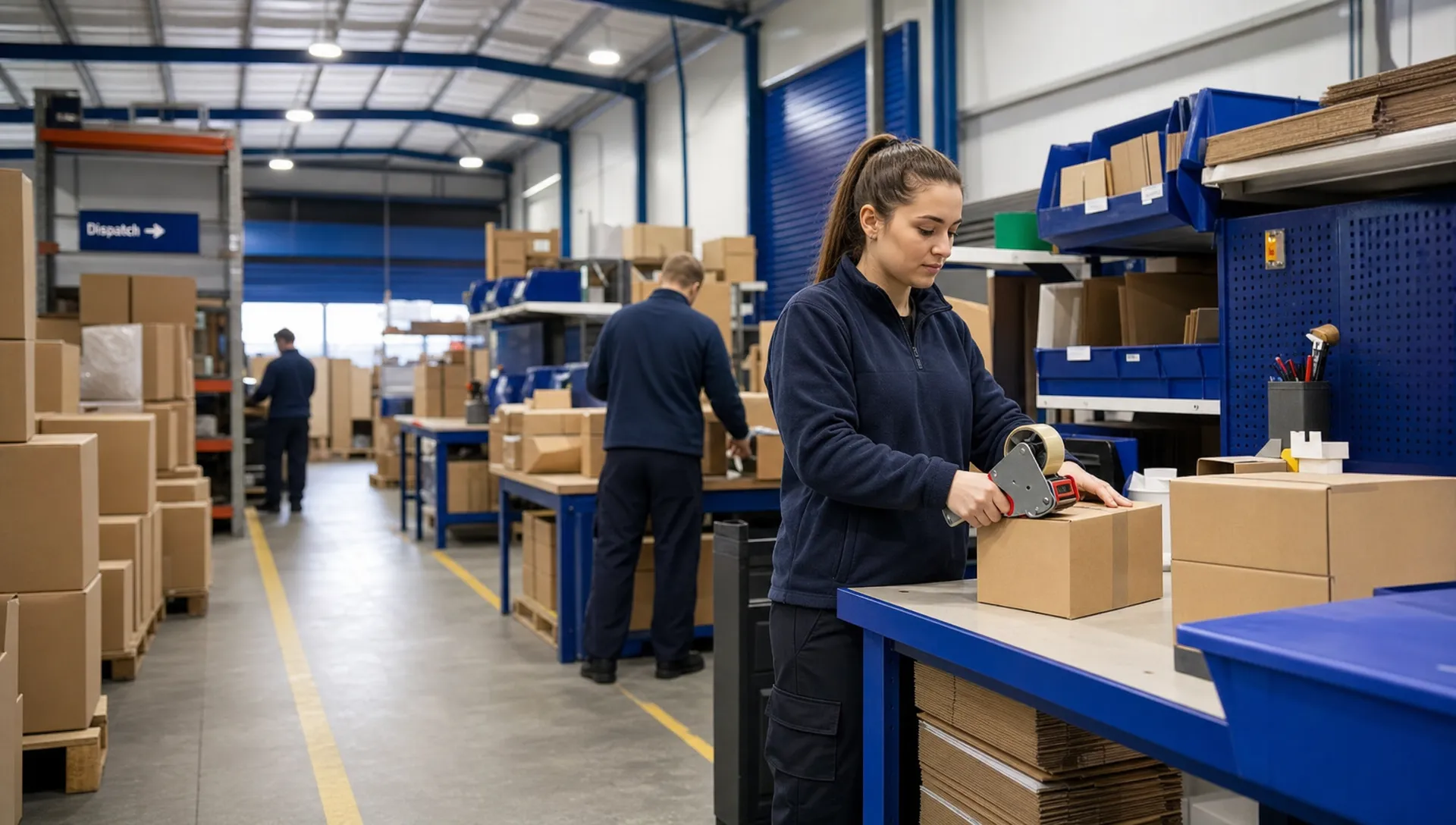
Packing is often treated as a final task, but it can become a serious bottleneck. If staff have to choose from too many box sizes, search for inserts or manually solve every awkward packing job, orders slow down.
Standardising packaging helps in three ways. It speeds up decision-making, reduces mistakes and makes carrier selection more predictable. If packers know which box, mailer or pallet configuration applies to each product type, they can work faster and produce more consistent consignments.
This can also help control costs. Poor packaging choices can increase dimensional weight, raise damage risk and cause rework. A slightly better packing process may reduce both delivery delays and avoidable charges.
Review your top-selling SKUs and define preferred packing methods for each. Include fragile items, bundles, multi-unit orders and returns-ready packaging where relevant. The goal is not to remove judgement from the team, but to stop them having to solve the same problem hundreds of times.
Match each order to the right delivery method
Improving delivery times does not mean every order needs the fastest possible service. It means each order should move through the most suitable route based on size, destination, urgency and customer promise.
For example, a small parcel going to a domestic customer may need a different service from a palletised B2B order going into a distribution centre. A retail replenishment order may need timed delivery instructions, booking references or specific unloading requirements. A failed first attempt can be more expensive and slower than choosing the right service from the start.
Segment your orders into simple groups:
- Small parcels for standard consumer delivery
- Large parcels or fragile items needing extra handling
- Palletised B2B deliveries
- Retail or distribution centre deliveries with booking requirements
- Urgent same-day or next-day consignments
Once orders are grouped properly, you can avoid overpaying for speed where it is not needed and reserve faster transport for orders that genuinely require it.
For a deeper look at this part of the process, Gus Logistics has also covered how logistics transportation affects delivery speed across warehousing, handovers and final delivery.
Reduce failed deliveries and rework
A failed delivery is not just inconvenient. It extends the delivery timeline, creates extra admin and can lead to customer complaints, replacement orders or additional transport costs.
Common causes include incorrect addresses, missing contact details, unsuitable delivery services, poor labelling and unclear delivery instructions. For B2B orders, failures can also happen when goods arrive without the correct booking reference, paperwork or delivery window.
You can reduce these problems by checking address data before dispatch, validating postcodes, capturing mobile numbers, making delivery instructions visible to the warehouse team and ensuring labels are printed clearly. For pallet or retail deliveries, confirm whether the receiving site needs advance booking, tail-lift delivery, Moffett offload or specific paperwork.
The cheapest delivery is often the one that succeeds first time.
Plan transport earlier in the day
Transport problems become more expensive when they are solved late. If urgent orders, pallet movements or replenishment loads are left until the end of the day, your options narrow and premium charges become more likely.
Planning earlier gives you more room to consolidate shipments, choose the right vehicle and avoid last-minute courier upgrades. It also gives the warehouse team clearer priorities, so orders can be picked and staged in the correct sequence.
For SMEs, this is especially useful during seasonal peaks, product launches or retailer promotions. Even a simple daily transport plan can help teams avoid the scramble that causes late dispatches.
A useful rhythm is to review the next day’s known orders, inbound stock and dispatch priorities before the current day ends. That way, the team starts with a clear plan rather than reacting to problems as they appear.
Improve communication between sales, warehouse and customer service
Delivery delays often grow in the gaps between teams. Sales promises a date, the warehouse does not know it is urgent, customer service only hears about the problem once the customer complains and transport is booked too late to fix it.
Clear internal communication can improve delivery times without adding cost. Make sure the warehouse can see priority orders, customer service can see dispatch status and sales teams understand realistic lead times.
This matters even more when orders have special requirements. Examples include Amazon preparation rules, retailer delivery windows, product kitting, promotional bundles, batch-controlled stock or customer-specific packing instructions. If those details are hidden in emails or spreadsheets, delays are more likely.
A shared system, clear order notes and agreed escalation rules can prevent small issues becoming missed delivery promises.
Know when outsourcing can be the lower-cost route
There comes a point where improving delivery times in-house becomes difficult without hiring more staff, taking more space or investing in systems. Outsourcing to a 3PL can reduce pressure because you gain access to established warehouse processes, carrier relationships, storage space and transport planning without building everything yourself.
This is not about handing over control. A good 3PL should give you better visibility and a more reliable day-to-day operation. For growing product businesses, the right partner can help orders move faster because fulfilment is no longer competing with every other task inside the business.
Gus Logistics supports UK businesses with B2B fulfilment in Cheshire, including order processing, pick and pack, storage and dispatch. The team also works with eCommerce brands, manufacturers and product businesses that need a practical route to faster, more consistent delivery.
How Gus Logistics helps businesses improve delivery times
Gus Logistics is a family-run 3PL logistics provider based in Nantwich, Cheshire, supporting businesses across the UK. The location gives strong access to major routes including the M6, M56 and M62, which helps with UK-wide distribution.
For order fulfilment, Gus Logistics integrates with 60+ platforms including Shopify, Amazon, eBay, WooCommerce and Magento. Late cut-offs up to 10pm and next-day dispatch can help businesses get orders moving sooner without automatically increasing delivery spend.
For warehousing, the team offers racked and floor storage with real-time WMS tracking through a client portal. Batch, serial number and best-before date tracking are available where needed, which helps reduce the delays caused by stock uncertainty.
For transport, Gus Logistics operates its own fleet of vans, 7.5t, 18t and 26t rigids, artics and Moffetts, with access to 5,000+ vehicles across the UK and Europe. That mix gives businesses more flexibility when choosing the right route for each consignment.
Just as importantly, customers speak directly to the people handling their freight. There are no call centres and no minimum volume requirements, which makes the service practical for growing SMEs as well as more established product businesses.
Frequently Asked Questions
How can I improve delivery times without paying for faster couriers? Start by measuring the time between order placement and dispatch. Many delays happen in order processing, stock checks, picking, packing and carrier handover. Improving those stages can shorten the total delivery time without upgrading every shipment.
What is the biggest cause of late deliveries for small businesses? Common causes include inaccurate stock data, unrealistic cut-off times, slow picking, unclear packing processes and late transport planning. The exact cause varies, so it is worth reviewing order data before changing courier services.
Can outsourcing fulfilment reduce delivery times? Yes, if your current in-house process is constrained by space, staffing, systems or transport access. A 3PL can help by providing structured fulfilment processes, integrated systems, warehouse capacity and planned dispatch operations.
Do later cut-off times always improve delivery performance? Only if the warehouse can reliably process orders before collection. A later cut-off that the team cannot meet will increase pressure and customer complaints. The best cut-off is one that reflects real picking, packing and collection capacity.
Is faster delivery always more expensive? Not always. Faster dispatch, fewer failed deliveries, better stock accuracy and earlier transport planning can improve customer delivery times without raising courier spend. The focus should be on removing delays before paying for premium services.
Improve delivery times with a practical logistics partner
If you want to improve delivery times without raising costs, start by removing the delays that slow orders down before they leave the warehouse. Better stock visibility, realistic cut-offs, faster picking, standardised packing and smarter transport planning can all make a measurable difference.
If you need support with fulfilment, storage or UK-wide distribution, Gus Logistics can help. Call 01270 335014 to speak to the team or get in touch via the contact page to discuss your requirements.
Looking for a Logistics Partner You Can Trust?
From warehousing and order fulfilment to transport and FSDU design - Gus Logistics handles it all from our base in Nantwich, Cheshire. Over 10 years experience, no minimum volumes, no long contracts.
