
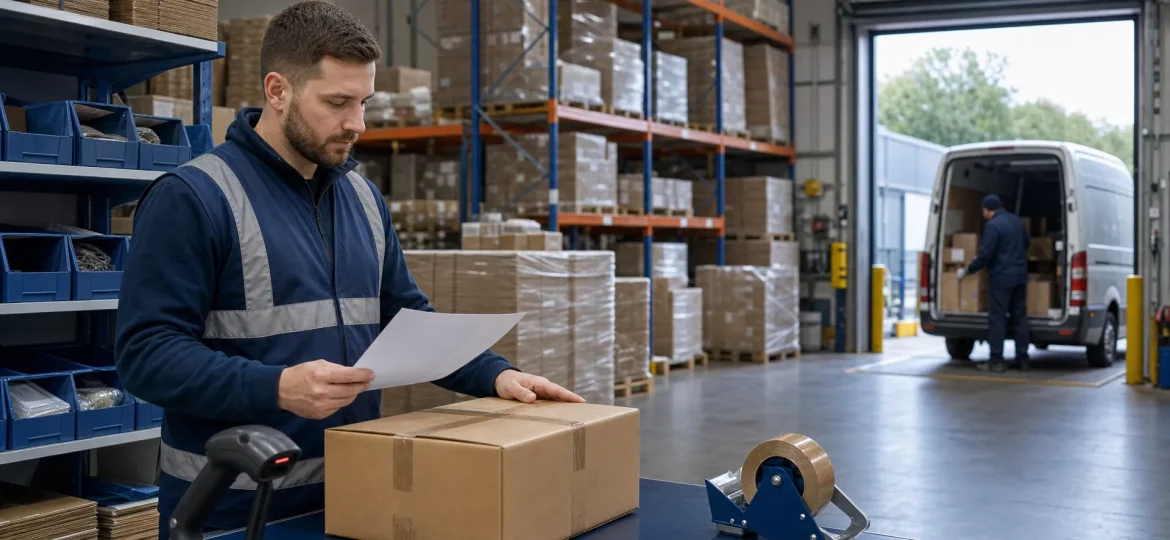
Order Fulfilment Mistakes That Cost Brands Time and Money
A wrong item in a parcel is rarely just a small mistake. It can trigger a replacement shipment, a return label, a refund request, a customer service ticket and, in the worst cases, a negative review that puts future buyers off.
For growing eCommerce brands, order fulfilment mistakes often start quietly. A team member copies orders from one system to another. Stock gets stored wherever there is space. Packing materials are ordered at the last minute. Carrier choices are based on habit rather than parcel type. Each issue looks manageable on its own, but together they create delays, avoidable costs and unhappy customers.
The good news is that most costly fulfilment problems are preventable. Whether you handle orders in-house or use an outsourced order fulfilment service, the same principle applies: fulfilment needs a clear process, accurate stock information and enough flexibility to cope with busy periods.
Below are the order fulfilment mistakes that most often cost brands time and money, plus practical ways to avoid them.
1. Relying on manual order processing for too long
Manual order processing often works at the start. When you are sending a small number of parcels each day, copying order details from Shopify, Amazon, eBay or WooCommerce into a spreadsheet may feel simple enough.
The problem comes when order volume increases. Manual work is slower, harder to check and more likely to create errors. A postcode can be mistyped. A SKU can be copied into the wrong row. A paid order can be missed because it arrived after the last spreadsheet export.
The cost is not only the mistake itself. It is the time spent finding the order, checking what happened, contacting the customer, correcting the shipment and updating the record.
A better approach is to integrate your sales platforms with your fulfilment process as early as possible. Automated order flow reduces duplicate data entry and helps your warehouse team pick, pack and dispatch from one reliable source of information.
If you are still using manual order exports, ask these questions:
- How many times is the same order information being copied or retyped?
- How quickly do new orders reach the person responsible for dispatch?
- Is there a clear way to spot paid orders that have not been shipped?
- Can tracking information be sent back to the sales channel automatically?
If the answer to any of these is unclear, your fulfilment process is probably costing more time than it should.
2. Poor stock control and inaccurate inventory records
Stock errors are one of the fastest ways to lose customer trust. If your website says an item is available but the warehouse cannot find it, the customer experience breaks down immediately.
Poor stock control can happen for several reasons. Goods may arrive without being checked properly. Damaged items may not be separated from saleable stock. Returns may be put back into stock before they have been inspected. Bundles, multipacks and product variants may not be recorded accurately.
The result is overselling, delayed dispatch, partial orders and unnecessary customer service work.
Strong stock control starts before the order is placed. Every product should have a clear SKU. Every goods-in delivery should be counted and checked. Stock movements should be recorded in a warehouse management system, not only in someone’s notebook or inbox.
Brands that store larger quantities of stock should also think carefully about how goods are held. Using organised warehouse storage with real-time stock visibility can make it easier to manage pallet quantities, batch numbers, serial numbers and best-before dates where those details matter.
| Fulfilment mistake | What it can cost | Practical fix |
|---|---|---|
| Manual stock updates | Overselling and time spent correcting records | Use a live stock system connected to order processing |
| Unclear SKU names | Wrong items picked, especially where variants look similar | Create consistent SKU naming rules and label locations clearly |
| Weak goods-in checks | Missing stock discovered only when orders are due out | Count and inspect stock when it arrives |
| Poor returns handling | Unsellable products placed back into available stock | Inspect returned items before updating inventory |
3. Letting SKU and product variant confusion grow
SKU confusion is common for brands with colour, size, fragrance, flavour or bundle variations. To a customer, the difference between two products may be obvious. In a busy packing environment, similar packaging or unclear product codes can easily lead to the wrong item being picked.
This is especially important for apparel, cosmetics, food and gift products, where variants may look similar from the outside. If your brand sources or develops clothing through a specialist partner such as a custom clothing manufacturer, for example, the fulfilment setup still needs to distinguish every size, colour and style clearly once the finished stock arrives.
To reduce variant mistakes, make sure each sellable item has its own SKU and barcode where possible. Avoid using vague product names internally, such as “blue hoodie” or “standard candle”, if there are multiple similar versions. The warehouse should not need to guess which product an order refers to.
A simple SKU structure is usually better than a clever one. It should be easy for your team and fulfilment partner to understand, print, scan and check.
4. Using packaging that is too slow, too weak or too expensive
Packaging has a direct effect on fulfilment speed and cost. If a product takes too long to pack, labour costs rise. If the box is too large, shipping may cost more than necessary. If the packaging is too weak, products arrive damaged and the brand pays for replacements.
Many brands choose packaging based mainly on how it looks. Presentation matters, but it needs to work operationally too. Your packaging should protect the product, suit the carrier network and be simple for the packing team to assemble consistently.
Common packaging mistakes include:
- Using too many box sizes, which slows down packing decisions
- Choosing packaging that needs excessive tape, inserts or folding
- Sending fragile products without enough protection
- Using packaging that is too large for the item and increases carriage costs
- Failing to test packaging before a busy sales period
The best packaging setup balances brand experience with practical handling. If you sell premium products, that does not mean every parcel needs to be complex. A clean, repeatable packing process often creates a better customer experience than an impressive but inconsistent one.
5. Missing dispatch cut-offs
Customers judge your brand by the delivery promise you make at checkout. If your website offers next-day delivery but orders regularly miss the dispatch cut-off, you will spend time explaining delays rather than building loyalty.
Cut-off problems usually happen because the business has not matched its delivery promises to its operational capacity. Orders may arrive too late in the day for the team to pick and pack. Carrier collections may be booked too early. Stock may be split across locations, which slows down fulfilment.
To avoid this, review your cut-off times against real operating conditions. Look at when orders arrive, how long picking and packing takes, what time carriers collect and how many staff are available during peak periods.
Late cut-offs can be a real advantage, but only when the fulfilment operation is built to support them. Gus Logistics offers late cut-offs up to 10pm and next-day dispatch for suitable fulfilment operations, helping brands keep pace with customer expectations without stretching internal teams beyond capacity.

6. Choosing the wrong delivery service for the order
Not every parcel should be sent using the same delivery service. A small low-value item, a fragile product, a palletised wholesale order and a time-critical replacement all need different transport decisions.
Using the wrong service can create unnecessary costs. Sending every parcel on a premium service may protect speed but damage margin. Using the cheapest option for time-sensitive orders can lead to complaints, refunds and repeat shipments.
The right choice depends on product value, weight, size, destination, delivery promise and customer expectation. For B2B or larger retail deliveries, parcel networks may not be the right answer at all. You may need pallet delivery, dedicated transport or timed delivery instead.
Brands with mixed delivery needs should work with a partner that can support more than one route to market. Gus Logistics provides same-day and next-day transport using its own fleet and wider vehicle network, which can be useful when standard parcel services are not the best fit.
7. Treating returns as an afterthought
Returns are part of selling physical products. Ignoring them does not make them disappear. It only makes them more expensive to deal with later.
A poor returns process can create several problems at once. Customers may chase refunds. Returned goods may sit unprocessed. Sellable stock may be unavailable for too long. Damaged items may accidentally go back into stock.
A good returns process should be clear for the customer and controlled for the business. Returned products need to be identified, checked, graded and updated in the stock system. If the item can be resold, it should move back into available inventory quickly. If it cannot, it should be separated and recorded properly.
The key is to decide the rules before returns start building up. What counts as resellable? Who checks the item? What happens to damaged packaging? How quickly should refunds be approved? Clear answers reduce delays and protect margin.
8. Failing to plan for peak periods
Peak trading periods expose weak fulfilment processes. Black Friday, Christmas, product launches, influencer campaigns and retail promotions can all create sudden order spikes. If the warehouse process is already stretched on an average day, it will struggle when volume doubles or triples.
Peak problems usually include stock arriving too late, not enough packing materials, unclear staffing plans, missed carrier collections and customer service teams being overwhelmed by “where is my order?” messages.
Planning should start well before the busy period. Forecast expected order volumes, confirm stock arrival dates, agree cut-off times, pre-order packaging and decide how returns will be handled afterwards. If you use a fulfilment partner, share campaign dates and expected demand as early as possible.
This is also where outsourcing can make a significant difference. A 3PL that already has warehouse space, systems, staff and transport options can help absorb demand more easily than a small in-house team operating from a back room or small unit.
9. Measuring fulfilment only by postage cost
Postage is important, but it is not the whole cost of fulfilment. A cheaper delivery service can become expensive if it leads to more lost parcels, slower delivery or higher support demand. A low-cost packing process can cost more overall if it creates damage, errors or slow dispatch.
To understand the real cost of fulfilment, look beyond the price of each shipment. Include staff time, storage, packaging, software, error correction, returns processing, customer service and management time.
A simple way to review your operation is to track the following:
| Area to measure | Why it matters |
|---|---|
| Orders shipped on time | Shows whether your delivery promise is realistic |
| Picking and packing errors | Highlights training, labelling or process issues |
| Damage in transit | Shows whether packaging or carrier choice needs review |
| Time spent on customer service | Reveals hidden costs caused by fulfilment problems |
| Returns processing time | Shows how quickly stock can become available again |
Once you measure these areas, you can see where money is really being lost. Sometimes the biggest saving is not a cheaper label, but fewer mistakes.
10. Waiting too long to outsource fulfilment
Many business owners wait until fulfilment becomes painful before they ask for help. By that point, the team may already be missing dispatch times, running out of space and losing focus on sales, product development and customer service.
Outsourcing does not have to mean giving up control. A good 3PL should give you better visibility, clearer processes and more time to focus on growth. The right partner should also be able to support your current size, not only large enterprise volumes.
Gus Logistics is a family-run 3PL provider based in Nantwich, Cheshire, supporting eCommerce brands, manufacturers and product businesses across the UK. Its UK logistics services include order fulfilment, pallet storage, same-day transport, FSDU services, co-packing and contract packing.
Because Gus Logistics has no minimum volume requirements, businesses can start outsourcing before fulfilment becomes a crisis. Customers also speak directly to the people handling their freight, rather than through a call centre.
How to spot when fulfilment mistakes are affecting growth
If fulfilment is costing your brand time and money, you will usually see signs before the numbers become obvious. These signs are easy to dismiss at first, but they tend to get worse as order volume grows.
Look out for repeated customer questions about delivery, team members staying late to finish packing, stock records that no longer feel reliable, products stored in unsuitable spaces, too many urgent courier bookings and a growing pile of returns waiting to be processed.
If any of these are familiar, it may be time to review your fulfilment setup. You do not necessarily need to change everything at once. Start by identifying the biggest bottleneck. Is it order flow, stock control, packing speed, carrier choice or storage space? Fixing one high-impact issue can quickly reduce pressure across the whole operation.
Frequently Asked Questions
What is the most common order fulfilment mistake? One of the most common mistakes is relying on manual processes for too long. Manual order entry, stock updates and tracking uploads increase the risk of errors as order volume grows.
How do fulfilment mistakes affect profit? Fulfilment mistakes can lead to replacement shipments, refunds, damaged stock, extra labour, more customer service work and lost repeat purchases. The visible cost is often only part of the problem.
When should a brand outsource order fulfilment? A brand should consider outsourcing when fulfilment starts taking time away from growth, when dispatch times are being missed, when storage space is tight or when order errors are becoming more frequent.
Can a 3PL help small eCommerce brands? Yes. Some 3PL providers work with smaller brands as well as larger businesses. Gus Logistics has no minimum volume requirements, which makes outsourced fulfilment more accessible for growing product businesses.
Does better fulfilment improve customer experience? Yes. Accurate picking, reliable dispatch, suitable packaging and clear tracking all help customers receive the right order on time and in good condition.
Ready to reduce fulfilment mistakes?
Order fulfilment mistakes do not only slow your business down. They affect customer trust, team morale and profit margins. If your current process is becoming harder to manage, it may be time to bring in a fulfilment partner that can support your next stage of growth.
Gus Logistics provides order fulfilment, warehousing, transport and wider 3PL support from Nantwich, Cheshire, for brands across the UK. To discuss your fulfilment needs, call 01270 335014 or get in touch via the contact page.
Looking for a Logistics Partner You Can Trust?
From warehousing and order fulfilment to transport and FSDU design - Gus Logistics handles it all from our base in Nantwich, Cheshire. Over 10 years experience, no minimum volumes, no long contracts.
