
What Is Contract Packing and How Does It Work?
If packing work is starting to slow your business down, you are not alone. Many product businesses reach a point where their team is spending too much time building bundles, relabelling stock, assembling promotional packs or preparing products for retail, instead of focusing on sales, purchasing and customer service.
That is usually when the question comes up: what is contract packing, and could it work for us?
In simple terms, contract packing means outsourcing packing, assembly or rework tasks to a specialist third-party provider. Instead of using your own staff, space and equipment to prepare goods, you agree a packing specification with a logistics partner, send them the stock, and they carry out the work on your behalf.
It can be used for one-off projects, seasonal campaigns, retail promotions, ongoing product preparation or as part of a wider warehousing and fulfilment setup.
What is contract packing?
Contract packing is the process of preparing products for sale, storage, retail display or dispatch under an agreed brief. It is also often called co-packing.
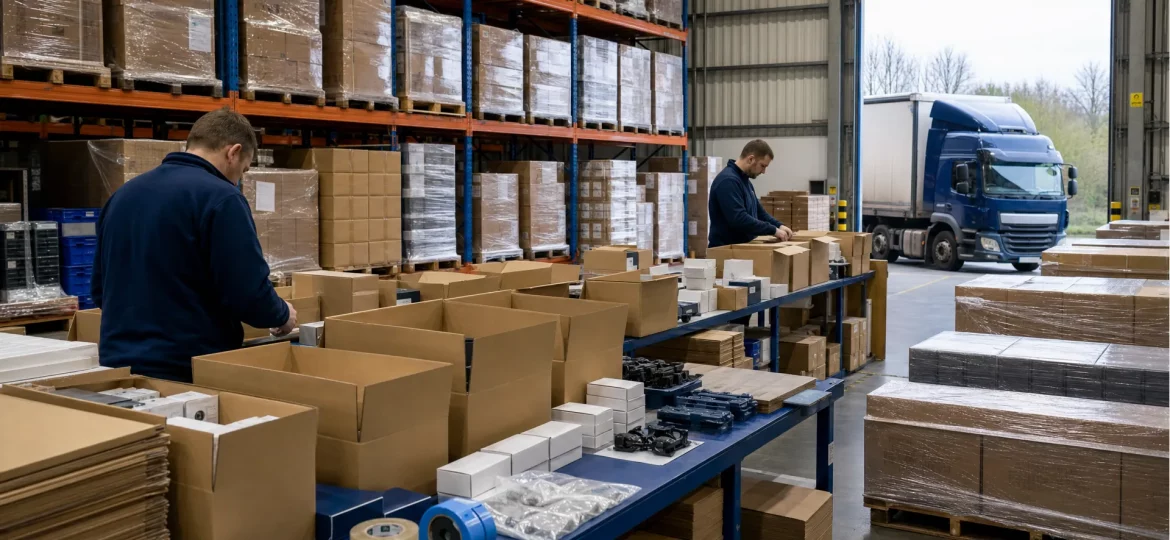
A contract packing provider might receive your stock, check it, store it, re-pack it, label it, bundle it, assemble it into kits or displays, then send it on to a retailer, wholesaler, fulfilment centre or end customer. The exact work depends on your product, packaging, sales channel and deadlines.
For example, a business might use contract packing to turn individual items into gift sets, add barcodes to imported stock, assemble promotional packs, prepare subscription boxes or build point of sale displays for a retail launch.
The main value is not just having more hands available. A good contract packing process gives you structure, accuracy, space, stock control and a clearer way to handle projects that would otherwise disrupt your normal operation.
| Contract packing task | What it usually involves | Common use case |
|---|---|---|
| Re-packing | Moving products into new packaging or changing outer cartons | Retail-ready presentation or damaged packaging replacement |
| Labelling | Applying barcodes, batch labels, compliance labels or shipping labels | Imported goods, retailer requirements or product updates |
| Bundling | Combining several items into one saleable pack | Gift sets, promotions or multi-buy offers |
| Kitting | Grouping components into a prepared kit | Starter packs, sample boxes or subscription boxes |
| POS assembly | Building retail display units or promotional displays | Supermarket, high street or seasonal retail campaigns |
| Container de-stuffing | Unloading goods from containers and preparing them for storage or onward handling | Bulk imports and stock intake projects |
Contract packing vs pick and pack vs kitting
These terms are often used together, but they are not always the same thing.
Contract packing is the broad service. It covers packing, re-packing, labelling, assembly, bundling and other product preparation tasks.
Co-packing usually means the same thing as contract packing. Some businesses use the term when talking about consumer goods, food and drink, retail products or promotional packs.
Kitting is more specific. It means taking separate items and grouping them into a single kit or pack. A starter kit with several components, a gift set or a subscription box are all common examples.
Pick and pack is usually part of order fulfilment. It means picking products from stock and packing them for dispatch after a customer order is received. If your contract packed goods are then sold online, they may move into an order fulfilment service where they are stored, picked, packed and dispatched to customers.
FSDU preparation is another related area. A free standing display unit is a retail display used in shops to promote products. Some retail brands need these units designed, manufactured, pre-filled and delivered ready for store campaigns. If your project involves retail displays, it may sit closer to an FSDU design, manufacture and dispatch service than a standard packing job.
How does contract packing work?
The best contract packing projects follow a clear process. The details will vary, but most jobs move through the same core stages.
1. You define the packing requirement
The first step is to explain what needs to happen to the product. This should include the product type, quantities, current packaging, final packaging, any labels required, the number of items per pack, deadlines and where the finished stock needs to go.
A clear packing specification matters. It reduces mistakes, improves quoting accuracy and makes quality checks much easier.
2. The provider reviews the job and quotes
The contract packing provider will assess the labour, space, materials, equipment and time needed. They may ask for samples or photos so they can understand how the product should be handled.
For simple work, such as applying labels or inserting leaflets, quoting may be straightforward. For more complex assembly, the provider may need to test the process first to estimate how long each unit takes.
3. Stock and packaging arrive
Your goods, packaging materials and any inserts are delivered to the packing site. The provider should check deliveries against the expected quantities and flag shortages or damage early.
This is where warehousing and packing often overlap. If the same partner can receive, store, pack and dispatch the goods, you avoid extra transport movements and unnecessary handovers.
4. The packing work is carried out
The packing team follows the agreed instructions. This might involve opening cartons, checking products, adding labels, inserting multiple items into a pack, sealing packaging, applying barcodes, building display units or palletising finished stock.
For repeat work, the process should become more efficient over time. For project work, the focus is usually on hitting the deadline while keeping accuracy and presentation consistent.
5. Quality checks are completed
Quality control should be built into the process, not left until the end. Checks may include confirming the right items are in each pack, labels are correctly applied, packaging is clean and secure, and finished goods match the agreed specification.
For products with batch, serial number or best-before tracking requirements, the provider should be able to maintain clear records.
6. Finished goods are stored, shipped or handed back
Once packed, the goods may be returned to you, delivered to retailers, moved into storage or transferred into an order fulfilment process. This final step is important because packing is often only one part of the wider supply chain.
If your products need to be stored and dispatched after packing, using a partner that can also provide warehousing and fulfilment support around Crewe can help keep the whole operation under one roof.

When should a business use contract packing?
Contract packing is worth considering when packing work is taking up too much internal time, creating bottlenecks or requiring space you do not have.
It is especially useful for growing businesses because demand is not always steady. You may not want to hire extra staff or lease more space for a short-term project, but you still need the work completed accurately and on time.
Typical situations include seasonal peaks, product launches, promotional campaigns, retailer deadlines, imported stock that needs relabelling, damaged packaging that needs rework, and online ranges that need bundling before sale.
It can also help when your operation has become too fragmented. If goods are stored in one place, packed somewhere else and then transported to another provider for dispatch, costs and delays can quickly build up.
What information do you need before asking for a quote?
You do not need a perfect technical document before speaking to a provider, but the more detail you can provide, the better the quote and timescale will be.
| Information to prepare | Why it matters |
|---|---|
| Product type and dimensions | Helps the provider plan handling, space and packing method |
| Quantity of units | Affects labour, time and pricing |
| Current and final packaging | Shows what needs to change during the packing process |
| Required labels or barcodes | Prevents compliance, retailer or scanning issues |
| Deadline | Determines staffing, scheduling and transport planning |
| Delivery destination | Impacts palletising, courier, retail or transport requirements |
| Quality requirements | Sets clear standards for checking finished goods |
If you are unsure about the exact process, a good provider should be able to talk it through with you. In many cases, they can suggest a more efficient way to pack, label or assemble the product once they understand the commercial goal.
What makes a good contract packing partner?
A good contract packing partner should make your operation simpler, not add another layer of complexity.
Look for a provider that asks practical questions at the start. They should want to understand your product, your sales channel, your deadlines and what could go wrong if the packing is not completed correctly.
Stock visibility is also important. If your goods are being stored before or after packing, you need confidence that quantities are being tracked properly. This becomes even more important when you have multiple product lines, batch information or customer orders linked to packed goods.
Flexibility matters too. Some packing jobs are predictable and repeat every month. Others come in quickly because a retailer has confirmed a promotion or a shipment has arrived later than expected. The right partner should be able to support both planned and time-sensitive work where capacity allows.
Location can also make a real difference. For businesses in Cheshire, Crewe, Nantwich, Chester, the North West and across the UK, working with a provider close to major routes can help reduce wasted time between storage, packing and transport.
How contract packing connects with wider logistics
Contract packing rarely exists in isolation. In many businesses, it sits between warehousing, fulfilment, transport and retail distribution.
For example, imported stock might arrive in bulk, be unloaded, checked and stored. It might then be re-packed into retail cartons, labelled, assembled into promotional units and delivered to a retailer. Alternatively, gift sets might be built in advance, stored as finished SKUs and then dispatched directly to online customers as orders come in.
This is why it often makes sense to work with a logistics partner that can manage more than just the packing bench. If the same provider can handle storage, packing, order fulfilment and transport, there are fewer handovers, fewer stock movements and fewer opportunities for confusion.
For businesses that need a joined-up service in Cheshire or the North West, professional contract packing services in Cheshire can be a practical alternative to stretching internal staff and warehouse space too thin.
How Gus Logistics supports contract packing projects
Gus Logistics is a family-run 3PL provider based in Nantwich, Cheshire, supporting eCommerce brands, manufacturers and product businesses across the UK.
For contract packing and co-packing work, Gus Logistics can support tasks such as re-packing, point of sale assembly, container de-stuffing and product preparation as part of a wider logistics operation. This can be combined with warehousing, order fulfilment, transport and FSDU services where required.
The benefit for growing businesses is that packing does not have to be treated as a separate problem. Stock can be received, stored, prepared, packed and moved through to dispatch with one team overseeing the process.
Gus Logistics also offers no minimum volume requirements, same-day quotes as standard and direct communication with the people handling the work, with no call centres. For SMEs and retail brands, that can make it easier to get clear answers quickly when deadlines are tight.
Frequently Asked Questions
What is contract packing in simple terms? Contract packing is when a business outsources packing, re-packing, labelling, bundling or assembly work to a specialist provider instead of doing it in-house.
Is contract packing only for large businesses? No. Contract packing can be useful for small and medium-sized businesses as well, especially when they have seasonal peaks, limited warehouse space or project-based packing work.
What is the difference between contract packing and fulfilment? Contract packing prepares products for sale, storage, display or dispatch. Fulfilment usually covers receiving customer orders, picking products, packing parcels and sending them to customers.
Can contract packing include retail display units? Yes, depending on the provider. Some contract packing projects include point of sale assembly, FSDU preparation and pre-filling retail displays for store campaigns.
Do I need to supply the packaging materials? It depends on the project and provider. Some businesses supply all packaging and labels, while others ask the contract packer to help source or manage materials. The best approach is to agree this before the job starts.
Need contract packing support?
If packing, rework, bundling or retail preparation is starting to hold your business back, Gus Logistics can help you plan a practical way forward.
To discuss contract packing, warehousing, fulfilment or transport support, call 01270 335014 or get in touch through the Gus Logistics contact page.
Looking for a Logistics Partner You Can Trust?
From warehousing and order fulfilment to transport and FSDU design - Gus Logistics handles it all from our base in Nantwich, Cheshire. Over 10 years experience, no minimum volumes, no long contracts.
