
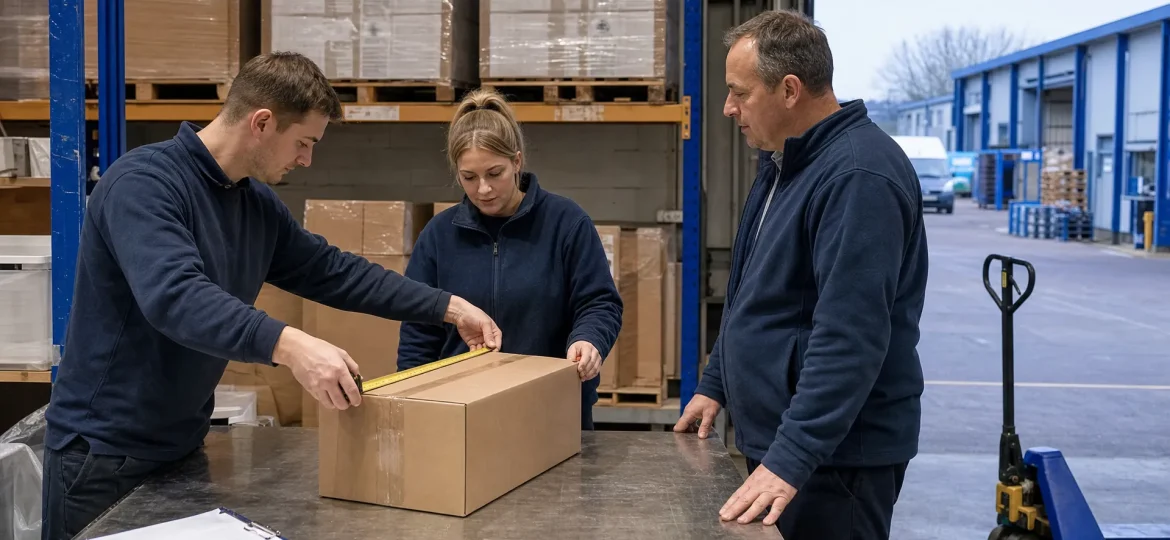
What Is Dimensional Weight and Why Can It Make Your Shipping Cost More?
A parcel can weigh very little on the scales and still attract a higher delivery charge than you expected. Dimensional weight is a way of pricing a shipment according to the space it occupies, rather than just its actual weight. Where a carrier uses this method, a large box containing lightweight products can be billed as though it weighs considerably more.
For eCommerce businesses, this can explain why shipping quotes and invoices do not always match. Understanding the calculation helps you choose suitable packaging, provide accurate booking details and compare delivery services on the same basis. The starting point is the packed parcel, not the product inside it.
Why a light parcel can cost more to deliver
A delivery vehicle has limits on both weight and space. A box of cushions might occupy as much room as a box of metal components, even though it weighs much less. Charging only by scale weight would not reflect the space needed to carry that lighter shipment.
Carriers therefore sometimes convert a parcel's volume into an equivalent weight. You may also see this called volumetric weight. The carrier then compares that figure with the parcel's actual weight and normally uses the higher figure for billing, subject to the service's rounding rules and minimum charges.
Not every UK delivery service prices parcels this way. Some use weight bands with maximum dimensions, while others apply separate oversized-item charges. Your carrier's terms determine which rules apply. A lightweight parcel is not automatically cheap to send, but neither should you assume that every bulky box will receive the same treatment.
How do you calculate dimensional weight?
The usual calculation is:
Length × width × height ÷ carrier's divisor = volumetric weight
When dimensions are measured in centimetres, the divisor supplied for that calculation converts the result into kilograms. The divisor is a number set by the carrier or service, not something you choose yourself.
For example, a service might specify a divisor of 5,000. That is the assumption used in the examples below, not a universal rule for UK shipping. Another service may use a different divisor or a different pricing method altogether.
Before calculating, check these details:
- Measurement units: Confirm whether the carrier requires centimetres, inches or another unit.
- Outer dimensions: Measure the fully packed parcel at its widest points, including any bulges or protrusions.
- Rounding rules: Check whether dimensions and calculated weights must be rounded before the price is applied.
- Billing method: Establish whether the calculation applies to each parcel separately or under another shipment-level rule.
Carrier guidance, such as UPS's information on shipment dimensions and weight, is a useful starting point. Your own service agreement remains the reference for the shipment you are booking.
A worked parcel example
Suppose your packed order weighs 4 kg and its outer dimensions are 50 × 40 × 30 cm. Using the illustrative divisor of 5,000, its dimensional weight is calculated as follows:
50 × 40 × 30 = 60,000 cm³
60,000 ÷ 5,000 = 12 kg
If the service bills the higher of actual and volumetric weight, the chargeable weight would be 12 kg, before any further rounding or tariff rules. The parcel has not become heavier. Its size has changed the basis of the charge.
Now consider a smaller box for the same order:
| Example | Packed dimensions | Actual weight | Calculated volumetric weight | Chargeable weight* |
|---|---|---|---|---|
| Original packaging | 50 × 40 × 30 cm | 4 kg | 12 kg | 12 kg |
| Smaller suitable packaging | 40 × 30 × 25 cm | 4 kg | 6 kg | 6 kg |
| Compact, heavier parcel | 30 × 20 × 20 cm | 8 kg | 2.4 kg | 8 kg |
These examples use a divisor of 5,000 and the higher of actual and volumetric weight, without additional rounding or minimum charges.
Halving the chargeable weight does not necessarily halve the price. Delivery tariffs can include weight bands, base charges and surcharges. You need the applicable rate card to calculate the financial saving.
Why the final invoice can differ from your quote
A booking quote depends on the information you supply. If you enter the product's weight but estimate the box size, the carrier may later measure a larger parcel and adjust the charge.
Dimensional weight can therefore become an unexpected cost when booking records do not match what leaves the packing bench. Common causes include using supplier carton dimensions, measuring an empty box rather than a sealed one or reusing saved dimensions after changing the packaging.
Soft packaging needs particular attention. A mailing bag containing clothing or bedding may bulge once filled. Its nominal bag size does not necessarily describe the external dimensions of the finished parcel.
However, a higher invoice is not proof that volume-based billing caused the difference. Other possible charges include an oversized-item fee, additional handling, a remote-area surcharge or an address correction.
Ask for the recorded dimensions, actual weight, chargeable weight and adjustment reason. Compare those with your dispatch records and the agreed service terms. That gives you a specific issue to resolve, rather than a general complaint that shipping has become more expensive.
How to reduce avoidable volume-based charges
Reducing dimensional weight starts with matching packaging to the order while maintaining adequate protection. The aim is to remove unnecessary space, not to make every parcel as small as physically possible.
Choose packaging around your regular orders
Look at your most frequently dispatched products and order combinations. If small items regularly leave in a large standard carton, check whether a smaller box or suitable mailing bag would protect them just as well.
A limited range of well-chosen packaging sizes can be more useful than one box for everything. Start with products where the packed volume is high relative to the actual weight, such as soft furnishings, lightweight accessories or empty containers.
Test the complete packing method before changing it. A smaller carton that causes crushed products, returns or replacement deliveries is not a saving. Include the cost of packaging materials and packing time in the comparison.
Keep packed measurements in your dispatch records
Record actual weight and external dimensions for repeatable packing configurations. A single-item order and a three-item order may need different records even when they contain the same product.
Recheck those measurements when you change cartons, protective inserts or the packing method. Occasional spot checks at dispatch can identify boxes that bulge or orders that no longer fit the recorded configuration.
Keep the measurement responsibility clear if you outsource fulfilment. Agree who maintains packaging records, who checks exceptions and how carrier adjustments are investigated. Accurate information is useful only if it reaches the booking process.
Compare services using the finished shipment
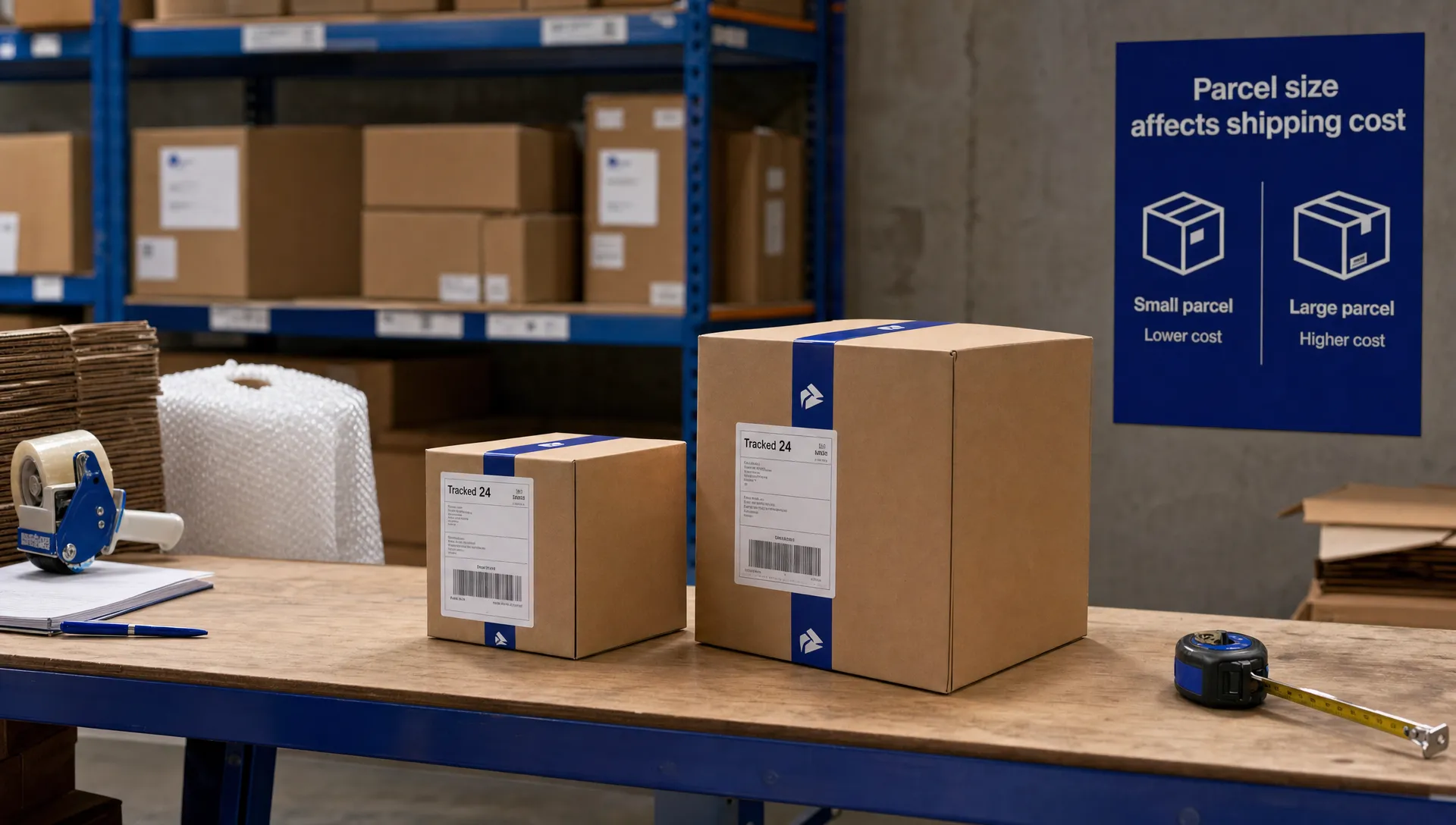
A service that looks inexpensive for a small parcel may be less suitable for a bulky shipment. Compare quotes using identical packed dimensions, actual weight, destination and delivery requirements.
For unusually large goods, multiple cartons or palletised orders, ask whether a different transport service would be more appropriate. Pallet and dedicated-vehicle services can use different charging structures, so the parcel formula should not be applied automatically.
Do not assume that combining orders always saves money, either. A larger combined box might cross a size limit or enter a higher charge band. Compare the complete shipment cost before changing the dispatch method.
For a wider review beyond parcel measurements, our guide to reducing shipping costs without slowing customer deliveries covers other areas worth checking.
What to ask before agreeing a shipping rate
The useful question is not simply whether a carrier uses dimensional weight. You need to understand how its rules affect the orders you actually send.
Ask the carrier or logistics provider:
- Which services use volume-based billing, and what divisor applies? Different services may have different rules.
- How are dimensions and weights rounded? Small measurement differences can affect the billed weight.
- What size limits trigger separate charges? Volumetric billing and oversized-item fees are different issues.
- How are multiple parcels assessed? Confirm whether each package is calculated separately.
- What evidence is available for invoice adjustments? Agree how measurement disputes will be reviewed.
Use a sample of your real packed orders when comparing providers. Include both typical parcels and awkward exceptions. This gives you a more meaningful comparison than a headline price based on an unspecified box.
Frequently asked questions
Is volumetric weight the same thing? In parcel shipping, the terms generally describe the same approach: converting package volume into an equivalent weight for pricing. Check the carrier's definition and calculation rules rather than relying on the label alone.
Does this apply to every UK parcel? No. Pricing varies by carrier, service and agreement. Some services use volume-based calculations, while others have weight bands, size limits or separate charges for large parcels.
Can a smaller box always reduce the delivery charge? No. It may reduce the calculated weight, but the parcel could remain in the same price band. If actual weight already determines the charge, reducing the box size may not change the price unless it also removes a size-related surcharge.
Should I use the dimensions of the product or the packaging? Use the external dimensions of the finished shipment. Include the carton, protective materials and any bulging or protruding parts. The carrier transports the packed parcel, not the unpacked product.
Get a clearer delivery plan for bulky shipments
Understanding dimensional weight gives you a better basis for discussing shipping costs. Accurate measurements and suitable packaging help, but the transport service also needs to fit the goods and the delivery requirement.
Gus Logistics is a family-run logistics provider based in Nantwich, Cheshire, supporting businesses across the UK. Its same-day and next-day transport services use an own fleet alongside access to a wider vehicle network, allowing you to discuss suitable options for your shipment rather than assume a standard parcel service is the right choice.
Have your packed dimensions, actual weight, collection and delivery postcodes ready. Call Gus Logistics on 01270 335014 to discuss your transport requirements and request a quote.
Looking for a Logistics Partner You Can Trust?
From warehousing and order fulfilment to transport and FSDU design - Gus Logistics handles it all from our base in Nantwich, Cheshire. Over 10 years experience, no minimum volumes, no long contracts.
