
How Do I Send Fragile Products to Customers Without Them Getting Broken?
A broken delivery costs more than a replacement product. You also lose packing time, delivery charges and customer confidence. Reliable fragile item fulfilment starts with matching the packaging to the product, then checking that the finished parcel can withstand the journey you have booked.
You cannot guarantee that every parcel will arrive undamaged. You can, however, reduce avoidable breakages by controlling movement, protecting weak points and making the packing method repeatable. The right approach is not simply to add more bubble wrap or write “Fragile” on the box.
Match the packaging to the product’s risks
Before buying packaging, assess how each product could fail. A heavy stoneware bowl needs different protection from a lightweight glass ornament, even if both fit inside the same box.
Check the item’s weight, shape, vulnerable parts and replacement value. Handles, thin edges and projecting components need particular attention. Also consider the order configuration: packaging that protects one mug may not protect four mugs packed together.
A useful starting point for fragile item fulfilment is to record the likely failure and the protection needed, rather than giving every product the same wrapping allowance.
| Product characteristic | Main risk | Packaging approach to assess |
|---|---|---|
| Heavy and brittle | Crushing cushioning or breaking through the box | Suitable box strength and cushioning that supports the weight |
| Thin edges or projecting parts | Concentrated impact on a weak point | Shaped supports or protection that keeps pressure away from vulnerable areas |
| Several items in one order | Products striking one another | Individual wrapping and secure compartments |
| Easily scratched finish | Surface damage during movement | Non-abrasive wrapping before impact protection |
| High replacement value | Expensive damage or loss | Tested packaging, suitable delivery service and confirmed compensation terms |
Choose the box and cushioning together
Use a sound corrugated outer box with enough space for protective material on every side. A retail presentation box is not automatically a shipping box, and a damaged reused carton may have lost strength.
Single-wall or double-wall construction alone does not tell you whether a box is suitable. Check the packaging supplier’s load guidance and assess the complete packed weight. Heavy goods may require stronger packaging or a different delivery method.
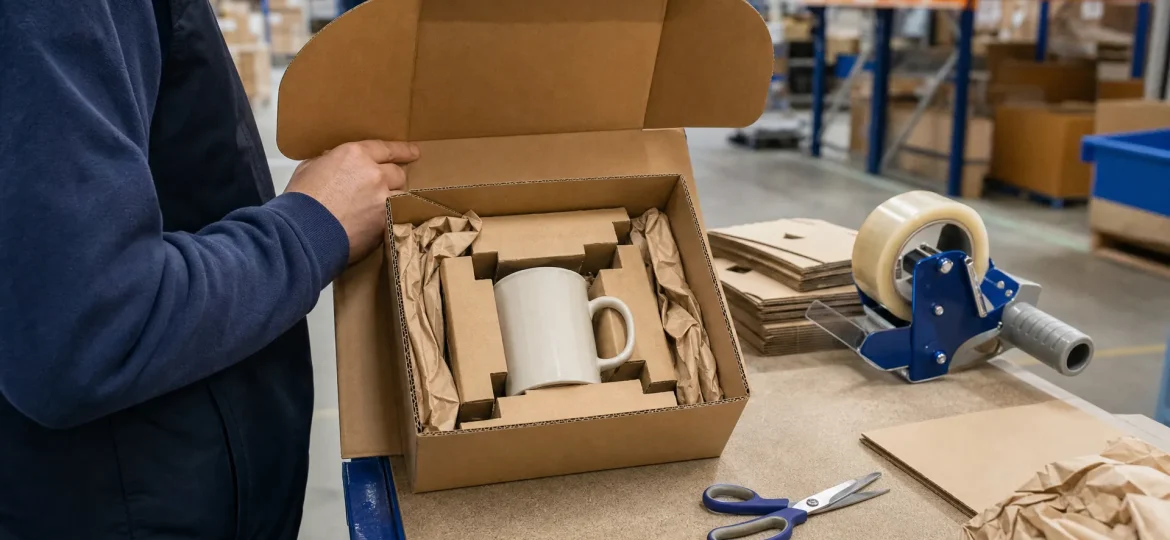
For fragile item fulfilment, cushioning must both absorb impact and hold the product in position. Loose void fill may fill empty space without supporting a heavy item adequately. Equally, forcing a product tightly against the box wall leaves little protection against external impact.
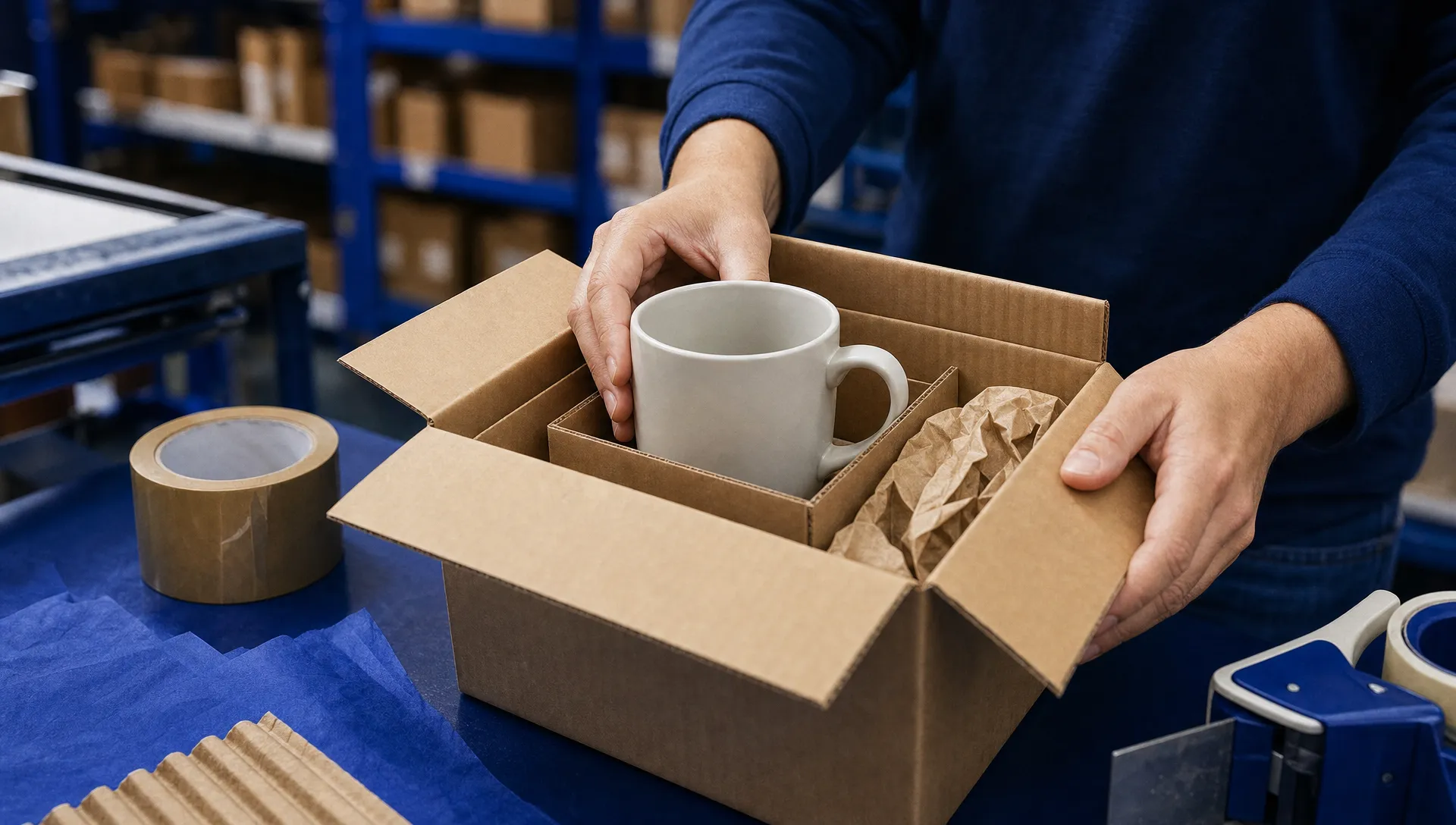
Double-boxing can help some products, but only when the inner box is immobilised within appropriate cushioning. Two boxes with an empty gap between them do not provide a reliable packing system.
Pack each order in a repeatable sequence
Give packers an approved method for each product or order combination. This makes the outcome less dependent on who happens to be working that day.
- Inspect the product: Check for chips, cracks, loose components or existing damage before wrapping. Do not send questionable stock and assume the packaging will hide the problem.
- Secure removable parts: Where the product design allows it, pack detachable components separately. Keep small parts contained so they cannot move around or disappear during unpacking.
- Protect surfaces and weak points: Apply a suitable non-abrasive layer first where needed, then protect vulnerable edges, handles and projections without putting pressure on them.
- Wrap and separate each item: Prevent direct contact between products. Use suitable dividers or compartments for multi-item orders rather than relying on wrapping alone.
- Support the contents on every side: Cushion the base, sides and top. The product should remain supported if the parcel is turned onto another face.
- Check movement and seal: Gently check for movement before closing. Seal the main seams with packaging tape suited to the carton and load, following the packaging supplier’s guidance.
- Complete the final check: Confirm the item, quantity, packaging specification and delivery label. For fragile item fulfilment, record any packing exception before the parcel leaves the bench.
A movement check catches obvious problems. It does not prove that the package will survive drops, stacking or vibration.
Adapt the method for different products
Use these distinctions when writing product-specific instructions. They are starting points for testing, not universal packaging specifications.
| Item type | Packing priority |
|---|---|
| Glassware and ceramics | Prevent item-to-item contact and protect rims, stems and handles |
| Framed prints and mirrors | Protect corners and surfaces, with a rigid packaging system suited to the dimensions |
| Jewellery and watches | Immobilise the item, protect the finish and contain loose components |
| Electronic products | Protect against impact and use appropriate anti-static materials where required |
| Bottled products | Prevent bottle contact and movement, then address leakage and any carrier restrictions |
Small items deserve specific instructions too. Raphana Jewellery’s packing guidance for jewellery and watches illustrates the importance of separately containing loose pieces when sending an item for assessment or repair. Its shipping arrangements relate to New Zealand, so UK businesses should check their own carrier’s requirements.
For your own fragile item fulfilment process, include accessories and inserts in the trial pack. A loose charger, metal fitting or display component can damage the main product even when the product itself is well wrapped.
Test the complete parcel before increasing volumes
Test the package customers will actually receive, including the outer carton, inserts, tape and any accessories. Testing an empty box or a single wrapped product misses problems caused by the complete order.
Start with representative samples of your most vulnerable products and common multi-item combinations. Check whether the contents shift, cushioning compresses or surfaces rub during handling. Include heavier configurations rather than testing only the easiest order.
Ask your packaging supplier about appropriate drop, compression and vibration testing. An independent packaging test provider can help when the product value, breakage history or order volume justifies a more formal assessment. Test conditions should reflect the intended delivery service.
Inspect the product after testing, not just the carton. A box can look intact while the item inside has cracked. Record the approved materials and arrangement, then reassess whenever the product, packaging supplier or order configuration changes.
Check courier acceptance and cover before booking
Many fragile products can travel through parcel networks, but acceptance depends on the product and the service’s terms. Check the rules before dispatch, particularly for glass, ceramics, liquids, electronics and valuable items.
There are two separate questions: will the carrier accept the parcel, and will it compensate you if the contents are damaged? Acceptance does not necessarily mean damage is covered. Carrier compensation and a separate insurance policy may also have different conditions.
Build these checks into fragile item fulfilment rather than discovering exclusions after a claim. Confirm the packaging requirements, prohibited or restricted items, compensation limits, evidence requirements and notification deadlines. Keep the relevant terms with your service records.
A “Fragile” label communicates a handling request. It does not guarantee separate handling or replace protective packaging. Likewise, orientation arrows cannot ensure that a parcel remains upright throughout its journey. Pack for foreseeable changes of position unless you have agreed a service that provides otherwise.
Choose delivery around size and value
A standard parcel service may be suitable for a small, properly protected item. Large mirrors, awkward sculptures or heavy brittle goods may need a pallet, dedicated vehicle or specialist handling arrangement instead.
Compare the handling involved, not just the delivery speed. A faster service is not automatically gentler, and tracking does not prevent breakage. Dedicated transport can reduce transfers, but you still need suitable packaging and load restraint.
If the packed dimensions or weight are unsuitable for parcel delivery, consider the alternatives for products that are too large for a normal parcel courier. Confirm unloading arrangements and what the recipient must do when the delivery arrives.
Make fragile item fulfilment repeatable in the warehouse
Good packaging will not compensate for stock that was damaged before it reached the packing bench. Give fragile products suitable storage locations, control stacking and separate damaged stock from saleable units.
When assessing warehousing and storage, ask how your products would be received, located and picked. Confirm whether supplier cartons protect individual units or only work while the full case remains intact.
At the packing bench, provide a short instruction sheet with photographs of the approved arrangement. Identify the box, protective materials, placement of each component and final checks. Include an instruction to stop and ask when an approved material is unavailable, rather than improvising a substitute.
Train staff using actual products and check that they can reproduce the pack. Review temporary staff and peak-period arrangements too, because an instruction sheet is only useful when it is followed.
Track damage by product, order configuration, packaging version and delivery service. Compare damage reports against the number of orders dispatched, not just the raw number of complaints. This helps you distinguish a packaging weakness from a rise in sales volume.
Separate customer support from the carrier claim
When a customer reports damage, resolve their order promptly while collecting evidence for your investigation. Do not make them wait for the carrier to decide your claim before addressing their rights.
For most UK consumer sales using delivery arranged by the retailer, section 29 of the Consumer Rights Act 2015 keeps the goods at the trader’s risk until the customer, or their nominated recipient, takes physical possession. Different rules can apply where the consumer independently commissions a carrier you did not offer.
Ask for safe photographs of the damaged item, outer carton, delivery label, internal packaging and the item’s position inside it, where practical. Do not ask anyone to handle broken glass or sharp pieces for a better picture.
For fragile item fulfilment claims, retain the order reference, tracking details, dispatch record, packaging specification, proof of value and customer correspondence. Ask the customer to keep packaging where safe and practical until you confirm whether an inspection is needed. Check the carrier’s reporting deadline immediately.
Keep returned damaged goods separate from available stock. Then investigate whether the failure came from product defects, inadequate support, packing variation or the delivery journey. Use that finding to change the process rather than simply adding more material to every order.
Frequently asked questions
Can fragile goods be sent by courier in the UK? Often, yes, provided the carrier accepts the product and you meet its packaging requirements. Check damage compensation separately because an accepted item may still be excluded from cover.
Does writing “Fragile” on a parcel prevent rough handling? No. Treat it as supplementary information, not a promise of special handling. The packaging should protect the contents through the normal handling conditions of the service you choose.
How much cushioning should I use? There is no single allowance that suits every product. Weight, shape, material and cushioning performance all matter. Ask your packaging supplier for a suitable specification and test the complete parcel before adopting it.
Can I outsource packing for breakable products? Yes, but agree the method before sending live orders. Ask the provider to review samples, confirm materials and document checks. A fragile item fulfilment arrangement should make responsibilities for packaging approval, exceptions and damage reporting clear.
Get help with packing and dispatch
Gus Logistics provides order fulfilment and pick and pack services from Nantwich, Cheshire, supporting eCommerce brands and product businesses across the UK. The family-run team has over 10 years of experience and no minimum volume requirements.
If you are considering outsourcing fragile orders, start by discussing your products, current packaging, order combinations and damage history. Agree what needs assessing before moving to a live packing process.
Call 01270 335014 to discuss your packing and dispatch requirements with Gus Logistics.
Looking for a Logistics Partner You Can Trust?
From warehousing and order fulfilment to transport and FSDU design - Gus Logistics handles it all from our base in Nantwich, Cheshire. Over 10 years experience, no minimum volumes, no long contracts.
