

How to Handle a Sudden Spike in Order Volume
A sudden order volume spike can feel like good news and a problem at the same time. More sales mean more revenue, but if your fulfilment process cannot keep up, the extra demand can quickly turn into late dispatches, picking mistakes, oversold stock, customer complaints and exhausted staff.
The right response depends on what has caused the spike. A planned product launch, a viral social post, a marketplace promotion, a wholesale order and a seasonal rush all create different pressures. The common thread is simple: you need to protect dispatch speed, stock accuracy and customer trust while you bring the operation back under control.
This guide explains what to do when order volume jumps suddenly, how to prioritise the work and when it makes sense to bring in extra fulfilment, warehousing or transport support.
Start by working out what kind of spike you are dealing with
Before changing shifts, calling couriers or pausing sales channels, take a short step back and understand the shape of the demand. Not every spike needs the same response.
Look at where the extra orders are coming from. If most of the increase is from one sales channel, such as Shopify, Amazon or eBay, your systems and stock feeds may need attention first. If the spike is across all channels, you may need more picking, packing, carrier collection and storage capacity.
You should also check whether the spike is concentrated around a small number of SKUs. A surge in one hero product is easier to manage than a broad uplift across hundreds of product lines because you can create a dedicated picking and packing process for the fast movers.
Ask three practical questions:
- Which channels are driving the additional orders?
- Which SKUs are selling fastest and are any close to running out?
- What is the oldest unfulfilled order and when was it promised to the customer?
Once you know the answers, you can stop treating the problem as general busyness and start making targeted decisions.
Prioritise orders by promise date, not by panic
When the warehouse or stockroom is under pressure, teams often default to working through orders in the order they see them. That can work at normal volume, but it is risky during a spike.
Instead, sort orders by customer promise date, shipping service and commercial importance. Orders with next-day delivery, marketplace service-level requirements or wholesale delivery slots should be protected first. Orders that are still within their promised dispatch window can wait, provided the customer is kept informed.
This does not mean ignoring smaller orders. It means making sure the orders most likely to damage customer trust, marketplace performance or retailer relationships are handled in the right order.
A simple triage table can help your team make fast decisions.
| Order type | Priority level | Action |
|---|---|---|
| Late or at risk of missing promised dispatch | Highest | Pick, pack and dispatch first |
| Paid express or next-day delivery | High | Keep separate from standard orders |
| Marketplace orders with strict service levels | High | Check cut-off times and tracking upload |
| Standard direct-to-consumer orders | Medium | Dispatch in age order where possible |
| Internal transfers or non-urgent replenishment | Lower | Pause if labour is needed elsewhere |
If you use an order management system, create temporary filters or tags so the team can see priority orders clearly. If you are working manually, even a clean exported spreadsheet is better than relying on memory.
Freeze non-essential warehouse activity
A sudden order volume spike is not the time to reorganise every shelf, count every slow-moving SKU or process low-priority admin. Your available time should go into the activities that move orders out accurately.
Pause anything that does not directly support dispatch, stock accuracy or inbound stock availability. That might include deep cleaning, non-urgent stock relocation, photography samples, internal repacking projects or routine improvement work.
This is not about cutting corners. It is about protecting the core fulfilment flow until the pressure drops.
The essential work usually falls into four areas:
- Receiving urgent inbound stock
- Replenishing pick locations
- Picking and packing customer orders
- Booking, labelling and handing over parcels or pallets to carriers
Make sure everyone knows the temporary priority. If your team is small, write it down and share it at the start of the shift. Clear direction saves time when people are already busy.
Protect stock accuracy before it creates a second problem
During busy periods, stock mistakes multiply quickly. A picker grabs from the wrong location, a returned item is put back without being checked, or an inbound delivery is partially received but fully marked as available. At low volume, these issues may be caught before they hurt customers. At high volume, they can create overselling within hours.
Your first stock control job is to identify risk SKUs. These are usually fast sellers, low-stock items, products with similar variants and anything sold across multiple channels.
If stock is tight, reduce the chance of overselling by checking available stock before pushing more sales. For products with variants, check each variant separately. Colour, size, pack quantity and bundle differences are common sources of fulfilment errors.
If you are using multiple sales channels, make sure stock feeds are syncing properly. A delay between your warehouse count and your online sales channels can create avoidable customer service issues.
For a more detailed approach to avoiding stock issues when demand increases, Gus Logistics has a separate guide on reducing stockouts during busy periods.
Simplify the pick and pack process
When order volume jumps, complexity becomes expensive. Every unnecessary decision slows the team down and increases the chance of error.
Look for ways to make picking and packing simpler without weakening quality control. For example, move bestsellers closer to packing benches, pre-build common packaging sizes, separate single-SKU orders from multi-SKU orders and keep fragile or high-value items in a controlled workflow.
Single-SKU orders are often the quickest win. If 200 orders contain the same product, picking them in a batch and packing them in a repeatable process can save hours compared with treating every order as unique.
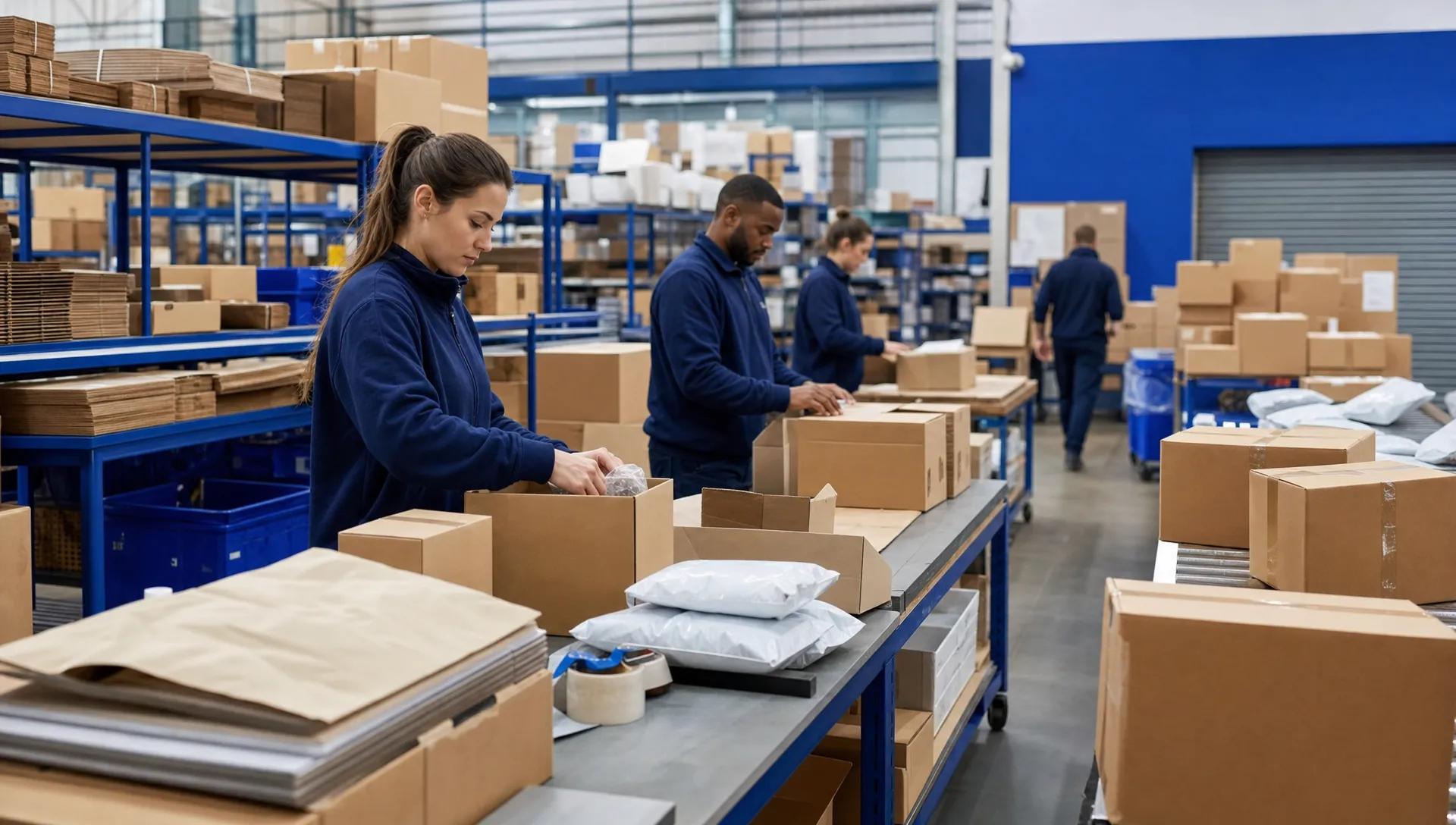
You can also reduce packing delays by making materials easy to reach. Boxes, mailers, void fill, tape, labels and inserts should be positioned where the team can use them without walking back and forth. This sounds basic, but during a spike, seconds per parcel become hours across the day.
If you are already close to capacity, outsourced Shopify fulfilment in the UK can help take pressure off your internal team by connecting your store to a fulfilment operation built for picking, packing and dispatching orders at scale.
Check carrier capacity before the backlog grows
Getting orders packed is only half the job. If parcels or pallets cannot leave your site quickly enough, the backlog simply moves from the packing bench to the dispatch area.
Contact your carriers as soon as you see the spike forming. Confirm collection times, maximum parcel volumes, trailer or van availability and any restrictions on size or weight. If you usually rely on one carrier, check whether you need a temporary backup.
For palletised goods, retail orders or wholesale replenishment, the issue may not be parcel capacity. It may be booking slots, vehicle availability or timed delivery requirements. Leaving this until the end of the day can put your dispatch schedule at risk.
Where same-day movement is needed, a logistics partner with access to flexible vehicle options can be useful. Gus Logistics operates its own fleet including vans, 7.5t, 18t and 26t rigids, artics and Moffetts, with access to a wider UK and Europe-wide vehicle network when needed.
Communicate early with customers and sales channels
Customers are usually more understanding when they are told early and clearly. They are far less forgiving when they receive no update, no tracking and no realistic dispatch date.
If you know orders will be delayed, update your website delivery messaging, marketplace handling times or customer emails as soon as possible. Avoid vague wording. A message that says dispatch is currently taking 48 hours is more useful than saying orders may be delayed.
For direct-to-consumer brands, customer service teams should have a simple answer ready. They need to know current dispatch times, which order groups are being prioritised and how refunds or cancellations should be handled if customers no longer want to wait.
For wholesale or retail customers, proactive contact is even more important. If delivery slots are at risk, tell the buyer or depot contact early so they can advise on the best next step.
Separate urgent inbound stock from routine deliveries
A spike often drains fast-moving stock faster than expected. If replenishment is arriving soon, make sure inbound deliveries are booked, identified and processed quickly.
Do not let urgent replenishment sit behind routine inbound goods. Label it clearly before it arrives, tell the receiving team what is inside and decide whether it needs to go straight to a pick face rather than into bulk storage.
If you use pallet storage, make sure your warehouse can distinguish between goods that are simply being stored and goods needed immediately for live orders. Real-time visibility helps here because your team can make decisions based on actual available stock rather than assumptions.
Gus Logistics provides pallet and bulk storage in Cheshire with racked and floor storage, real-time WMS tracking through a client portal and options for batch, serial number and best-before date tracking where required.
Bring in extra labour carefully
Adding people can help, but only if the work is simple enough to train quickly. Throwing untrained staff into a busy fulfilment operation can create more errors than progress.
If you bring in temporary labour, give them defined tasks that are easy to check. Good examples include building boxes, moving packed parcels to the dispatch area, applying inserts, replenishing packaging or picking simple single-SKU batches under supervision.
Keep experienced staff on tasks that require product knowledge, system use, quality control or exception handling. During a spike, your best people should not spend the whole day doing work that someone else could learn in 10 minutes.
A short shift briefing is essential. Cover the current order priority, packing standards, where to place completed work, who answers questions and what should be escalated.
Watch for hidden bottlenecks
A spike rarely causes just one problem. It exposes whichever part of your operation has the least spare capacity.
For some businesses, the bottleneck is picking. For others, it is packing benches, label printing, carrier collection, stock receiving, customer service or returns processing. If you fix the wrong bottleneck, the backlog will not move.
Walk the process from order download to dispatch handover and look for where work is piling up. The biggest queue usually points to the constraint.
| Bottleneck | Typical sign | Short-term fix |
|---|---|---|
| Picking | Packers waiting for orders | Batch fast-moving SKUs and replenish pick faces |
| Packing | Picked orders piling up | Add benches, pre-build packaging and split simple orders |
| Labelling | Packed orders waiting for shipping labels | Check printer, system and carrier service rules |
| Carrier collection | Dispatch area full at end of day | Request extra collection or use backup transport |
| Stock receiving | New stock not available to sell | Prioritise urgent inbound SKUs |
| Customer service | More where is my order queries | Update delivery messaging and tracking emails |
Review this at least once a day while the spike continues. The bottleneck may move as soon as you fix the first one.
Decide when to pause promotions or limit sales
It can feel wrong to slow down sales when demand is strong, but sometimes it is the right commercial decision. If your operation is close to failure, continuing to push orders through may damage reviews, marketplace ratings and repeat purchase rates.
Consider pausing paid ads, ending a discount early, hiding low-stock products or extending delivery promises. If only certain SKUs are causing the issue, avoid a full site-wide slowdown and manage the affected products instead.
This is especially important if your brand depends on repeat purchases. A short delay with honest communication is usually easier to recover from than a wave of incorrect orders and refund requests.
Plan for returns before they arrive
Order spikes often create return spikes a few days or weeks later. Fashion, consumer goods, subscription boxes, electronics and gift-led products can all see a noticeable increase in returns after a busy sales period.
If you only focus on outbound dispatch, returned stock can become the next backlog. Decide in advance how returns will be checked, graded, restocked, quarantined or disposed of. Make sure customer service knows the expected turnaround time.
Returned items that are suitable for resale should be processed quickly, especially if the product is still in demand. Slow returns processing ties up cash and can leave sellable stock outside your available inventory.
Build a simple recovery plan after the spike
Once the immediate pressure has passed, take time to review what happened. This is where you turn a stressful week into a stronger operation.
Look at the numbers first. How many orders came in? How many were dispatched on time? Which SKUs caused the most pressure? Where did errors happen? How many customer service contacts were linked to delivery or fulfilment?
Then review the process with the people who handled the work. Ask what slowed them down, what helped and what they would change before the next spike. Warehouse teams often spot practical issues that reports do not show.
Your recovery plan might include better stock buffers, clearer marketplace rules, improved pick locations, extra packing stations, carrier backups, earlier inbound booking or a move to outsourced fulfilment.
If the spike was not a one-off and order volumes are likely to stay higher, it may be time to review your wider fulfilment setup. This guide on scaling fulfilment during rapid growth explains how to grow capacity without losing accuracy or control.
When should you outsource fulfilment after a sudden spike?
Outsourcing does not have to mean handing over everything immediately. Many growing businesses start by outsourcing a specific channel, product range, peak period or overflow stock.
A 3PL can be especially useful when you are running out of space, struggling to recruit warehouse staff, missing dispatch cut-offs or spending too much management time on operational firefighting. It can also help if order volume is unpredictable and you do not want to commit to fixed warehouse space or permanent labour before you are ready.
Gus Logistics supports eCommerce brands, manufacturers and product businesses across the UK with order fulfilment, pick and pack, warehousing, transport, returns management, co-packing and FSDU services. The operation is based in Nantwich, Cheshire, close to the M6, M56 and M62 for UK-wide distribution.
For eCommerce brands, the key benefit is that your sales channels, stock and dispatch process can be connected to a fulfilment setup built for growth. Gus Logistics integrates with 60+ platforms including Shopify, Amazon, eBay, WooCommerce and Magento, with late cut-offs up to 10pm and next-day dispatch available.
Unlike some fulfilment providers, Gus Logistics has no minimum volume requirements. That can be helpful if your business is growing quickly but order patterns are still uneven.
Quick checklist for handling a sudden order volume spike
Use this checklist when orders rise faster than expected:
- Identify which channels and SKUs are driving the spike
- Prioritise orders by promise date, delivery service and risk
- Pause non-essential warehouse work until the backlog is stable
- Check stock accuracy for fast-moving and low-stock SKUs
- Batch simple orders and simplify packing where possible
- Confirm carrier collections, vehicle capacity and cut-off times
- Update customer delivery messaging before complaints increase
- Prioritise urgent inbound stock and replenishment
- Use temporary labour only on simple, controlled tasks
- Review bottlenecks daily until the spike is under control
- Plan returns handling before returned stock builds up
- Review whether internal fulfilment still fits your growth plans
Frequently Asked Questions
What is the first thing to do during a sudden order volume spike? Start by identifying where the extra orders are coming from, which SKUs are affected and which orders are closest to missing their promised dispatch date. This gives you a clear priority list instead of reacting randomly.
Should I keep taking orders if fulfilment is falling behind? It depends on how far behind you are and whether you can give customers realistic delivery times. If delays are growing, update delivery messaging, consider pausing promotions and protect high-priority orders before taking on more demand.
How can I reduce picking errors when order volume increases? Simplify the process. Batch fast-moving SKUs, separate single-SKU orders, keep similar variants apart and make sure experienced staff handle exceptions. Stock accuracy checks are especially important for low-stock and high-demand items.
When is a 3PL worth considering after an order spike? A 3PL is worth considering if spikes are becoming common, you are running out of space, dispatch is slipping or your team is spending too much time firefighting. It can also help if you want flexible capacity without taking on fixed warehouse commitments.
Can Gus Logistics support short-term increases in order volume? Gus Logistics supports growing product businesses with order fulfilment, warehousing, transport and related logistics services. Because there are no minimum volume requirements, it may be suitable for businesses dealing with uneven or fast-changing demand.
Need help getting order volume under control?
If a sudden order volume spike has exposed limits in your current fulfilment, storage or transport setup, Gus Logistics can help you build a more reliable way forward.
From Shopify fulfilment and pick and pack to pallet storage, returns and UK-wide transport, the team can support your operation without call centres or unnecessary complexity. To discuss your current order volumes and what support would make the biggest difference, call 01270 335014 or get in touch via the contact page.
Looking for a Logistics Partner You Can Trust?
From warehousing and order fulfilment to transport and FSDU design - Gus Logistics handles it all from our base in Nantwich, Cheshire. Over 10 years experience, no minimum volumes, no long contracts.
