
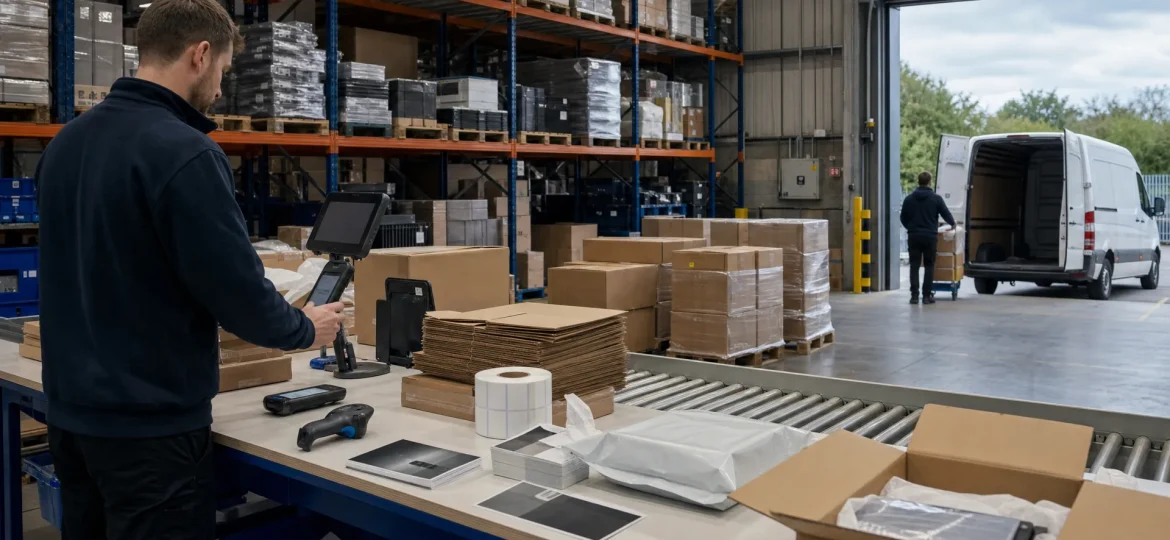
What Is White Label Fulfilment?
If customers buy from your brand, they expect the parcel, tracking updates, packaging and returns experience to feel like one joined-up service. They usually do not care whether the order was packed in your own stockroom or by a third-party logistics partner. What they do care about is accuracy, speed and consistency.
That is where white label fulfilment comes in.
White label fulfilment is a way to outsource the operational work of storing stock, picking orders, packing parcels and arranging delivery while keeping the customer-facing experience under your own brand. For growing eCommerce businesses, it can be the difference between spending every afternoon packing orders and having a scalable fulfilment process that still feels personal to the customer.
What does white label fulfilment mean?
White label fulfilment means a 3PL provider carries out fulfilment on behalf of your business without putting their own brand at the centre of the customer experience.
In practical terms, the fulfilment partner works behind the scenes. Your customer places an order through your website, marketplace or sales channel. The order flows to the fulfilment partner, who picks, packs and dispatches it according to your agreed process. The parcel may use your packaging, your inserts, your packing rules and your preferred delivery approach, depending on what has been set up.
The key point is simple: your customer buys from you, not from your warehouse provider.
White label fulfilment is not the same as white label manufacturing. It does not mean another company makes your product and lets you sell it under your brand. It specifically refers to the fulfilment service that happens after the sale, including storage, picking, packing, dispatch and often returns handling.
How white label fulfilment works
A white label fulfilment process usually starts with your sales channels and stock data. Your eCommerce store or marketplace needs to connect to your fulfilment partner, so orders can be received automatically rather than forwarded manually by email.
For many brands, the starting point is a reliable order fulfilment service that can connect to the platforms they already use and process orders quickly. Once the system is connected, stock is booked into the warehouse and assigned to your account. From there, every order follows a defined workflow.
A typical white label fulfilment process looks like this:
- Stock is received and checked: Products arrive at the warehouse, are counted, labelled if needed and stored in agreed locations.
- Orders are imported: Orders flow from your sales channel into the warehouse management system.
- Items are picked: Warehouse staff select the correct SKUs, quantities and variants.
- Orders are packed to your rules: This may include agreed packaging, packing slips, inserts, bundles or special handling instructions.
- Parcels are dispatched: Orders are labelled, handed to the carrier and sent using the agreed service level.
- Tracking is updated: Tracking information is passed back to your store or marketplace where the integration allows it.
- Returns are processed: Returned items are handled according to your rules, such as restock, quarantine, dispose or inspect.
The exact setup will depend on your provider, your systems, your products and the level of branding you need. Some brands simply want plain packaging and invisible warehouse support. Others want a more detailed brand experience with product inserts, specific packing layouts and defined customer communication rules.
White label fulfilment vs standard fulfilment
White label fulfilment and standard fulfilment both involve outsourcing storage, picking, packing and dispatch. The difference is the level of control over the brand experience.
| Area | Standard fulfilment | White label fulfilment |
|---|---|---|
| Customer-facing brand | Often neutral and operationally focused | Designed to feel like it comes from your brand |
| Packaging | Standard warehouse packaging may be used | Packaging and inserts can follow agreed brand rules |
| Packing process | Built around speed and accuracy | Built around speed, accuracy and presentation |
| Customer perception | Customer may simply receive a neutral parcel | Customer experience can feel more connected to your brand |
| Best fit | Businesses focused mainly on dispatch efficiency | Brands that care about presentation, loyalty and consistency |
In reality, many businesses sit somewhere between the two. You may not need fully branded boxes for every order, but you may want plain packaging, a specific return address, careful presentation or promotional inserts during key campaigns.
What parts of fulfilment can be white labelled?
The most common parts of the fulfilment process that can be white labelled are the touchpoints your customer sees. That usually includes the parcel, paperwork, inserts, delivery notifications and returns experience.
Depending on the provider and your setup, white label fulfilment may cover:
- Branded or plain outer packaging
- Custom packing slips or paperwork
- Product inserts, thank-you cards or promotional leaflets
- Specific packing instructions by SKU, bundle or order type
- Return address and returns handling rules
- Kitting, bundling or subscription-style packing
- Sender details and tracking information where supported by the systems involved
Before assuming any of these are included, ask your fulfilment partner exactly what can be supported and what needs to be supplied by you. For example, if you want branded tissue paper, inserts or custom boxes, you may need to provide those materials and agree where they will be stored.
Why growing eCommerce brands use white label fulfilment
The main reason brands choose white label fulfilment is to keep control of the customer experience without having to run the warehouse themselves.
When order volumes are low, packing in-house can feel manageable. You know where everything is, you can spot issues quickly and you can add a personal touch to each parcel. As volumes grow, that same process can become slow, stressful and inconsistent. Staff get pulled away from sales, marketing or product development. Stock ends up spread across rooms, garages or small storage units. Mistakes become harder to prevent.
White label fulfilment helps by giving you a more structured process while allowing your brand to remain front and centre.
For eCommerce businesses, the benefits often include:
- More time to focus on growth: Your team spends less time packing boxes and more time selling, buying stock and serving customers.
- A more consistent customer experience: Orders follow agreed packing rules rather than changing depending on who packed them that day.
- Better capacity during busy periods: A fulfilment partner can help you prepare for launches, seasonal peaks and promotional spikes.
- Access to warehouse systems: Stock visibility, order tracking and dispatch updates are much easier when a proper warehouse management system is in place.
- Less pressure on your premises: You do not need to keep expanding office, garage or small unit space just to hold more stock.
If your business is growing beyond in-house storage, combining fulfilment with professional warehouse storage can make the whole operation easier to manage.
When white label fulfilment may not be the right fit
White label fulfilment is useful, but it is not automatically the best choice for every business.
If every order requires complex personalisation, handwritten work or last-minute product decisions, outsourcing may need more planning. If your SKU data is inaccurate, your products are not barcoded or your stock records are unreliable, those problems should be fixed before going live with a fulfilment partner.
It may also be less urgent if you are sending only a small number of orders and your current process is still accurate, profitable and not taking too much time. That said, it is worth having the conversation early if you expect growth. Moving fulfilment during a peak trading period is usually harder than planning ahead.
The best time to consider white label fulfilment is when your current process is still working, but you can see the strain coming.

What should you agree before starting?
White label fulfilment works best when both sides are clear about the details before the first order is dispatched. Do not rely on assumptions. The more specific your rules are, the easier it is for the warehouse team to deliver the experience you want.
Key points to agree include packaging, carrier services, cut-off times, stock booking, order priority, returns handling, damaged goods, low stock alerts and what happens when an order has a problem.
You should also agree how stock will be tracked. If your products have batches, serial numbers or best-before dates, make sure the 3PL can support the level of traceability you need. This matters for food and drink, health products, cosmetics, technical products and any business that needs to know exactly which stock went to which customer.
It is also sensible to test the process before moving everything over. Send test orders, check how they look when they arrive and review how quickly tracking information updates. A small pilot can prevent bigger problems later.
What does white label fulfilment cost?
There is no single price for white label fulfilment because the cost depends on your products, order volumes, storage needs, packing requirements and delivery services.
Most fulfilment pricing is built from several parts:
| Cost area | What affects it |
|---|---|
| Storage | Number of pallets, shelves, bins or bulk locations needed |
| Pick and pack | Number of items per order, order complexity and packing time |
| Packaging | Standard materials, custom packaging or supplied brand materials |
| Delivery | Parcel size, weight, destination, carrier and speed of service |
| Returns | Inspection, restocking, repacking, disposal or quarantine requirements |
| Integrations | Sales channels, marketplaces and system setup needs |
| Special projects | Kitting, bundling, relabelling, co-packing or promotional inserts |
The cheapest option is not always the best value. A low pick and pack fee can become expensive if stock accuracy is poor, orders are delayed or customer complaints increase. Look at the whole service, not just one line on a quote.
Questions to ask a white label fulfilment provider
Before choosing a provider, ask practical questions that reveal how the service will work day to day.
Useful questions include:
- Which eCommerce platforms and marketplaces can you integrate with?
- How quickly can orders be imported and dispatched?
- What packing rules can be set for different products or order types?
- Can you store and use our own packaging or inserts?
- How will we see live stock levels and order status?
- What happens if stock is missing, damaged or incorrectly labelled?
- Can you handle returns according to our rules?
- Who will we speak to when there is a problem?
- Do you offer transport options for larger, urgent or business-to-business orders?
The last question matters because many growing brands eventually need more than parcel dispatch. You may start with eCommerce orders, then add wholesale orders, pallet deliveries, retail display shipments or urgent stock movements. Working with a provider that can support wider UK logistics services can reduce the need to keep changing suppliers as you grow.
Choosing a UK white label fulfilment partner
A good white label fulfilment partner should feel like an extension of your business. They do not need to be visible to your customers, but they do need to understand the promises you have made to those customers.
For UK businesses, location can make a real difference. A warehouse with strong access to motorway networks can support faster national distribution and more flexible transport options. If you sell across the UK, consider how close the provider is to major routes, carriers and your suppliers.
You should also look at communication style. When a customer is waiting for an urgent order or a retailer needs a delivery window confirmed, you need quick answers. A provider with clear communication and direct access to the people handling your freight can be much easier to work with than a faceless ticketing system.
If you need same-day or next-day movements alongside fulfilment, it is also worth checking whether the provider can support transport and delivery services as part of the wider operation.
How Gus Logistics supports growing brands
Gus Logistics is a family-run 3PL provider based in Nantwich, Cheshire, supporting eCommerce brands, manufacturers and product businesses across the UK.
For businesses exploring white label fulfilment, Gus Logistics can support the operational foundations behind the customer experience, including order fulfilment, pick and pack, pallet and bulk warehousing, transport, co-packing and contract packing.
The team integrates with 60+ platforms including Shopify, Amazon, eBay, WooCommerce and Magento. Late cut-offs up to 10pm and next-day dispatch are available, helping businesses keep orders moving even when volumes increase. Gus Logistics also offers real-time WMS tracking through a client portal, with batch, serial number and best-before date tracking available where required.
Because Gus Logistics is family-run, customers speak directly to the people handling their freight rather than being passed through a call centre. There are no minimum volume requirements, and same-day quotes are standard. Its Cheshire location near the M6, M56 and M62 also makes it well placed for North West and UK-wide distribution.
Frequently Asked Questions
What is white label fulfilment in simple terms? White label fulfilment is when a 3PL stores, picks, packs and dispatches orders for your business while the customer experience remains under your brand.
Is white label fulfilment only for large eCommerce brands? No. It can suit small and medium-sized businesses as well, especially when in-house packing is taking too much time or stock control is becoming difficult.
Can I use my own packaging with white label fulfilment? Often, yes, but it depends on the provider and the setup. You should confirm whether your packaging can be stored, picked and used correctly before you go live.
Is white label fulfilment the same as dropshipping? No. With white label fulfilment, you usually own the stock and your 3PL dispatches it from their warehouse. With dropshipping, a supplier often holds the stock and sends it directly to your customer.
What should I prepare before outsourcing fulfilment? Prepare accurate SKU data, product dimensions, stock counts, sales channel access, packaging rules, returns instructions and expected order volumes.
How do I know if I am ready for white label fulfilment? You are likely ready if order packing is slowing your team down, stock is becoming hard to manage or you want a more professional dispatch process without running your own warehouse.
Ready to discuss white label fulfilment?
If you want to outsource fulfilment without losing control of your customer experience, Gus Logistics can help you build a practical setup around your products, order volumes and growth plans.
Call 01270 335014 to speak to the team, or get in touch through the Gus Logistics contact page.
Looking for a Logistics Partner You Can Trust?
From warehousing and order fulfilment to transport and FSDU design - Gus Logistics handles it all from our base in Nantwich, Cheshire. Over 10 years experience, no minimum volumes, no long contracts.
