
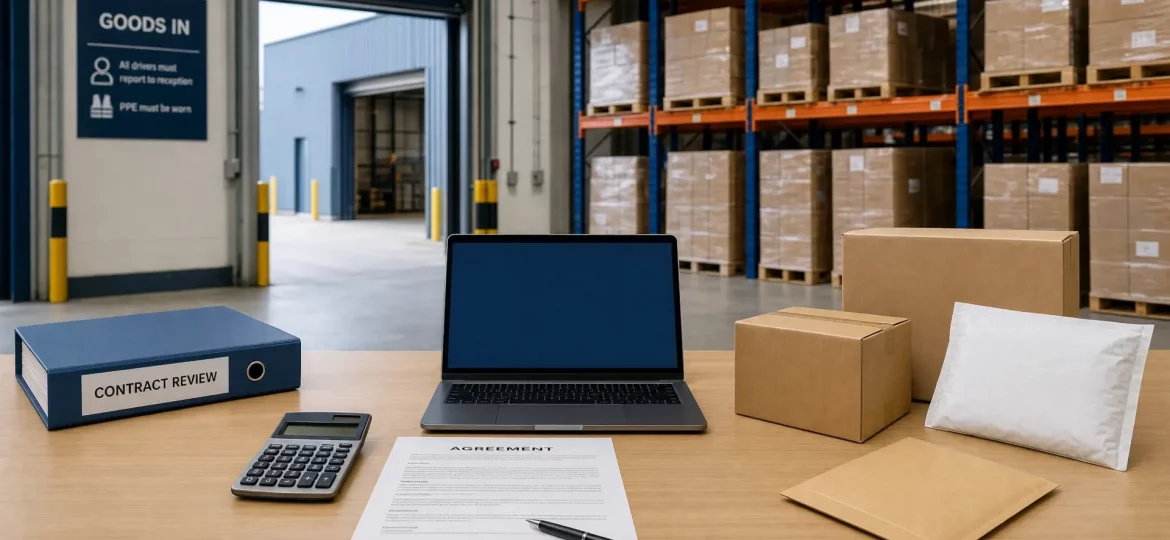
What to Look for in a 3PL Contract Before You Sign
A 3PL contract is not just paperwork. It sets the rules for how your stock is received, stored, picked, packed, dispatched, reported on and, if needed, moved away again.
For a growing product business, that matters. A vague contract can create unexpected costs, slow decisions and make it harder to hold your logistics partner to the service you were promised. A clear contract, on the other hand, gives both sides the same expectations from day one.
The aim is not to review it like a solicitor. It is to read it like a business owner or operations manager who needs to know: what am I paying for, what happens if volumes change, how quickly will orders go out, and how easy is it to leave if the relationship no longer works?
Below are the practical commercial points to check before you sign a 3PL agreement.
Start with the scope of service
Before looking at price, check whether the contract actually covers what you need the provider to do. Many issues start when the proposal sounds broad, but the signed agreement is narrow.
For example, if you are outsourcing eCommerce fulfilment, the contract should be clear on whether the 3PL is responsible for goods in, storage, pick and pack, packaging, dispatch, returns processing, carrier booking and inventory updates. If you also need pallet storage, ad-hoc transport or co-packing, those services should be included clearly rather than assumed.
A good contract should match the way your operation works in practice. If you sell through Shopify, Amazon, eBay or wholesale channels, make sure the agreement reflects those workflows. If your goods have batch numbers, serial numbers or best-before dates, the contract should say how those will be handled.
| Contract area | What to clarify | Why it matters commercially |
|---|---|---|
| Services included | Storage, pick and pack, returns, transport, co-packing or other tasks | Prevents arguments over what is included in the monthly cost |
| Stock handling | Pallets, cartons, loose units, fragile items or dated stock | Helps avoid delays and handling errors |
| Sales channels | eCommerce platforms, marketplaces, wholesale or retail routes | Ensures the 3PL can support your actual order flow |
| Reporting | Inventory visibility, proof of delivery and order status updates | Gives you control without needing to be on site |
| Exceptions | Damaged stock, incorrect deliveries, urgent orders and stock discrepancies | Makes problem solving faster when something goes wrong |
If your business needs a mix of warehousing, fulfilment and delivery support, it is worth comparing the contract against the provider's wider UK 3PL logistics services so you can see whether the offer fits your full operation, not just one part of it.
Check minimum volumes and minimum charges
Minimum volumes are one of the most important commercial points in any 3PL contract. They are not automatically bad. A provider needs to plan labour, space and systems properly. But the minimums must be realistic for your business.
Look for any reference to minimum monthly order volumes, minimum storage charges, minimum pallet spaces, minimum pick and pack fees or minimum monthly spend. These can all affect your costs if sales dip, you launch later than planned or your stock profile changes.
The key question is simple: what happens if you do not hit the forecast?
A contract might state that you pay for a minimum number of orders even if fewer are dispatched. It might reserve a fixed number of pallet spaces even when your stockholding falls. It might apply a monthly management fee regardless of activity. None of this is necessarily unfair, but it should be understood before you commit.
Seasonal businesses need to be especially careful. If you sell heavily in Q4, run retail promotions or launch product drops, your average monthly volume may hide big peaks and troughs. Ask whether minimums are based on a rolling average, a fixed monthly commitment or a forecast agreed upfront.
If you are a smaller business, also ask whether the provider has minimum volume requirements at all. Gus Logistics does not have minimum volume requirements, which can make outsourcing more accessible for SMEs that want professional logistics support without committing to unrealistic order levels from the start.
Understand the full pricing schedule
The headline rate is rarely the full cost of 3PL management. A low pick fee may look attractive, but the total cost depends on how storage, packaging, returns, integrations, goods in and transport are charged.
Before signing, ask for a complete rate schedule in plain English. It should show what is included, what is optional and what triggers additional charges. The most common areas to check are:
- Onboarding and account setup fees
- System integration fees
- Goods in and stock checking charges
- Pallet, carton or shelf storage costs
- Pick and pack charges per order or per item
- Packaging materials and custom packaging work
- Returns handling and inspection fees
- Carrier, fuel, surcharge and failed delivery charges
- Stock counting, relabelling, kitting or rework fees
- Charges for urgent, manual or non-standard requests
Ask how often prices can be reviewed and how much notice you will receive before changes take effect. Also ask whether rates change once you pass certain volume bands. If your business grows, you do not want to be stuck on a pricing model designed for much smaller order volumes.
For eCommerce businesses, check whether the price reflects the real complexity of your orders. One business may dispatch simple single-item parcels. Another may have multi-line orders, inserts, branded packaging, fragile items and regular returns. Those two operations may have very different handling requirements, even if their order volumes look similar.
Be clear on integration costs and responsibilities
Systems are where a 3PL contract can look simple but become complicated. If your online store, marketplace account or ERP system does not connect properly with the warehouse, orders can be delayed and stock accuracy can suffer.
Check which integrations are included in the contract. Ask whether the 3PL already supports your platforms, whether the integration is direct or through middleware, and what is needed from your team before go-live.
If you are outsourcing an order fulfilment service, the contract should explain how orders flow into the warehouse, how tracking information comes back to you and how stock levels are updated. It should also say who is responsible for testing before launch.
Integration questions to ask include:
- Is the platform connection included in the onboarding cost?
- Are there extra fees for additional sales channels?
- Who maps SKUs, shipping rules and product data?
- How long does setup usually take once access is provided?
- What happens if the platform changes or an integration breaks?
- Can you export order, inventory and customer delivery data if you leave?
Gus Logistics integrates with more than 60 platforms, including Shopify, Amazon, eBay, WooCommerce and Magento, and offers cloud-based logistics systems with a 24-hour integration turnaround. If fast setup matters to your business, make sure any provider you are considering can explain exactly what that setup involves.
Look closely at SLA commitments
A service level agreement, often shortened to SLA, should turn promises into measurable commitments. It should not be full of vague phrases such as "as soon as possible" or "best endeavours" without any practical detail.
For most businesses, the most useful SLA points are operational. You want to know when orders will be dispatched, how quickly stock will be booked in, how returns will be processed and how issues will be escalated.
Good SLA commitments often cover:
- Order cut-off times
- Same-day or next-day dispatch rules
- Picking and packing accuracy expectations
- Goods-in booking times after stock arrives
- Returns processing times
- Inventory update frequency
- Proof of delivery availability
- Response times for operational queries
The contract should also explain what does not count towards the SLA. For example, a provider may not be responsible for delays caused by late inbound deliveries, missing product data, stock shortages, platform outages or carrier disruption. That is reasonable, but the exceptions should be clear.
Ask how SLAs are measured and reported. A target is only useful if you can see whether it has been met. If reports are available through a client portal or warehouse management system, ask what you will be able to view and how often it updates.

Review notice periods and exit terms
It may feel negative to think about leaving before you have even started, but exit terms are a practical business issue. If your product range changes, your order volumes grow sharply or the service no longer fits, you need to know how easily you can move.
Check the notice period carefully. Whether it is 30 days, 60 days, 90 days or another term, the important point is whether it gives both sides enough time to plan without trapping you unnecessarily.
Also check when notice can be given. Some contracts allow notice at any time. Others only allow it after an initial term or at the end of a billing period. If there is a fixed-term commitment, make sure you understand when it starts and when it ends.
The practical exit points to clarify are:
- How much notice must you give?
- Are there early exit fees?
- How will final storage, fulfilment and transport charges be calculated?
- How quickly can stock be released or transferred?
- Are there charges for preparing stock for collection?
- Can you export inventory, order and reporting data?
- What happens to packaging, inserts or branded materials held by the 3PL?
A clear exit process protects both sides. It helps the provider plan labour and space, and it helps you avoid disruption to customers if you ever need to move stock elsewhere.
Confirm how storage and inventory responsibility work
If your 3PL is storing your stock, the contract should make clear how that stock is managed. This is especially important if you hold a mix of pallets, cartons, SKUs, dated goods or high-value items.
Look for details on where stock will be stored, how it will be identified and how inventory records will be maintained. If you need racked storage, floor storage, bulk storage or pick-face locations, make sure that is reflected in the operating plan.
For businesses using warehouse storage, important contract points include stock visibility, goods-in checks, stock rotation, batch tracking, serial number tracking and best-before date tracking where relevant. The more complex your stock, the more important these controls become.
You should also ask how stock discrepancies are handled. No warehouse operation should be casual about missing, damaged or miscounted stock. The contract should explain the reporting process, investigation steps and how adjustments are agreed.
If the provider gives access to a warehouse management system or client portal, ask what information you will see. Real-time or near real-time stock visibility can reduce the number of manual emails and help your team make faster purchasing, sales and customer service decisions.
Check transport and delivery terms
Many 3PL contracts include transport, but the details vary. Some providers manage courier bookings only. Others operate their own vehicles, use carrier networks or provide same-day and next-day transport for larger consignments.
The contract should make clear who is responsible for booking transport, selecting carriers, managing delivery issues and providing proof of delivery. It should also explain how costs are passed on, including fuel, surcharges, failed deliveries, re-deliveries or special services.
If your business needs urgent movements, retail deliveries, pallet distribution or ad-hoc collections, make sure the agreement allows for that. Standard parcel fulfilment terms may not cover the practical needs of wholesale, retail or bulky stock movements.
Gus Logistics provides transport and delivery support using its own fleet of vans, 7.5t, 18t and 26t rigids, artics and Moffetts, as well as access to a wider UK and Europe-wide vehicle network. If transport flexibility is important, it is worth asking any 3PL how they handle jobs outside standard parcel dispatch.
Make sure communication routes are named
A contract can include strong service promises, but if you cannot get hold of the right person when something changes, the relationship will still feel difficult.
Ask who your day-to-day contact will be. Is it an account manager, warehouse contact, transport planner or shared support inbox? How are urgent issues handled? Who makes decisions when a same-day dispatch, stock discrepancy or customer complaint needs attention?
For many SMEs, communication is one of the biggest reasons to outsource to a smaller or family-run 3PL rather than a large call-centre-style operation. You need to know that someone understands your stock, your customers and your deadlines.
Good 3PL management depends on regular communication, not just a signed agreement. Ask whether you will have review meetings, performance reports or seasonal planning discussions. If you expect peak periods, product launches or retail campaigns, those should be discussed before they become urgent.
Consider flexibility for growth and change
Your contract should not only fit where your business is today. It should also give enough flexibility for where you are going next.
A product business can change quickly. You might add a new sales channel, launch a subscription offer, start selling into retail, need container de-stuffing, increase pallet storage or introduce FSDUs and point of sale displays. If every change requires a slow contract amendment or unclear extra charges, growth becomes harder than it needs to be.
Ask how the provider handles new services. Can they add storage space? Can they support more SKUs? Can they manage bulk orders as well as single parcels? Can they support next-day dispatch during busier periods? Can they help with transport if you need to move stock between sites or to retail locations?
Flexibility does not mean everything is free or instant. It means the process for change is clear. You should know who to speak to, how costs are agreed and how quickly the provider can respond.
Red flags and good signs before you sign
A contract does not need to be complicated to be effective. In fact, the best 3PL agreements are often clear, practical and easy to operate from.
| Red flag | Better sign |
|---|---|
| Pricing is vague or spread across several unclear documents | You receive a clear rate card with service explanations |
| Minimum volumes are higher than your realistic forecast | Minimums, if any, match your actual trading pattern |
| SLA wording is broad and hard to measure | Dispatch, goods-in and reporting standards are specific |
| Integration responsibilities are not defined | Setup steps, data requirements and timelines are written down |
| Exit process is unclear | Notice, stock release and final charges are explained |
| You do not know who to contact day to day | Named contacts and escalation routes are provided |
| The provider avoids discussing exceptions | Common issues and how they are handled are agreed upfront |
If something is unclear, ask before signing. A good logistics partner should be willing to explain the commercial terms in plain English. If they cannot explain a charge, process or commitment clearly at proposal stage, it may not become clearer once your stock is already in their warehouse.
A practical pre-signing checklist
Before you commit, take one final pass through the contract using operational questions rather than legal language.
- Does the contract match the services you actually need?
- Are all fees, minimum charges and review points clear?
- Do the volume assumptions reflect realistic trading patterns?
- Are integration costs, responsibilities and timelines defined?
- Are SLAs specific enough to measure performance?
- Do you understand the notice period and exit process?
- Is stock visibility and inventory reporting clear?
- Are transport responsibilities and delivery costs explained?
- Do you know who your day-to-day contacts will be?
- Is the provider flexible enough to support growth or seasonal peaks?
If you can answer these questions confidently, you are much more likely to start the 3PL relationship on the right footing.
Frequently Asked Questions
What is the most important thing to check in a 3PL contract? The most important thing is clarity. You should understand exactly what services are included, how fees are calculated, what minimum volumes apply, what service levels are promised and how you can leave if the arrangement no longer works.
Are minimum volumes in a 3PL contract a bad sign? Not always. Minimum volumes can help a provider plan labour and space, but they should be realistic for your business. If you are early-stage, seasonal or growing unpredictably, ask whether the provider can offer more flexible terms.
What integration costs should I ask about? Ask whether setup, platform connection, testing, SKU mapping and future sales channels are included. You should also ask what happens if an integration fails or if you need to export your data later.
How detailed should SLA commitments be? SLA commitments should be specific enough to measure. Useful examples include order cut-off times, dispatch times, goods-in processing times, returns handling times and response times for operational queries.
Should I choose the cheapest 3PL contract? Not necessarily. The cheapest headline rate can become expensive if storage, returns, packaging, transport and manual tasks are charged separately. Focus on total cost, service fit and clarity.
Speak to Gus Logistics before you sign your next 3PL contract
If you are comparing 3PL contracts and want a practical conversation before committing, Gus Logistics can help you understand what your operation needs and what to look out for commercially.
Gus Logistics is a family-run 3PL provider based in Nantwich, Cheshire, supporting eCommerce brands, manufacturers and product businesses across the UK. With no call centres, no minimum volume requirements and same-day quotes as standard, you can speak directly to people who understand warehousing, fulfilment and transport in practice.
To discuss your 3PL requirements, call 01270 335014 or get in touch via the Gus Logistics contact page.
Looking for a Logistics Partner You Can Trust?
From warehousing and order fulfilment to transport and FSDU design - Gus Logistics handles it all from our base in Nantwich, Cheshire. Over 10 years experience, no minimum volumes, no long contracts.

[…] can release inventory once the account is closed. If you are unsure what to look for, this guide on what to check in a 3PL contract before you sign is useful for understanding the clauses that can cause issues […]